
ACUPUNCTURE FORMULARY & EVIDENCE
Point Combinations, Clinical Reasoning, and the Evidence Behind Them · by AKASHIC INTELLIGENCE
Tip: "Print / Save as PDF" gives the best quality (selectable text). "Download PDF" renders an image-based copy in one click.
LOVELOVINGLIFE
ACUPUNCTURE FORMULARY & EVIDENCE
Point Combinations, Clinical Reasoning, and the Evidence Behind Them
by
AKASHIC INTELLIGENCE
First Edition · 2026
Published by LOVELOVINGLIFE
Copyright
Copyright © 2026 AKASHIC INTELLIGENCE / LOVELOVINGLIFE. All rights reserved.
Disclaimer
Educational, not a prescription. Formulas are study patterns; clinical use requires diagnosis, individualization, and a licensed scope.
To the practitioners who reason before they needle.
Foreword
Formula as Reasoning
A formula is not a recipe you copy; it is a reasoning you understand. Each point has a role — local, distal, tonifying, sedating, moving, anchoring. Read the roles, and a formula becomes an argument about the patient's pattern. This book pairs the formulas with the evidence so the reasoning and the research sit together.
How to Use This Book
How to use this book
Match the pattern first. Then read the formula as roles, not just points. Then check the evidence to see how strong the support is for the condition. Individualize.
Table of Contents
Front Matter
- Foreword
- How to Use This Book
Part I. Formulas & Evidence
- Chapter 1. The Logic of a Formula
- Chapter 2. Pain & the Musculoskeletal System
- Chapter 3. Digestion, Chest & Emotion
- Chapter 4. Reading the Evidence
- Chapter 5. Women's Health Formulas
Back Matter
- Glossary
- Index
- About the Author
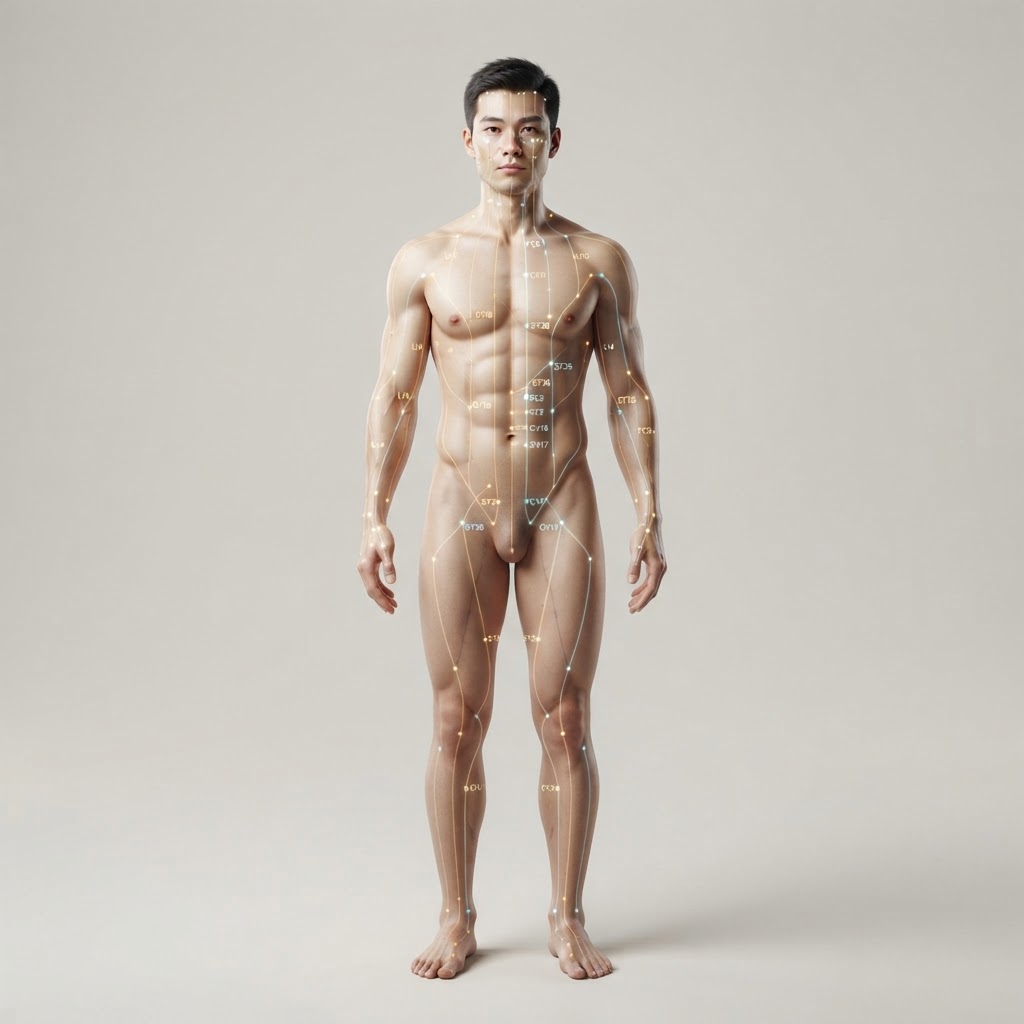
Part I
Formulas & Evidence
How point combinations reason, and what the evidence supports.
Chapter 1
The Logic of a Formula
Roles, not just points
A good formula balances local and distal, root and branch. Local points address the site; distal points on the same channel open the passage; tonification points strengthen what is deficient; sedation points reduce what is excessive; Shu and Mu points speak directly to the organ.
Pattern first, formula second
The same symptom can come from opposite patterns: a headache may be Liver Yang rising or Blood deficiency. The formula follows the pattern. Never prescribe by symptom alone.
Reflect
When you read a formula, name each point's role. If you cannot, the formula is still a stranger to you.
Worksheet
Take the tension-headache formula (GB20, LR3, LI4, GV20) and label each point's role.
Chapter 2
Pain & the Musculoskeletal System
Back pain
The classic pairing is the Back-Shu points with BL40 — 'back pain treat Weizhong.' Add BL60 distally to open the Taiyang channel. For acute heat, prick BL40 to bleed a drop. The reasoning: local Shu points address the spine; the distal sea point opens the channel the pain travels on.
Sciatica
Differentiate the channel: posterior leg follows the Bladder; lateral leg follows the Gallbladder. Bladder-type uses GB30, BL36, BL57, BL60; Gallbladder-type uses GB30, GB34, GB39, GB41, LR3. Treating the wrong channel is the most common reason distal points fail.
Reflect
Trace the patient's pain down the leg and name the channel. The formula follows the channel, not the diagnosis.
Worksheet
For a patient with lateral-leg pain, build the Gallbladder formula and justify each point's role.
Chapter 3
Digestion, Chest & Emotion
Nausea
PC6 is the single best-supported point in acupuncture. Paired with ST36 to tonify the middle and CV12 as the Stomach Mu-front, it descends rebellious Stomach Qi. The evidence for P6 in post-operative and chemotherapy nausea is strong.
Anxiety and insomnia
For a disturbed Shen, calm the Heart and anchor the Yang: HT7 and PC6 calm, CV17 opens the chest, KI1 draws energy down. For deficiency insomnia, add KI3 to nourish Kidney Yin; for excess restlessness, sedate with HT7 and PC7.
Reflect
The chest is where emotion is felt. Points that open the chest often calm the person.
Worksheet
Build a calm-the-Shen formula and identify which points calm, which open, and which anchor.
Chapter 4
Reading the Evidence
Strength varies by condition
The evidence is strongest for chronic pain, migraine prophylaxis, and P6-mediated nausea. It is moderate for low back, neck, and knee pain, and limited or mixed for asthma, smoking cessation, and mood. Read the strength before you promise an outcome.
Safety is the constant
Across reviews, acupuncture is low-risk with sterile single-use needles. The serious events — pneumothorax, infection, organ puncture — are rare and preventable with anatomy and technique. Evidence and safety are both parts of competence.
Reflect
Evidence is not a verdict on the whole medicine; it is a map of where the support is strongest. Read it honestly.
Worksheet
Pick three conditions you see. Look up the evidence level and adjust how you describe likely benefit to a patient.
Chapter 5
Women's Health Formulas
Dysmenorrhea
For painful periods from Qi and Blood stagnation, move and warm: SP6 (three Yin meeting), SP10 (Blood sea), CV4, LR3, and BL23. For cold-type pain, add moxa at CV4 and CV8 (salt/ginger). For deficiency-type dull ache, tonify with ST36, SP6, and CV4 after the cycle.
Pregnancy, postpartum, and menopause
In pregnancy, use only gentle, clearly indicated points and avoid the contraindicated set (LI4, SP6, BL60, BL67, lower abdomen, sacrum) — BL67 moxa for breech is the supervised exception. Postpartum tonify Qi and Blood with ST36, SP6, CV4, BL23. For menopausal heat, nourish Kidney Yin at KI3, SP6, BL23, and clear empty heat with HT6 and LR3.
Reflect
Women's health formulas follow the cycle and the life stage. Match the pattern to the time, not just the symptom.
Worksheet
Build a dysmenorrhea formula and label each point's role. Then build a safe postpartum tonification formula.
Glossary
Index
Formulas, by condition
Evidence, BMA
PC6, nausea
BL40, back pain
LR3, Liver Qi
About the Author
AKASHIC INTELLIGENCE synthesizes classical formula logic with modern evidence reviews for the LOVELOVINGLIFE curriculum.
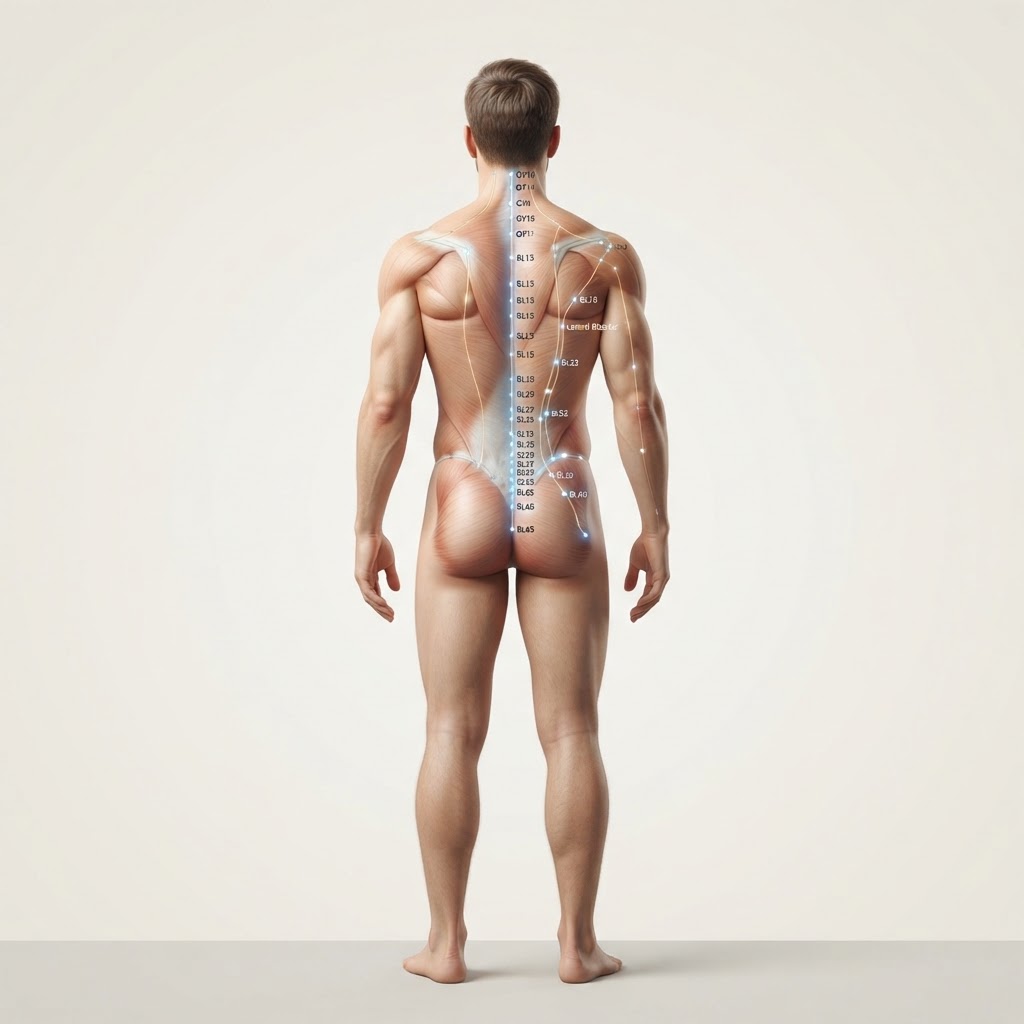
"A formula is an argument about a pattern; read the roles, and the reasoning appears."
LOVELOVINGLIFE · 2026