
ACUPUNCTURE POINT ATLAS
The 361 Standard Points — Location, Depth, and Region · by AKASHIC INTELLIGENCE
Tip: "Print / Save as PDF" gives the best quality (selectable text). "Download PDF" renders an image-based copy in one click.
LOVELOVINGLIFE
ACUPUNCTURE POINT ATLAS
The 361 Standard Points — Location, Depth, and Region
by
AKASHIC INTELLIGENCE
First Edition · 2026
Published by LOVELOVINGLIFE
Copyright
Copyright © 2026 AKASHIC INTELLIGENCE / LOVELOVINGLIFE. All rights reserved.
Disclaimer
Educational reference, not medical advice. Point location and needling should be performed by a licensed acupuncturist. This atlas follows the WHO Standard Acupuncture Point Locations (2008) as a study aid.
To the cartographers of the body who mapped the unseen channels.
Foreword
Why an Atlas
An atlas is a map, not a destination. The 361 standard points are landmarks along channels you cannot see; you find them by proportion, by palpation, and by the relationship of one to another. This volume gives the location, the depth, and the caution — so the practitioner's hand knows where to go before it goes.
How to Use This Book
How to use this atlas
Read the location string as a path of landmarks: start at a known bony point, count cun from there, and palpate for the depression or tender spot. The depth and caution tell you how and how not to arrive.
Table of Contents
Front Matter
- Foreword
- How to Use This Book
Part I. The Atlas
- Chapter 1. The Method of Location
- Chapter 2. Head, Face & Neck
- Chapter 3. Chest, Abdomen & Back
- Chapter 4. Limbs — Distal Power
- Chapter 5. The Female Body — Landmarks & Variation
Back Matter
- Glossary
- Index
- About the Author
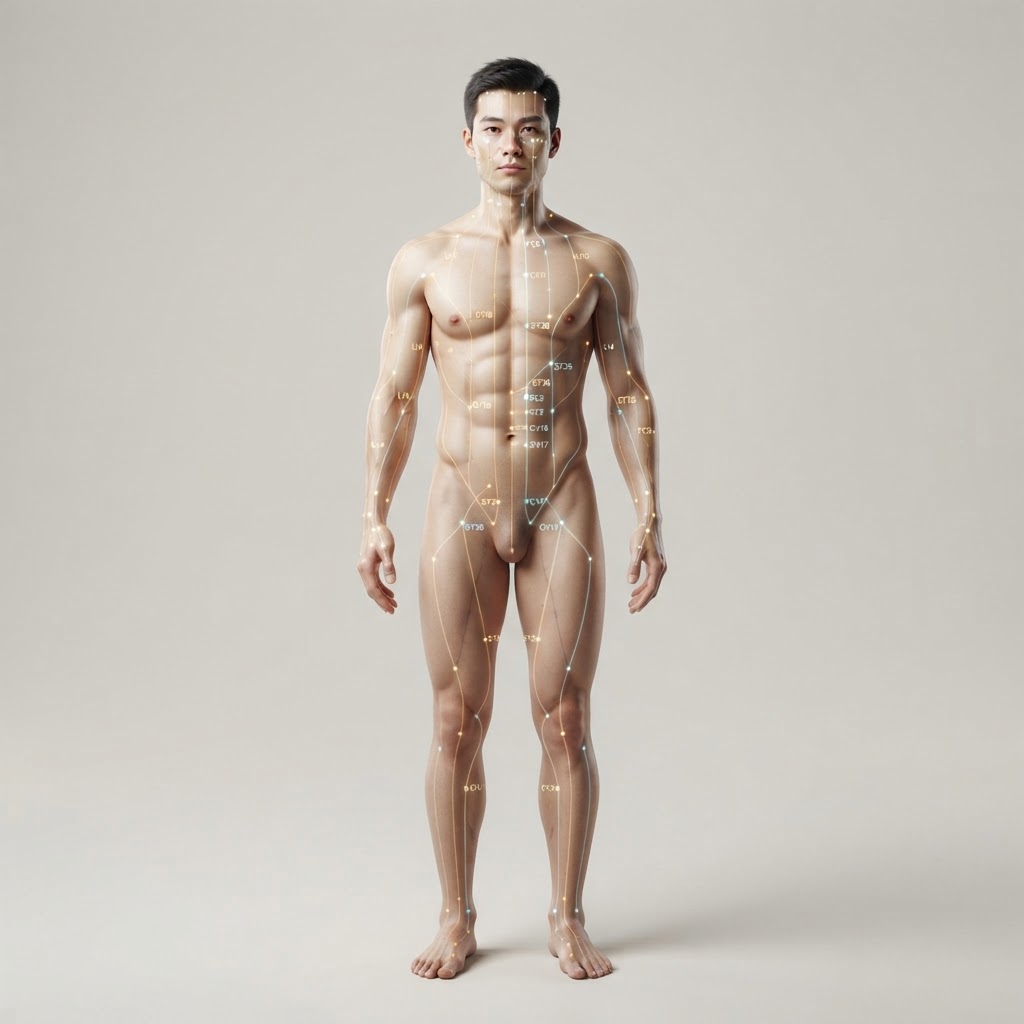
Part I
The Atlas
Region by region, the standard points and how to find them.
Chapter 1
The Method of Location
Proportional Measurement
Every point is found by cun — a body-inch proportional to the patient. One cun is the width of the thumb at the interphalangeal joint; three cun is the breadth of the four fingers held together. The same number of cun locates the point on a large or small person; the body is its own ruler.
Landmarks Before Numbers
Find the bone first: the radial styloid, the medial malleolus, the patella, the occipital protuberance. The cun count begins there. A point located only by a number, without a landmark, is a point you will miss.
Reflect
Which landmarks can you already find with your eyes closed? Practice locating them before you count a single cun.
Worksheet
On your own hand, find the radial styloid and count 1.5 cun up the forearm to LU7. Then on the leg, find the medial malleolus and count 3 cun up to SP6.
Chapter 2
Head, Face & Neck
The Face
Points on the face are shallow and near vital structures. ST1 sits below the pupil on the infraorbital ridge — push the eyeball up and needle along the bone. LI20 lies in the nasolabial groove; GB20 sits in the suboccipital hollow between the trapezius and sternocleidomastoid. Depth here is measured in millimetres of caution.
The Neck
ST9 and LI18 sit near the carotid sheath. Palpate the pulse before you needle; the artery is the boundary, not the target. Depth is shallow; the structure you protect is greater than the point you seek.
Reflect
The face carries emotion as well as points. Notice how releasing facial tension changes the breath.
Worksheet
Locate GB20 on a partner: find the hollow below the occipital bone, lateral to the trapezius. Press gently and observe.
Chapter 3
Chest, Abdomen & Back
Chest and Upper Back
The ribs are the limit. Above the diaphragm, needle oblique and shallow — never perpendicular and deep, for the pleura lies close. BL11–BL17, the upper Back-Shu points, demand an oblique angle toward the spine. The pneumothorax is the single most cited serious risk of acupuncture; this is where it lives.
Abdomen and Lower Back
Below the diaphragm, depth increases: the Mu-front points and the Sea points of the abdomen take 0.5–1.5 cun. In the lower back, BL23 (Kidney Shu) sits at L2; excessive depth risks the kidney. Empty the bladder before needling the lower abdomen.
Reflect
The trunk holds the organs; needling it is a conversation with what you cannot see. Practice the angle before the depth.
Worksheet
On a skeleton image, trace the pleural reflection line. Mark every chest point and confirm your needle angle is oblique.
Chapter 4
Limbs — Distal Power
Hands and Feet
The distal points are the workhorses: LI4 for the head, LR3 for the Liver, SP6 for the three Yin, BL60 and KI1 for the back and grounding. They are shallow, often tender, and disproportionately powerful. Well points at the nail corners are pricked to bleed for acute heat.
Elbow and Knee
The Sea points at the elbow and knee — LI11, ST36, BL40, GB34 — are where the channel deepens and the organ speaks. ST36 tonifies the whole system; GB34 governs the tendons; BL40 is the back's distal key.
Reflect
The furthest point can be the most effective. Notice how a distal point can shift a proximal pain.
Worksheet
For a frontal headache, press LI4 on the hand. For low-back ache, press BL60 at the ankle. Note the distal effect.
Chapter 5
The Female Body — Landmarks & Variation
Same channels, different landmarks
The meridians run the same courses on a female body; what changes is the soft-tissue landscape you palpate through. The Ren meridian crosses the lower abdomen over the uterus; the Stomach meridian crosses the chest over breast tissue, shifting the palpation of ST12–ST18. Find the bony landmarks first — the pubic symphysis, the costal margin, the sternum — and the cun count lands the same.
Pregnancy changes the map
In pregnancy the abdomen expands, the lumbar curve deepens, and point depth over the lower abdomen and sacrum changes. Several points are traditionally avoided — LI4, SP6, BL60, BL67, and the lower-abdomen and sacral points — except for supervised, specific use such as BL67 moxa for breech. Always note pregnancy before locating on the trunk.
Reflect
The body is the same map drawn on different terrain. Name the landmark, not just the point.
Worksheet
On a female anterior plate, locate CV4 from the pubic symphysis and ST25 lateral to the umbilicus. Note how breast tissue changes the palpation of the chest Stomach points.
Glossary
Index
Acupoints, 361
Cun measurement, 1
WHO, 1
Depth, per point
Caution, chest & neck
About the Author
AKASHIC INTELLIGENCE publishes the LOVELOVINGLIFE cross-tradition curriculum. This atlas synthesizes the WHO standard locations as a unified study reference.
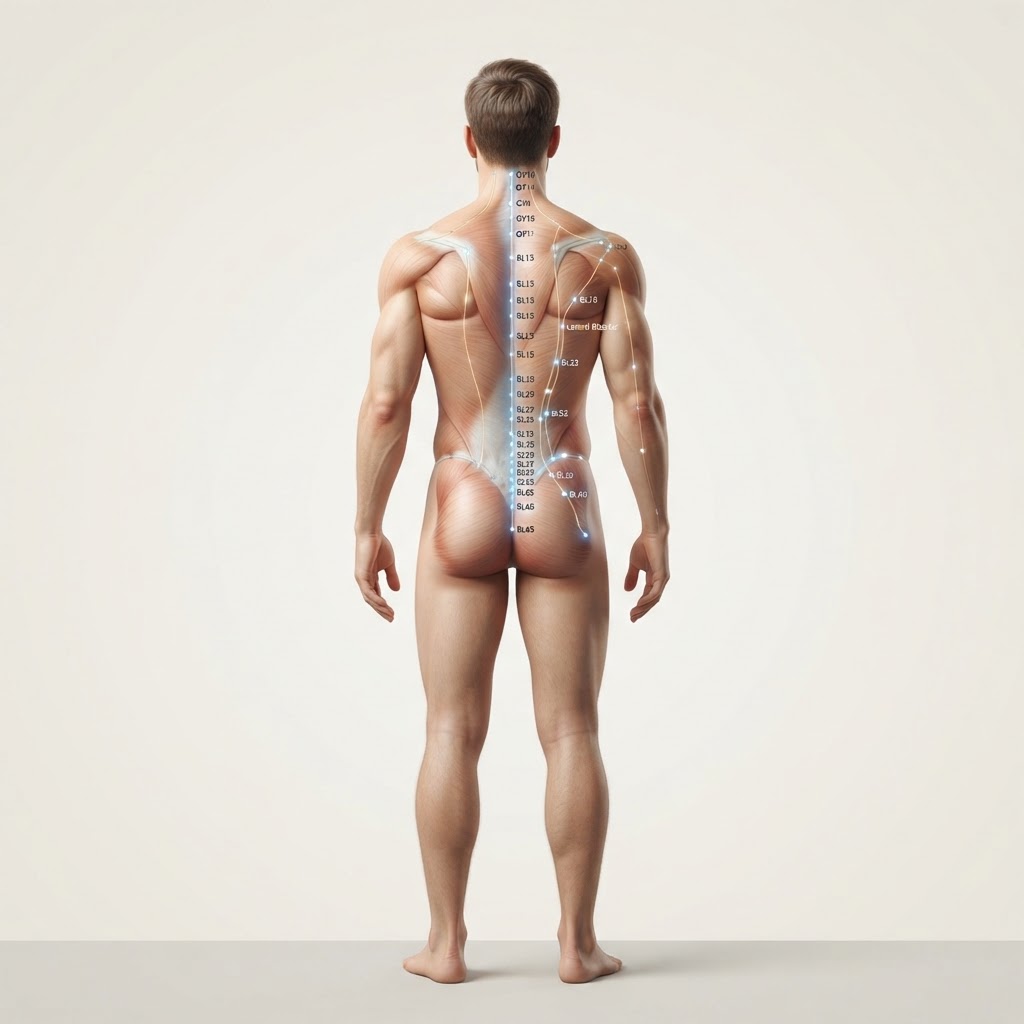
"The body is its own ruler; learn to measure it, and you will never lose a point."
LOVELOVINGLIFE · 2026