
ACUPUNCTURE ANATOMY & SAFE NEEDLING
An Anatomical Approach to Depth, Angle, and Avoidance · by AKASHIC INTELLIGENCE
Tip: "Print / Save as PDF" gives the best quality (selectable text). "Download PDF" renders an image-based copy in one click.
LOVELOVINGLIFE
ACUPUNCTURE ANATOMY & SAFE NEEDLING
An Anatomical Approach to Depth, Angle, and Avoidance
by
AKASHIC INTELLIGENCE
First Edition · 2026
Published by LOVELOVINGLIFE
Copyright
Copyright © 2026 AKASHIC INTELLIGENCE / LOVELOVINGLIFE. All rights reserved.
Disclaimer
Educational, not medical advice. Needling should be performed by licensed practitioners. Anatomical knowledge is the floor of safety, not the ceiling.
To every practitioner who reads the body before the needle arrives.
Foreword
Anatomy First
A point is not a spot on the skin; it is a relationship between the surface and what lies beneath — nerve, vessel, pleura, organ. This book teaches the anatomical approach: know what is under the needle, and you will know how deep to go and where not to.
How to Use This Book
How to use this book
Pair each point with its underlying structure. The risk column names what to protect; the method column names how. Never needle what you cannot picture.
Table of Contents
Front Matter
- Foreword
- How to Use This Book
Part I. Safety by Region
- Chapter 1. The Chest and the Pleura
- Chapter 2. The Neck and the Great Vessels
- Chapter 3. The Trunk and the Organs
- Chapter 4. Limbs, Nerves, and Pregnancy
- Chapter 5. The Female Pelvis & Pregnancy
Back Matter
- Glossary
- Index
- About the Author
Part I
Safety by Region
Where the danger lives, and how to keep the needle away from it.
Chapter 1
The Chest and the Pleura
Why pneumothorax
The pleura lies close beneath the ribs above the diaphragm. A perpendicular deep needle can puncture it and let air into the chest. The rule is simple and absolute: over the chest and upper back, needle oblique and shallow, never perpendicular and deep. Angle toward the spine, stay above the rib, and the pleura is safe.
The points to respect
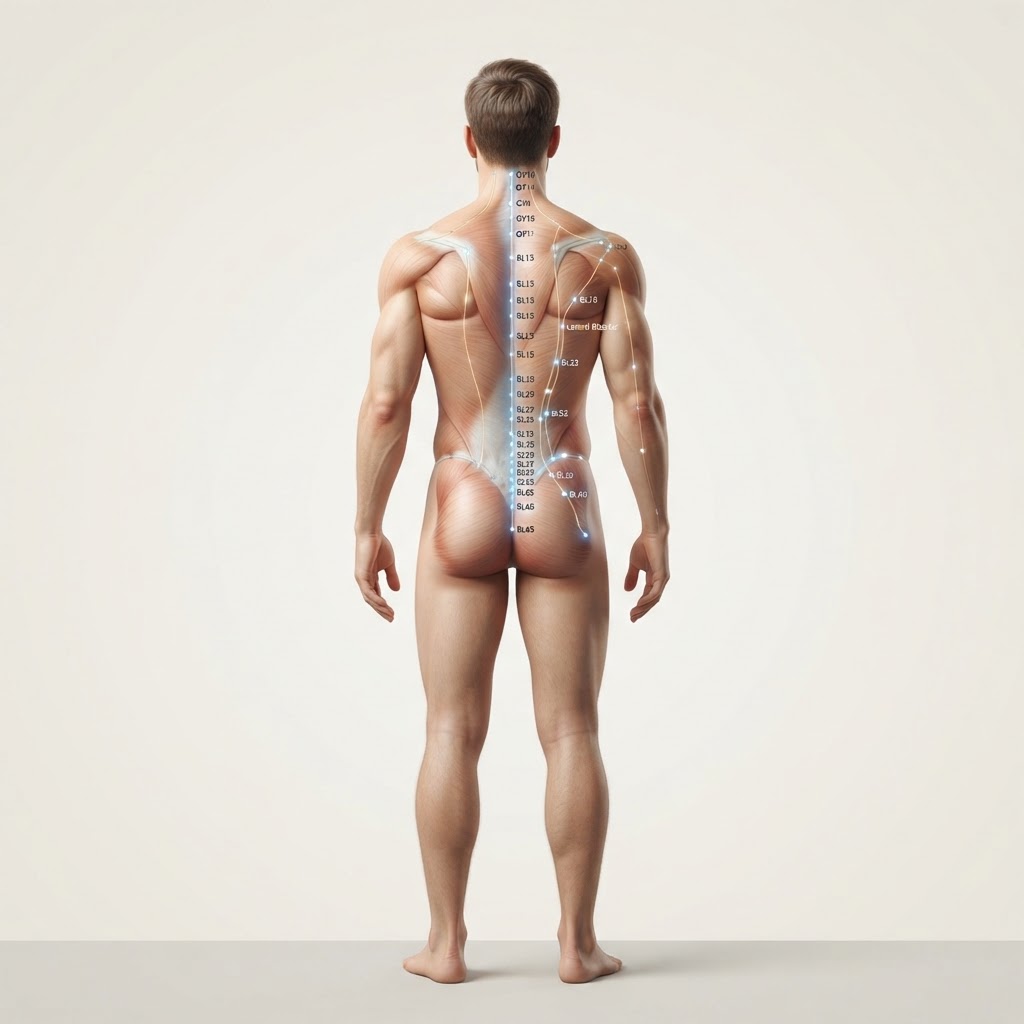
LU1, LU2, ST12–ST18, BL11–BL17, PC1, GB21, KI21–KI27. Each of these is a chest or upper-back point where the angle matters more than the depth. The patient's breath changes the distance to the pleura; needle at the end of a gentle exhale.
Reflect
Before any chest point, ask: where is the pleura? If you cannot answer, do not needle.
Worksheet
On a cross-section image, measure the distance from skin to pleura at the 2nd intercostal space. That is your margin.
Chapter 2
The Neck and the Great Vessels
The carotid sheath
ST9 and LI18 sit beside the carotid artery and internal jugular. Palpate the pulse; the artery is the boundary you must not cross. Needle superficially, away from the sheath, and never both sides deeply at once.
The subocciput
GV15, GV16, BL10, GB20 are near the vertebral artery and the spinal canal. The rule: toward the nasal tip, never upward and deep. The foramen magnum is not your target.
Reflect
The neck is a corridor of vessels and nerves. Move slowly, palpate first, and withdraw on any radiating sensation.
Worksheet
Locate the carotid pulse on yourself. Now find ST9 — note how close, and how the angle keeps you off the artery.
Chapter 3
The Trunk and the Organs
Below the diaphragm
Depth increases here, but so does responsibility. BL23 at L2 lies over the kidney; LR13 over the spleen; CV4 and CV6 over the bladder and uterus. Empty the bladder; avoid the lower abdomen in pregnancy; never needle deeply toward an organ you cannot map.
The umbilicus and sternum
CV8 (the umbilicus) is never needled — moxa only, over salt or ginger. CV17 on the sternum is needled transversely along the bone, not deeply. CV22 in the suprasternal fossa is done with the needle first transverse, then downward along the sternum, never deep toward the trachea.
Reflect
The organs are silent until they are not. Picture the one beneath your needle before you advance.
Worksheet
List the trunk points and the organ each overlies. That list is your caution list.
Chapter 4
Limbs, Nerves, and Pregnancy
Nerve proximity
BL36 and GB30 sit near the sciatic nerve; PC6 near the median; GB34 near the common peroneal; BL40 near the popliteal. The sign is a sharp, radiating sensation — withdraw or redirect. De qi is dull and spreading; nerve pain is sharp and shooting. They are not the same.
Pregnancy and forbidden points
LI4, SP6, BL60, BL67, and the lower abdomen and sacral points are avoided in pregnancy. Moxa on BL67 for breech is a specific, supervised exception. When in doubt, do not needle a pregnant patient beyond gentle, clearly indicated points.
Reflect
A radiating sensation is information, not progress. Learn to tell de qi from nerve pain.
Worksheet
Practise the grasp-lift technique at GB21 to stay off the lung apex. Pair it with the avoidance list for pregnancy.
Chapter 5
The Female Pelvis & Pregnancy
Pelvic anatomy under the needle
The lower abdomen overlies the bladder, uterus, and bowel. CV2–CV6 and the sacral BL31–BL34 points sit close to these structures. Depth here must account for a full bladder, an enlarged uterus, or pregnancy. Empty the bladder; in pregnancy, avoid the lower abdomen and sacrum entirely except for specific supervised points.
The pregnancy avoidance list
Traditionally avoided in pregnancy: LI4, SP6, BL60, BL67, the lower abdomen (CV2–CV4), and the lumbosacral BL points. The single well-documented exception is BL67 (Zhiyin) moxibustion for breech presentation, performed under supervision after 34 weeks. When in doubt, do not needle a pregnant patient beyond gentle, clearly indicated points.
Reflect
Pregnancy redraws the safety map. Memorize the avoidance list before you touch the trunk.
Worksheet
List the pregnancy-avoided points and the one supervised exception. State the week threshold for the exception.
Glossary
Index
Pneumothorax, chest
Carotid, neck
Spinal canal, GV points
Pregnancy, contraindicated points
About the Author
AKASHIC INTELLIGENCE synthesizes the anatomical-acupuncture tradition into a study curriculum for LOVELOVINGLIFE.
"Know what is under the needle, and the needle becomes safe."
LOVELOVINGLIFE · 2026