
FOUNDATIONS OF CHINESE MEDICINE
A Complete Guide to the Theory and Practice of Traditional Chinese Medicine · by AKASHIC INTELLIGENCE
Tip: "Print / Save as PDF" gives the best quality (selectable text). "Download PDF" renders an image-based copy in one click.
LOVELOVINGLIFE
FOUNDATIONS OF CHINESE MEDICINE
A Complete Guide to the Theory and Practice of Traditional Chinese Medicine
by
AKASHIC INTELLIGENCE
First Edition · 2026
Published by LOVELOVINGLIFE
Copyright
Copyright © 2026 AKASHIC INTELLIGENCE / LOVELOVINGLIFE. All rights reserved.
No part of this book may be reproduced or transmitted in any form without prior written permission, except for brief quotations in reviews.
First Edition, 2026. Published by LOVELOVINGLIFE.
Disclaimer
Educational, not medical advice. Traditional Chinese Medicine is a complementary system.
Do not use acupuncture, herbs, or any TCM method as a substitute for professional medical care. Needling should only be performed by a licensed acupuncturist. Always consult a physician for medical conditions.
To the physicians of the Yellow Emperor's court, and to every practitioner who has felt a pulse and listened to what it said.
Foreword
A Medicine of Relationships
Traditional Chinese Medicine is not a collection of remedies. It is a way of seeing the body as a system of relationships — between yin and yang, between the five elements, between the organs and the seasons, between a person and their environment. Disease, in this view, is not an invader to be killed but an imbalance to be read and rebalanced.
This book teaches the working foundations: the theories that organize the practice, the channels and points, the diagnostic methods, and the techniques. It is a guide to understanding, not a license to needle.
How to Read This Book
Part I grounds the theory: yin and yang, the vital substances, the five elements, and the meridian system. Part II covers diagnosis — the four examinations. Part III covers the therapeutic methods and point categories. Read the theory first; the practice is meaningless without it.
How to Use This Book
Theory Before Technique
Western students often want to jump to points and needles. Without the theory, technique becomes rote. With it, every point choice becomes a reasoning about relationships. Learn the theory; the technique will then teach itself.
Table of Contents
Front Matter
- Foreword
- How to Use This Book
Part I. Foundations
- Chapter 1. Yin and Yang
- Chapter 2. The Vital Substances
- Chapter 3. The Five Elements
- Chapter 4. The Meridian System
Part II. The Meridian System: Pathways of Energy
- Chapter 6. The Twelve Primary Meridians
- Chapter 7. The Eight Extraordinary Vessels
- Chapter 8. Point Categories: The Hierarchy of Points
- Chapter 9. Diagnostic Methods: The Four Examinations
- Chapter 10. Treatment Principles and Strategies
Part III. The Clinical Art — Diagnosis, Pattern Differentiation, and Treatment Strategy
- Chapter 1. The Four Examinations — Looking, Listening, Asking, Touching
- Chapter 2. Tongue Diagnosis — The Map of the Interior
- Chapter 3. Pulse Diagnosis — The Twenty-Eight Qualities
- Chapter 4. Pattern Differentiation — The Eight Principles
- Chapter 5. The Organ Patterns (Zang-Fu Differentiation)
- Chapter 6. Treatment Principles — From Pattern to Strategy
- Chapter 7. Point Selection — The Strategy on the Body
- Chapter 8. Herbal Strategy — The Formula as the Composition
- Chapter 9. Prevention — The Superior Medicine
- Chapter 10. Integration — Chinese Medicine in the Modern World
Part IV. The Advanced Practice — The Five Elements in Depth
- Chapter 1. The Five Elements — Generating and Controlling
- Chapter 2. The Five Element Points — Clinical Application
Part V. The Healing Life — TCM as a Way of Living
- Chapter 1. Living with the Seasons — The Five Seasons of Health
- Chapter 2. The Three Treasures — Jing, Qi, and Shen
Back Matter
- Glossary
- Index
- About the Author
Part I
Foundations
Before points and needles, you need the theories that organize the whole system: yin and yang, the vital substances, the five elements, and the channels. These chapters give the ground every later chapter stands on.
Chapter 1
Yin and Yang
The Original Polarity
Yin and yang are not forces; they are a way of describing the relative position of any phenomenon along a polarity. Yin is the shady, cold, inward, descending, still, substantial aspect; yang is the sunny, warm, outward, ascending, active, functional aspect. Nothing is absolutely yin or yang; each is yin or yang relative to something else.
Health is the dynamic balance of the two. Disease is imbalance — deficiency or excess of one relative to the other, or a failure of them to transform into each other.
The Four Principles
Yin and yang oppose each other, depend on each other, consume and support each other, and transform into each other. These four principles govern every clinical reasoning in Chinese medicine. A fever is not simply 'too much heat' — it may be a deficiency of yin that allows yang to flare, or an excess of yang. Treatment depends on which.
Reading the Balance
The practitioner's first job in every encounter is to locate the patient along the yin-yang polarity: is this a hot or cold pattern, a deficient or excess one, an interior or exterior one, a yin or yang disease? Everything that follows — the points, the herbs — flows from this single reading.
Reflect
Where in your own life is the balance of yin and yang off? Are you too yang — always doing, always outward — or too yin — withdrawn, stagnant? The first diagnosis is on yourself.
Worksheet
Spend one day noting your activities as yin or yang. Sleep, stillness, inward attention are yin; work, exercise, outward engagement are yang. Is there a side you never visit?
Chapter 2
The Vital Substances
Qi
Qi is the vital energy that animates the body. It has functions: it moves the blood, warms the body, defends against pathogens, holds organs and fluids in place, and transforms one substance into another. Qi deficiency shows as fatigue, weak voice, and low resistance; qi stagnation shows as pain, distension, and emotional constraint.
Blood and the Other Substances
Blood in Chinese medicine is broader than the Western concept; it nourishes and moistens the body and anchors the shen (spirit). Where blood is deficient, there is pallor, dizziness, and poor sleep. Jing is the essence, the inherited reservoir; shen is the spirit. Together qi, blood, jing, shen, and the fluids (jin-ye) are the vital substances whose balance is the body's health.
Deficiency and Excess
Every substance can be deficient (not enough) or in excess (not moving or too much). The clinical art is to determine which substance, in what direction, is the root of a pattern. A headache, for instance, could be blood deficiency failing to nourish the head, or qi stagnation failing to move through it — opposite treatments for the same symptom.
Reflect
Which vital substance do you most clearly feel the state of in yourself? Fatigue points to qi; dryness and poor sleep to blood; a sense of depletion to jing. Listen to your own body's vocabulary.
Worksheet
Keep a one-week log: each morning note your energy, sleep quality, and mood. After a week, read the log as a clinician would — which substance seems most often out of balance?
Chapter 3
The Five Elements
Phases, Not Elements
The five 'elements' — Wood, Fire, Earth, Metal, Water — are better understood as five phases of a transformation cycle. Wood is the springing-up, ascending phase; Fire is the flaring-up, maximum-yang phase; Earth is the ripening, balancing phase; Metal is the descending, gathering phase; Water is the still, storing, minimum-yin phase. Each is associated with an organ pair, an emotion, a season, a taste, and a tissue.
Generating and Controlling
The elements relate through two cycles. The generating (sheng) cycle feeds each element forward: Wood feeds Fire, Fire feeds Earth, and so on. The controlling (ke) cycle keeps each in check: Wood controls Earth, Earth controls Water, and so on. Disease is often a break in one of these cycles — a Wood that over-controls Earth, or a Water that fails to nourish Wood.
Clinical Use
The five-element framework turns symptoms into relationships. A liver (Wood) pattern may show as digestive (Earth) complaints because Wood over-controls Earth. Treating the root — the Wood — resolves the branch. This relational reasoning is the heart of five-element practice.
Reflect
Which element do you most resemble? Quick-tempered and visionary like Wood, warm and joyful like Fire, steady and nurturing like Earth, precise and letting-go like Metal, or deep and still like Water?
Worksheet
Identify your dominant element and the one you most lack. For one week, bring small practices of the lacking element into your routine. Note what changes.
Chapter 4
The Meridian System
Channels of Qi
Meridians are the channels along which qi flows through the body. There are twelve principal meridians, each associated with a zang or fu organ, plus eight extraordinary vessels. The acupuncture points lie along these channels; needling a point influences the qi of the channel and, through it, the organ.
The Organ Clock
Each meridian has a two-hour peak in the daily cycle. The lung channel peaks at 3–5 a.m., the liver at 1–3 a.m. The clock is a diagnostic tool: a symptom that reliably appears at a given hour points to the channel peaking then. Waking at 3 a.m. every night is a classic lung-channel sign.
Point Categories
Points are categorized by function: source points, luo-connecting points, xi-cleft points, shu points on the back, mu points on the front, and the five shu points (well, spring, stream, river, sea). Each category has a clinical use. Knowing the categories means a small set of points can address a wide range of patterns.
Reflect
What time do you wake at night, if you wake? The organ clock is one of the most practical diagnostics you carry with you every day — written in your own sleep.
Worksheet
For one week, note any recurring wake times and the accompanying feeling. Compare to the organ clock. Which channel is asking for your attention?
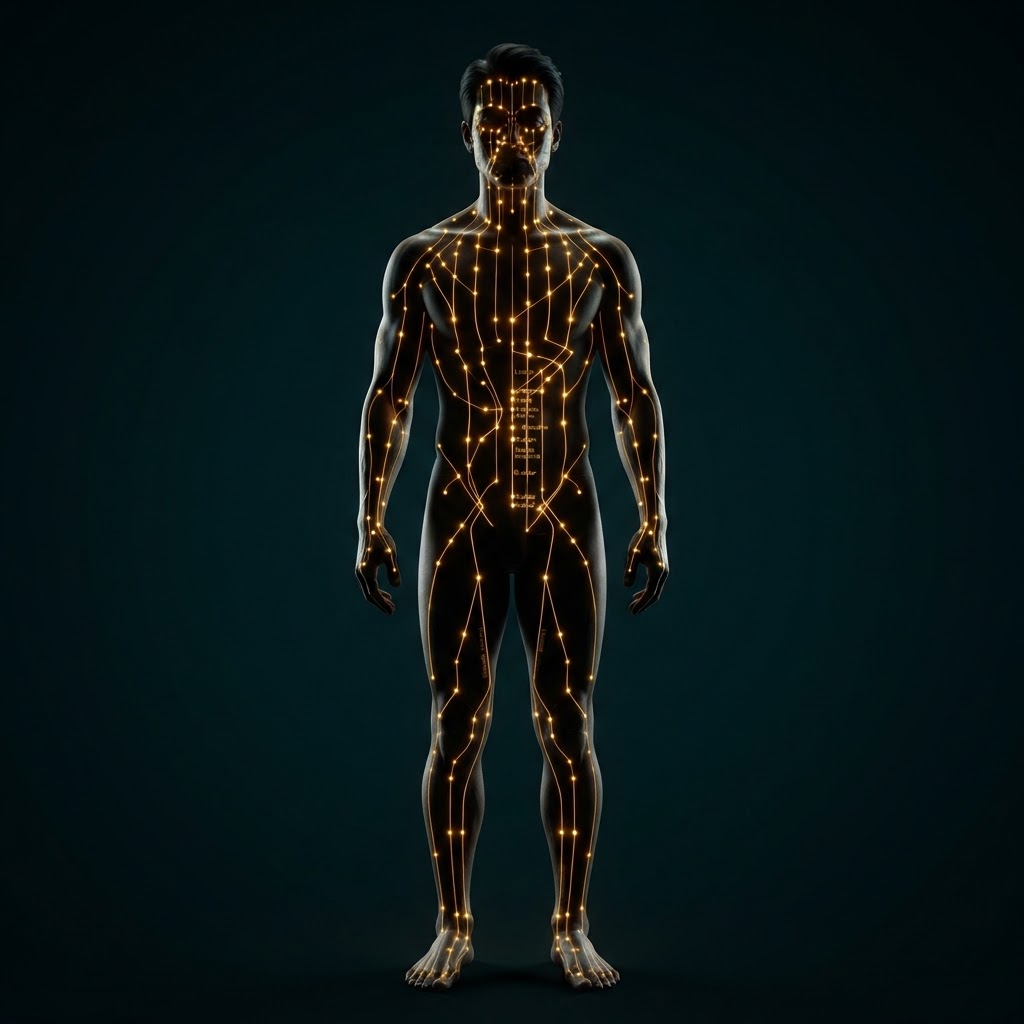
Part II
The Meridian System: Pathways of Energy
The meridians are the channels through which qi flows through the body, connecting the internal organs to the surface and to each other. This part covers the twelve primary meridians, the eight extraordinary vessels, the point categories along each channel, and the clinical applications of meridian theory. Understanding the meridian system is the bridge between theory and practice in Chinese medicine.
Chapter 6
The Twelve Primary Meridians
What a Meridian Is
A meridian is a pathway along which qi and blood flow through the body. In Chinese medicine, the meridians are not physical structures visible to the anatomist — they are functional pathways, identified through centuries of clinical observation. They connect the internal organs to the surface of the body, and they connect the organs to each other, forming a network that integrates the body into a unified system.
Each of the twelve primary meridians is associated with a specific organ (called a 'zang-fu' organ in Chinese medicine) and follows a specific pathway on the surface of the body. Along each pathway are specific points where the qi of the meridian can be accessed and influenced — these are the acupuncture points. There are 361 standard acupuncture points on the twelve primary meridians and the two central vessels (ren mai and du mai).
The twelve meridians are paired into six yin-yang pairs, each pair consisting of a yin organ (zang — solid, storing) and a yang organ (fu — hollow, transforming). The pairs are: Lung (yin) and Large Intestine (yang), Spleen (yin) and Stomach (yang), Heart (yin) and Small Intestine (yang), Kidney (yin) and Bladder (yang), Pericardium (yin) and Triple Warmer (yang), Liver (yin) and Gallbladder (yang). Each pair is also associated with an element — metal, earth, fire, water, fire (again), and wood, respectively.
The Flow of Qi Through the Meridians
Qi flows through the twelve meridians in a specific, continuous cycle, completing one full circuit every 24 hours. Each meridian has a two-hour period during which its qi is at maximum strength (the 'organ clock'), and a two-hour period during which it is at minimum strength. This daily cycle is one of the most practically useful concepts in Chinese medicine, as it explains many physiological rhythms and provides guidance for treatment timing.
The cycle begins at 3 AM with the Lung meridian (qi peaks 3-5 AM), then flows to the Large Intestine (5-7 AM), Stomach (7-9 AM), Spleen (9-11 AM), Heart (11 AM-1 PM), Small Intestine (1-3 PM), Bladder (3-5 PM), Kidney (5-7 PM), Pericardium (7-9 PM), Triple Warmer (9-11 PM), Gallbladder (11 PM-1 AM), and Liver (1-3 AM), before returning to the Lung to begin the cycle again.
The organ clock has practical applications: Waking consistently between 1 and 3 AM may indicate Liver meridian disharmony (often related to anger, frustration, or stress). Waking between 3 and 5 AM may indicate Lung meridian disharmony (often related to grief or sadness). Digestive problems in the morning (7-9 AM) may relate to Stomach meridian. Afternoon energy crashes (3-5 PM) may relate to Bladder meridian. Planning activities during the peak time of relevant organs can optimize results — creative work during Liver time (1-3 AM is impractical, but the Liver's paired meridian, the Gallbladder, peaks 11 PM-1 AM, and its influence extends through the night), important decisions during Gallbladder time.
The Yin Meridians
The six yin meridians run along the inner (medial) aspect of the limbs and are associated with the solid organs (zang). They are: Lung (LU), Pericardium (PC), Heart (HT) on the arms, and Spleen (SP), Liver (LR), Kidney (KI) on the legs. The yin meridians are generally associated with storage, nourishment, and interior functions.
Lung meridian (LU): Begins in the middle jiao (abdominal area), descends to connect with the large intestine, then ascends through the lung, up the throat, and down the anterior aspect of the arm to the thumb. It has 11 points. The Lung governs qi and respiration, opens into the nose, and is associated with the emotion of grief and the skin. Common indications for Lung points: respiratory conditions (cough, asthma, congestion), skin conditions, grief, and immune support.
Heart meridian (HT): Begins in the heart, descends through the diaphragm to connect with the small intestine, then a branch ascends to the eye, while the main pathway runs down the posterior-medial aspect of the arm to the little finger. It has 9 points. The Heart governs blood and houses the shen (spirit/mind), opens into the tongue, and is associated with the emotion of joy. Common indications: heart conditions, anxiety, insomnia, mental and emotional disorders.
Liver meridian (LR): Begins on the great toe, ascends the medial aspect of the leg, through the genital area, up the abdomen, and into the ribs. It has 14 points. The Liver governs the smooth flow of qi, stores blood, opens into the eyes, and is associated with the emotion of anger. Common indications: stress, anger, menstrual disorders, eye problems, headaches, and digestive issues related to qi stagnation.
The Yang Meridians
The six yang meridians run along the outer (lateral) aspect of the limbs and are associated with the hollow organs (fu). They are: Large Intestine (LI), Triple Warmer (TW), Small Intestine (SI) on the arms, and Stomach (ST), Gallbladder (GB), Bladder (BL) on the legs. The yang meridians are generally associated with transformation, transportation, and exterior functions.
Large Intestine meridian (LI): Begins at the index finger, ascends the lateral aspect of the arm, across the shoulder, up the neck, and across the face to the opposite side of the nose. It has 20 points. The Large Intestine governs elimination, and its points are commonly used for digestive disorders (constipation, diarrhea), facial and dental issues, and immune support (LI-4 is one of the most commonly used points for pain and immune function).
Stomach meridian (ST): Begins below the eye, descends across the face, along the neck, down the anterior aspect of the body and leg, to the second toe. It has 45 points — the most of any meridian. The Stomach governs the reception and digestion of food, and its points are used for digestive disorders, facial and dental issues, and general tonification (ST-36 is one of the most important tonification points in the body).
Bladder meridian (BL): Begins at the inner canthus of the eye, ascends over the head, and descends along the entire back in two parallel lines, down the posterior aspect of the leg, to the little toe. It has 67 points — the most of any meridian. The Bladder's long pathway along the back includes the 'shu points' (associated point of each organ), making it extremely important for treating all internal organ systems. BL-40 is a major point for lower back pain; BL-60 for heel pain; BL-23 (Kidney shu) for kidney tonification.
Gallbladder meridian (GB): Begins at the outer canthus of the eye, zigzags across the side of the head and body, down the lateral aspect of the leg, to the fourth toe. It has 44 points. The Gallbladder governs decision-making and the smooth flow of qi (paired with the Liver), and its points are used for headaches (especially temporal), side-of-body pain, digestive issues, and emotional disorders. GB-20 is a major point for headaches and neck tension; GB-34 for tendon and muscle problems.
The Internal-External Pathways
Each meridian has both an external pathway (the course on the surface of the body where the acupuncture points are located) and an internal pathway (the course through the interior of the body that connects to the associated organ and to other organs). The internal pathways explain why points on the surface can affect internal organs, and why internal organ dysfunction can manifest as pain or tenderness along the surface pathway.
The internal pathways also explain the 'referred pain' patterns that are so useful in diagnosis. Heart pain may radiate to the medial aspect of the left arm (along the Heart meridian pathway). Gallbladder problems may cause pain in the right shoulder or the side of the head (along the Gallbladder meridian). Kidney problems may manifest as pain in the lower back or the sole of the foot (along the Kidney meridian).
Understanding the internal pathways also explains the connections between paired organs. The Lung and Large Intestine are paired not just theoretically but through actual meridian connections — the Lung meridian descends to connect with the Large Intestine, and the Large Intestine meridian connects to the Lung. This is why a respiratory condition may be accompanied by bowel changes, and why treating the Large Intestine can affect the Lung. These internal-external connections are the basis of the 'paired organ' treatment strategy in acupuncture.
Reflect
Do you notice any patterns in when you feel best and worst during the day? Do they correspond to the organ clock? What would change if you aligned your activities with the natural energy rhythms of your body?
Worksheet
For one week, note your energy levels, mood, and any symptoms at each two-hour block of the day. At the end of the week, compare your patterns to the organ clock. Are there correlations? Which organ's time seems to be your weakest? What does this suggest about your health?
Chapter 7
The Eight Extraordinary Vessels
What the Extraordinary Vessels Are
In addition to the twelve primary meridians, Chinese medicine describes eight 'extraordinary vessels' — deeper, more fundamental pathways that regulate and connect the primary meridians. The extraordinary vessels are not associated with specific organs (unlike the primary meridians) but instead govern broader functions: constitutional energy, ancestral heritage, and the fundamental yin-yang balance of the body.
The eight extraordinary vessels are: the Du Mai (Governing Vessel), the Ren Mai (Conception Vessel), the Chong Mai (Penetrating Vessel), the Dai Mai (Girdling Vessel), the Yin Qiao Mai (Yin Heel Vessel), the Yang Qiao Mai (Yang Heel Vessel), the Yin Wei Mai (Yin Linking Vessel), and the Yang Wei Mai (Yang Linking Vessel). Of these, the Du Mai and Ren Mai have their own acupuncture points; the other six share points with the primary meridians but are accessed through 'master points' on specific primary meridians.
The extraordinary vessels are considered 'reservoirs' of qi and blood. When the primary meridians are full, excess qi flows into the extraordinary vessels for storage. When the primary meridians are depleted, qi is drawn from the extraordinary vessels to supplement them. This reservoir function makes the extraordinary vessels particularly important in constitutional treatment, chronic conditions, and conditions involving deep depletion.
The Du Mai (Governing Vessel)
The Du Mai, or Governing Vessel, runs along the posterior midline of the body, from the tailbone up the spine, over the head, to the upper lip. It is the 'sea of yang meridians' — it governs and regulates all the yang energy in the body. The Du Mai has 28 points along its pathway, many of which are among the most clinically important points in acupuncture.
The Du Mai is particularly important for the spine, the brain, and the nervous system. Points along the Du Mai are used for back pain, neurological conditions, mental and emotional disorders, and conditions involving the head and neck. GV-14 (Da Zhui, 'Great Vertebra') is a major point for releasing exterior pathogens and reducing fever. GV-20 (Bai Hui, 'Hundred Meetings') is used for clearing the mind, lifting prolapsed organs, and treating headaches. GV-26 (Shui Gou, 'Water Trough' — also known as Ren Zhong) is the famous revival point used for fainting, shock, and emergencies.
The Du Mai also governs the yang aspect of the kidneys — the foundational yang energy that warms the body and powers all physiological activity. Tonification of the Du Mai (through moxibustion, needling, or qi gong) can address constitutional yang deficiency — chronic cold, fatigue, low back pain, frequent urination, and poor digestion. This makes the Du Mai particularly important in the treatment of chronic, debilitating conditions where the body's fundamental energy is depleted.
The Ren Mai (Conception Vessel)
The Ren Mai, or Conception Vessel, runs along the anterior midline of the body, from the perineum up the front of the body, along the midline of the chest and abdomen, to the chin. It is the 'sea of yin meridians' — it governs and regulates all the yin energy in the body, particularly the receptive, nurturing, and reproductive functions.
The Ren Mai has 24 points along its pathway. It is particularly important for the reproductive system, the digestive system, and the respiratory system. CV-4 (Guan Yuan, 'Gate of Origin') is a major tonification point for the kidneys and lower jiao, used for fatigue, reproductive disorders, and constitutional weakness. CV-6 (Qi Hai, 'Sea of Qi') tonifies the overall qi of the body. CV-12 (Zhong Wan, 'Middle Cavity') is the influential point for the fu organs and a major point for digestive disorders. CV-17 (Shan Zhong, 'Chest Center') is the influential point for qi and is used for respiratory and emotional conditions.
The Ren Mai is particularly important in women's health — it governs the uterus, menstruation, pregnancy, and menopause. Many gynecological conditions are treated through the Ren Mai and its associated points. The vessel is also important for men's reproductive health, though this is less commonly emphasized. In both sexes, the Ren Mai's role in governing yin makes it essential for conditions involving yin deficiency — heat symptoms, dryness, restlessness, and night sweats.
The Chong Mai and Dai Mai
The Chong Mai, or Penetrating Vessel, is the 'sea of blood' — it governs the blood and the deepest energetic reserves of the body. It runs from the lower abdomen upward along the kidney meridian pathway, branching through the chest and the reproductive organs. The Chong Mai is particularly important for blood-related conditions — menstrual disorders, blood stasis, and deep constitutional depletion. Its master point is SP-4 (Gong Sun), and its coupled point is PC-6 (Nei Guan).
The Chong Mai is often used in combination with the Ren Mai for gynecological conditions, as both vessels influence the uterus and the reproductive system. The Chong Mai's role as the 'sea of blood' makes it particularly relevant for conditions involving insufficient blood (anemia, scanty menstruation, dryness) or blood stasis (clots, pain, fixed masses).
The Dai Mai, or Girdling Vessel, is the only meridian that runs horizontally — it circles the waist like a belt, binding and connecting all the other meridians. The Dai Mai governs the horizontal energy of the body and is particularly important for conditions involving energy that is 'leaking' or 'descending' — prolapse, vaginal discharge, chronic diarrhea, and conditions where energy is not properly contained. Its master point is GB-41 (Zu Lin Qi), and its coupled point is TH-5 (Wai Guan).
The Dai Mai is also important for conditions involving the waist and hips — lower back pain, hip pain, and abdominal fullness. Its horizontal pathway makes it unique among the meridians, and its binding function means that it can be used to 'gather' or 'contain' energy that is scattered or leaking. This makes it useful in the treatment of chronic, complex conditions where the body's energy is disorganized or depleted.
The Qiao and Wei Vessels
The Yin Qiao Mai (Yin Heel Vessel) and Yang Qiao Mai (Yang Heel Vessel) govern the body's lateral mobility and balance. The word 'qiao' means 'heel' or 'to lift' — these vessels are associated with the ability to lift the body, move quickly, and maintain balance. They are particularly important for conditions of the legs, gait, and sleep. The Yin Qiao's master point is KI-6 (Zhao Hai); the Yang Qiao's master point is BL-62 (Shen Mai).
The Qiao vessels are unique in their relationship to the eyes and sleep. The Yin and Yang Qiao vessels meet at the inner canthus of the eye, and they are said to govern the opening and closing of the eyes — the Yin Qiao governs closing (sleep), and the Yang Qiao governs opening (wakefulness). This makes them particularly important for sleep disorders: insomnia is often treated through the Yang Qiao (excess yang prevents sleep), and excessive sleepiness through the Yin Qiao (excess yin prevents waking).
The Yin Wei Mai (Yin Linking Vessel) and Yang Wei Mai (Yang Linking Vessel) govern the body's connections — they 'link' the meridians together and maintain the coherence of the energetic network. The Wei vessels are particularly important for conditions involving pain that crosses meridian boundaries, or conditions where the body's energetic network is disorganized. The Yin Wei's master point is PC-6 (Nei Guan) — one of the most clinically important points, used for chest pain, nausea, and emotional disorders. The Yang Wei's master point is TH-5 (Wai Guan), used for external conditions, fever, and side-of-body pain.
Together, the eight extraordinary vessels provide a deeper level of treatment than the primary meridians alone. They are particularly valuable for chronic, complex, or constitutional conditions where the primary meridians have been treated but the underlying pattern persists. The extraordinary vessels address the foundational level — the level of reservoir, constitution, and deep energetic architecture — that the primary meridians cannot reach.
Reflect
The extraordinary vessels represent the deepest level of the body's energetic architecture. How does this concept of 'reservoir' energy — stored for times of need — relate to your own energy patterns? When do you feel your deepest energy reserves being called upon?
Worksheet
Note any chronic, recurring patterns in your health — issues that keep returning despite treatment. These may involve the extraordinary vessels rather than the primary meridians. Which extraordinary vessel seems most relevant to your pattern? Consider consulting a practitioner who works with the extraordinary vessels.
Chapter 8
Point Categories: The Hierarchy of Points
Why Points Are Categorized
Not all acupuncture points are equal. The 361 standard points have different functions, strengths, and clinical applications. Chinese medicine categorizes points into several groups based on their properties, allowing practitioners to select the most effective points for specific conditions. Understanding these categories is essential for effective point selection and for understanding why certain points are used repeatedly across very different conditions.
The major point categories are: the five shu points (jing-well, ying-spring, shu-stream, jing-river, he-sea), the yuan-source points, the luo-connecting points, the xi-cleft points, the mu-alarm points, the shu-transport points, the eight influential points, and the intersection points. Each category has specific properties that make it useful for specific types of conditions.
The categories are not mutually exclusive — a single point may belong to multiple categories. For example, LI-4 (He Gu) is both a yuan-source point and a jing-river point, as well as being a major point for the face and head. The multiple categories a point belongs to contribute to its overall clinical profile and help the practitioner understand its full range of effects.
The Five Shu Points
The five shu points are located on each of the twelve primary meridians, below the elbow or knee. They are named after natural features that describe the flow of qi: jing-well (at the fingernail/toenail, where qi is minimal, like a well spring), ying-spring (where qi begins to flow, like a spring), shu-stream (where qi flows more strongly, like a stream), jing-river (where qi is abundant, like a river), and he-sea (where qi is maximal, like a sea flowing into the organ).
Each of the five shu points is associated with one of the five elements, and the association differs for yin and yang meridians. For yin meridians (Lung, Spleen, Heart, Kidney, Pericardium, Liver), the jing-well point is wood, ying-spring is fire, shu-stream is earth, jing-river is metal, he-sea is water. For yang meridians, the sequence is shifted: jing-well is metal, ying-spring is water, shu-stream is wood, jing-river is fire, he-sea is earth.
The five shu points have specific clinical applications based on their elemental associations and their position in the qi flow. Jing-well points are used for emergencies, mental disorders, and conditions at the extreme ends of the body. Ying-spring points are used for heat conditions. Shu-stream points are used for heaviness and joint pain. Jing-river points are used for cough, asthma, and conditions involving the throat. He-sea points are used for disorders of the fu organs and reverse flow of qi (nausea, vomiting).
The five element theory provides additional treatment possibilities. Using the 'mother-son' rule (tonify the mother, sedate the son), a practitioner can select points that tonify or sedate a meridian based on the generational cycle of elements. For example, to tonify the Lung (metal), one would tonify the mother element (earth — Spleen/Stomach), so SP-9 (the he-sea point of the Spleen, which is the water point on the earth meridian) or ST-36 (the he-sea point of the Stomach) might be selected.
The Yuan-Source and Luo-Connecting Points
The yuan-source points are located near the wrist or ankle on each of the twelve primary meridians. They are the points where the original (yuan) qi of the organ is most accessible. The yuan-source points are used for tonification or sedation of their associated organ — they are the primary points for treating organ-level deficiency or excess. For example, LU-9 (Tai Yuan) is the yuan-source point of the Lung meridian and is used for lung deficiency (weak breathing, weak voice, fatigue).
The luo-connecting points are located near the yuan-source points and serve as the connecting points between paired yin-yang meridians. Each luo-connecting point has a branch that connects to the paired meridian — the Lung's luo-connecting point (LU-7) connects to the Large Intestine, and vice versa. This connection allows treatment of both paired organs from one point. The luo-connecting points are also used for conditions involving the area that the luo vessel covers — for example, LU-7 is used for neck and head problems because the Lung luo vessel runs along the neck.
The yuan-source and luo-connecting points of paired meridians are often used together in treatment — a technique called 'yuan-luo pairing.' For example, the yuan-source point of the Lung (LU-9) paired with the luo-connecting point of the Large Intestine (LI-6) treats both organs simultaneously. This pairing is particularly effective for conditions involving the paired organs' shared function, such as respiratory conditions with bowel involvement.
The Xi-Cleft Points
The xi-cleft points are located on each of the twelve primary meridians (and on some extraordinary vessels) and are the points where qi and blood 'gather' or 'accumulate.' The word 'xi' means 'cleft' or 'fissure' — these are points where the meridian's energy is particularly concentrated and accessible. Xi-cleft points are primarily used for acute conditions and pain — they are the first points to needle when treating acute disorders of their meridian.
Each xi-cleft point is used for acute conditions related to its meridian. For example, the xi-cleft point of the Stomach (ST-34, Liang Qiu) is used for acute stomach pain and acute diarrhea. The xi-cleft point of the Bladder (BL-63, Jin Men) is used for acute back pain and acute urinary disorders. The xi-cleft point of the Pericardium (PC-4, Xi Men) is used for acute chest pain, angina, and acute emotional distress.
Xi-cleft points are also used diagnostically — tenderness at a xi-cleft point often indicates a disorder in the corresponding meridian or organ. This makes them useful for both assessment and treatment. A practitioner may palpate the xi-cleft points to identify which meridians are involved in a condition, then needle the tender points for treatment. The combination of diagnostic and therapeutic value makes the xi-cleft points particularly important in clinical practice.
The Mu and Shu Points
The mu points (front-alarm points) and shu points (back-transport points) are pairs of points — one on the front of the body (mu) and one on the back (shu) — for each of the twelve organs. They are the most direct access points to the organ's energy and are used both diagnostically (tenderness indicates organ disorder) and therapeutically (needling treats the organ).
The mu points are located on the abdomen and chest, near their associated organ. For example, the mu point of the Stomach (CV-12, Zhong Wan) is on the midline of the abdomen, directly over the stomach. The mu point of the Liver (LR-14, Qi Men) is on the chest, below the nipple. The mu points are used for disorders of their associated organ and are often needled when the organ is in excess or has qi stagnation.
The shu points are located on the back, along the Bladder meridian, at the level of the corresponding organ. For example, the shu point of the Lung (BL-13, Fei Shu) is at the level of T3. The shu point of the Stomach (BL-21, Wei Shu) is at the level of T12. The shu points are used for disorders of their associated organ, especially for deficiency conditions. They are often treated with moxibustion (warming) for tonification.
The mu and shu points are frequently used together — a technique called 'mu-shu pairing' — to treat both the front and back aspects of the organ simultaneously. This combination is particularly effective for chronic organ disorders. For example, treating the mu point of the Spleen (LR-13, Zhang Men) and the shu point of the Spleen (BL-20, Pi Shu) together addresses spleen deficiency from both the front and back, tonifying the organ more effectively than either point alone.
Reflect
The point categories reveal that acupuncture is not random needling but a highly systematic practice. How does understanding the categories change your perception of acupuncture? What does the existence of specific points for specific functions suggest about the body's energetic organization?
Worksheet
Identify the five shu points on one meridian (start with the Stomach, which is commonly treated). Look up each point's name, location, and elemental association. Note the clinical application of each. This exercise will give you a concrete understanding of how the point category system works in practice.
Chapter 9
Diagnostic Methods: The Four Examinations
The Four Examinations
Chinese medicine diagnosis is based on four methods of examination: inspection (wang — looking), auscultation and olfaction (wen — listening and smelling), inquiry (wen — asking), and palpation (qie — touching). These four examinations, used together, provide a comprehensive picture of the patient's condition that guides treatment. Unlike Western medicine, which relies heavily on laboratory tests and imaging, Chinese medicine diagnosis is based on the practitioner's direct observation and interaction with the patient.
The four examinations are not equal — inspection is considered the highest art, and the ability to diagnose by looking alone is the mark of a master practitioner. But all four are essential, and the practitioner who relies on only one or two will miss information that the others provide. The four examinations are conducted systematically, in a specific order, to ensure that no aspect of the patient's condition is overlooked.
The goal of the four examinations is not to diagnose a disease in the Western sense (e.g., 'pneumonia') but to identify the pattern of disharmony (e.g., 'wind-heat attacking the Lung with phlegm'). The pattern — not the disease — is what guides treatment. Two patients with the same Western disease may have different Chinese medicine patterns and therefore receive different treatments. Conversely, two patients with different Western diseases but the same pattern receive similar treatments. This is the principle of 'one disease, different treatments; different diseases, same treatment.'
Inspection (Wang)
Inspection is the systematic observation of the patient's appearance, demeanor, and specific features. The practitioner observes: the overall spirit (shen) — the brightness of the eyes, the clarity of the mind, the overall vitality. A patient with good shen has a good prognosis regardless of the disease; a patient with poor shen (dull eyes, cloudy mind) has a more guarded prognosis.
The practitioner also observes the complexion and skin — color, moisture, and luster. A bright, moist complexion with luster indicates good qi and blood. A pale, dry complexion indicates deficiency. A red complexion indicates heat. A dark complexion indicates cold or kidney deficiency. A yellow complexion indicates spleen/stomach disorders. The specific location of color changes also matters — redness on the cheeks may indicate Lung or Heart heat, while redness in the center of the face may indicate Stomach heat.
Body type and movement are also observed. A robust, well-muscled body indicates sufficient qi and blood. A thin, frail body may indicate deficiency. Excessive weight with sluggish movement suggests phlegm-damp. Restlessness and rapid movement suggest heat or wind. Lethargy and slow movement suggest cold or deficiency. The practitioner observes how the patient enters the treatment room, how they sit, how they move — all of these observations contribute to the diagnostic picture before a single question is asked.
Tongue diagnosis is a specialized form of inspection that is one of the most important diagnostic methods in Chinese medicine. The tongue is examined for color (pale, red, scarlet, purple), shape (thin, swollen, cracked, quivering), coating (white, yellow, gray, black; thick, thin, peeled), and moisture (dry, normal, wet). Each feature corresponds to specific patterns. For example, a pale tongue indicates qi or blood deficiency; a red tongue indicates heat; a purple tongue indicates blood stasis; a swollen tongue with teeth marks indicates spleen qi deficiency with dampness; a yellow coating indicates heat; a white coating indicates cold or normal.
Auscultation and Olfaction (Wen)
Auscultation (listening) and olfaction (smelling) provide additional diagnostic information. The practitioner listens to the patient's voice — its strength, quality, and any abnormal sounds. A strong, clear voice indicates sufficient qi. A weak, faint voice indicates qi deficiency. A loud, booming voice may indicate excess. A hoarse voice may indicate Lung qi deficiency or external pathogen invasion. A voice that sounds like it is 'coming from a distance' may indicate severe deficiency.
The practitioner also listens to breathing — is it deep or shallow, rapid or slow, smooth or wheezing? Rapid, shallow breathing may indicate Lung heat or qi deficiency. Slow, deep breathing may indicate cold or Kidney deficiency. Wheezing with a wheezing sound on exhalation suggests asthma (recurring wheezing) with Lung qi deficiency and phlegm. Wheezing with a rattling sound suggests phlegm in the Lungs.
Coughing is also listened to. A dry, hacking cough suggests dryness or Lung yin deficiency. A cough with clear, watery phlegm suggests cold or Lung qi deficiency. A cough with yellow, thick phlegm suggests heat. A chronic, weak cough suggests Lung qi or yin deficiency. The sound and timing of the cough provide important diagnostic clues.
Olfaction (smelling) involves noticing any abnormal body or breath odors. A foul breath may indicate heat in the Stomach or food retention. A sour breath may indicate Liver qi stagnation affecting the Stomach. A fishy smell may indicate cold or damp. A strong, offensive body odor may indicate heat or damp-heat. These olfactory observations, while less emphasized than in ancient times (when hygiene was different), still provide useful information.
Inquiry (Wen)
Inquiry — the systematic questioning of the patient — is the most extensive of the four examinations. The practitioner asks about the chief complaint, the history of the present illness, the medical history, and the 'ten questions' that provide a comprehensive picture of the patient's condition.
The ten questions (as systematized by Zhang Jingyue in the Ming Dynasty): 1) Cold and heat (chills, fever, alternating chills and fever). 2) Sweat (do you sweat? when? where? how much?). 3) Head and body (headaches, dizziness, body aches). 4) Chest and abdomen (pain, fullness, distention). 5) Urine and stool (color, frequency, consistency, pain). 6) Appetite and thirst (hungry? thirsty? preferences for hot or cold drinks?). 7) Hearing and vision (tinnitus, deafness, blurred vision). 8) Sleep (difficulty falling asleep? waking in the night? excessive sleeping?). 9) Menstruation (for women: cycle, flow, pain, color). 10) Medical history and lifestyle (previous illnesses, diet, exercise, stress, emotional state).
The ten questions are not a rigid questionnaire but a framework that ensures no important area is missed. The skilled practitioner asks follow-up questions based on the patient's responses, probing deeper into areas that seem significant. The questioning also serves a therapeutic purpose — the patient feels heard, and the systematic inquiry often reveals connections that the patient had not previously noticed (e.g., that the digestive problems worsen with stress, suggesting Liver overacting on the Spleen).
Emotional state is particularly important in Chinese medicine, as each organ is associated with a specific emotion. The practitioner asks about chronic anger or frustration (Liver), fear and anxiety (Kidney), overthinking and worry (Spleen), grief and sadness (Lung), and excessive joy or mania (Heart). The emotional pattern, combined with the physical symptoms, helps identify the primary organ system involved in the disharmony.
Palpation (Qie)
Palpation — the examination by touch — includes pulse diagnosis, abdominal diagnosis, and palpation of the channels and points. Of these, pulse diagnosis is the most developed and the most distinctive feature of Chinese medicine.
Pulse diagnosis is performed at the radial artery, at the wrist, in three positions (cun, guan, chi) on each wrist, at three depths (superficial, middle, deep). This gives a total of nine pulse positions (three positions × three depths on each wrist). Each position corresponds to a specific organ: left cun = Heart, left guan = Liver, left chi = Kidney; right cun = Lung, right guan = Spleen, right chi = Kidney (Gate of Life / Ming Men).
The practitioner assesses the pulse for depth (can it be felt at superficial, middle, or deep level?), rate (slow, normal, rapid?), strength (forceful or weak?), rhythm (regular or irregular?), and quality (is it thin, thick, wiry, slippery, choppy, surging, etc.?). Each quality corresponds to a pattern. For example, a thin, weak pulse indicates qi or blood deficiency. A wiry pulse (like a guitar string) indicates Liver qi stagnation or pain. A slippery pulse (like a pearl rolling on a plate) indicates phlegm or dampness or pregnancy. A rapid pulse indicates heat. A slow pulse indicates cold.
Pulse diagnosis takes years to master and is considered the most difficult of the four examinations. The practitioner must develop sensitivity to subtle differences in pulse quality, and must be able to distinguish among dozens of pulse types. The pulse is also affected by many factors — time of day, season, emotional state, recent food or drink, activity level — that the practitioner must account for. Despite its difficulty, pulse diagnosis provides information that no other examination method can, and it is considered essential for accurate pattern identification in Chinese medicine.
Reflect
Chinese medicine diagnosis is based on direct observation and interaction — the practitioner sees, hears, asks, and touches. How does this differ from your experience of medical diagnosis? What might be gained or lost by relying primarily on laboratory tests versus direct observation?
Worksheet
Examine your own tongue in a mirror. Note: body color (pale, pink, red?), shape (thin, normal, swollen? teeth marks?), coating (color, thickness?), moisture (dry, normal, wet?). Look up the possible interpretations. Does your tongue reflect any health patterns you are aware of? This is the beginning of tongue diagnosis.
Chapter 10
Treatment Principles and Strategies
Pattern Identification Guides Treatment
In Chinese medicine, treatment is based not on the disease but on the pattern of disharmony. The pattern is identified through the four examinations and represents the specific way that the patient's body has gone out of balance. Two patients with the same disease — say, headaches — may have completely different patterns (one Liver yang rising, one Qi deficiency, one blood stasis) and therefore receive completely different treatments. This is the fundamental principle of Chinese medicine: 'same disease, different treatment.'
The corollary is equally important: 'different diseases, same treatment.' Two patients with different diseases — say, one with headaches and one with digestive disorders — may have the same underlying pattern (Liver qi stagnation) and therefore receive similar treatments. The treatment targets the pattern, not the disease. This is why a Chinese medicine practitioner might treat a headache, menstrual cramps, and digestive bloating with the same points — they are all manifestations of the same underlying Liver qi stagnation.
The major pattern identification systems are: the eight principles (yin/yang, interior/exterior, cold/heat, deficiency/excess), qi and blood patterns, organ patterns, pathogenic factor patterns (wind, cold, heat, damp, dry, summer-heat), and the six-stage (Liu Jing) and four-level (Wei Qi Ying Xue) systems for external diseases. Each system provides a different lens for understanding the patient's condition, and the skilled practitioner may use several systems to arrive at a comprehensive diagnosis.
The Eight Principles
The eight principles are the most basic and widely used diagnostic framework in Chinese medicine. They classify any condition along four binary dimensions: yin/yang (the overall nature of the condition), interior/exterior (the depth of the condition), cold/heat (the temperature nature), and deficiency/excess (the strength of the pathogen vs. the body's qi).
Interior/exterior: Exterior patterns are caused by external pathogens (wind, cold, heat, etc.) invading the body's surface. Symptoms include sudden onset, chills and/or fever, body aches, and a floating pulse. Interior patterns involve internal organ dysfunction. Symptoms include gradual onset, digestive or systemic symptoms, and changes in tongue and pulse that reflect organ-level disharmony.
Cold/heat: Cold patterns are characterized by cold signs (pallor, cold limbs, preference for warm drinks, clear urine, loose stool, pale tongue, slow pulse). Heat patterns are characterized by heat signs (redness, fever, preference for cold drinks, dark/scanty urine, constipation, red tongue, rapid pulse). Both can be further classified as deficiency or excess.
Deficiency/excess: Deficiency patterns involve insufficient qi, blood, yin, or yang. Symptoms are characterized by weakness, fatigue, low voice, pale complexion, and a weak pulse. Treatment requires tonification. Excess patterns involve an excess of pathogenic factors or stagnant qi/blood. Symptoms are characterized by strength, loud voice, forceful movements, and a forceful pulse. Treatment requires sedation or drainage.
Yin/yang: This is the overarching classification that summarizes the other three. Yang patterns are exterior, heat, and excess. Yin patterns are interior, cold, and deficiency. A condition may be classified as 'yang excess' (exterior heat with strong pathogen), 'yin deficiency' (interior heat from lack of cooling yin), 'yang deficiency' (interior cold from lack of warming yang), etc. The yin/yang classification provides the overall strategic direction for treatment.
Treatment Strategies
Once the pattern is identified, the treatment strategy follows logically. The basic strategies are: tonify deficiency (bu — supplement what is lacking), sedate excess (xie — drain what is excessive), warm cold (wen — add heat for cold patterns), clear heat (qing — remove heat for heat patterns), promote movement for stagnation (xing — move qi or blood that is stuck), and resolve pathogenic factors (jie biao — expel wind, cold, heat, etc. from the exterior).
The selection of points follows from the strategy. For a Lung qi deficiency pattern, the practitioner would select points that tonify Lung qi: LU-9 (yuan-source point of the Lung), LU-7 (luo-connecting point), ST-36 (general tonification point), BL-13 (Lung shu point), and possibly CV-17 (influential point for qi). For a Liver qi stagnation pattern, the practitioner would select points that move Liver qi: LR-3 (yuan-source point, moves qi), LI-4 (the 'four gates' combination with LR-3, moves qi and relieves pain), LR-14 (Liver mu point), and GB-34 (influential point for tendons, moves qi).
The number of points selected varies by tradition and condition. A typical treatment uses 6-12 points. The practitioner selects points based on the pattern, the specific symptoms, and the point categories. The selection is not random — each point is chosen for a specific reason, and the combination is designed to work synergistically. A well-constructed point prescription is like a well-composed recipe — each ingredient contributes to the overall effect, and the combination is more than the sum of its parts.
Needle Technique
The technique of needling — how the needle is inserted, manipulated, and retained — is as important as the point selection. The practitioner must consider: insertion direction (toward or away from the flow of qi), insertion depth (varies by point and body type), manipulation (lifting, thrusting, twisting — to tonify or sedate), and retention time (typically 20-30 minutes, but varies by condition).
Tonification technique: The needle is inserted slowly, in the direction of meridian flow, with gentle manipulation (light twisting, gentle lifting-thrusting). The needle is retained for a shorter time (10-15 minutes). This technique is used for deficiency patterns — the goal is to supplement, not to strongly stimulate.
Sedation technique: The needle is inserted quickly, against the direction of meridian flow, with stronger manipulation (vigorous lifting-thrusting, strong twisting). The needle is retained for a longer time (20-30 minutes or more). This technique is used for excess patterns — the goal is to drain the excess, so the stimulation is stronger.
Deqi — the 'arrival of qi' — is the sensation that indicates the needle has connected with the meridian's energy. The patient may feel a dull ache, heaviness, tingling, warmth, or an electric sensation radiating from the needle. The practitioner may feel a slight tightening of the needle, as if the tissue is gripping it. Deqi is considered essential for therapeutic effect — needling without deqi is considered ineffective. The practitioner manipulates the needle until deqi is achieved, then lets the needle rest.
Moxibustion and Other Techniques
Moxibustion — the burning of the herb mugwort (Artemisia vulgaris) over acupuncture points — is a treatment technique that is as old as needling itself. Moxibustion warms the meridians, tonifies qi and blood, and is particularly effective for cold patterns, deficiency patterns, and conditions requiring warming. The most common form is 'indirect moxibustion' — a moxa stick is held above the skin, warming the point without direct contact.
Direct moxibustion — placing a small cone of moxa directly on the skin and lighting it — is more powerful but can cause blistering or scarring. This form is less commonly used in modern practice but is still practiced in some traditions (particularly Japanese). 'Moxa on the needle' — placing moxa on the handle of an inserted needle and lighting it — combines the effects of needling and warming in a single technique.
Cupping — the application of glass or plastic cups that create suction on the skin — is used to draw out pathogens, move qi and blood, and relieve muscle tension. Cupging is particularly effective for muscle pain, respiratory conditions (cups on the back for cough and asthma), and digestive disorders. The characteristic circular marks left by cupping are not bruises in the conventional sense — they are the result of toxins being drawn to the surface and typically fade within a few days.
Other techniques include: electro-acupuncture (attaching a small electrical current to the needles for stronger stimulation, particularly used for pain), gua sha (scraping the skin with a smooth-edged instrument to release exterior pathogens and move qi/blood), tui na (Chinese therapeutic massage), and ear acupuncture (auricular therapy — the ear is a microsystem where points correspond to body areas). Each technique has specific applications and is chosen based on the patient's condition, preference, and the practitioner's assessment.
Reflect
Chinese medicine treats the pattern, not the disease. How does this approach differ from conventional medicine's approach? What might be the advantages and disadvantages of treating the individual pattern rather than the standardized disease?
Worksheet
Think about a health condition you have experienced. From the Chinese medicine perspective, what pattern might it represent? Is it interior or exterior? Cold or heat? Deficiency or excess? What treatment strategy would follow from this pattern? Consider consulting a Chinese medicine practitioner for a professional assessment.
Part III
The Clinical Art — Diagnosis, Pattern Differentiation, and Treatment Strategy
Part III moves from the foundations and the meridians into the clinical heart of Chinese medicine: the art of diagnosis and the strategy of treatment. Chinese medicine is, at its clinical core, a medicine of patterns — the practitioner reads the signs (the four examinations), differentiates the pattern (bian zheng), and establishes the treatment principle (zhi ze) that guides the selection of points, herbs, and techniques. This part is for the student who has the foundations and wants to understand how the clinician thinks, decides, and acts.
Chapter 1
The Four Examinations — Looking, Listening, Asking, Touching
The Classical Method
The four examinations (si zhen) are the classical method of diagnosis in Chinese medicine, and they are the framework that the clinician uses to gather the information from which the pattern will be differentiated. The four are: wang (looking), the observation of the complexion, the spirit (shen), the body, the tongue; wen (listening/smelling), the listening to the voice and the breathing, the smelling of the breath and the body; wen (asking), the questioning about the symptoms, the history, the lifestyle, the emotions; and qie (touching), the palpation of the pulse and the abdomen, and the examination of the painful points. Together, the four gather the whole picture, and the picture is the basis of the pattern.
The four examinations are notable for what they include and what they do not. They include the subjective (the patient's description), the objective (the observation and the palpation), and the contextual (the lifestyle, the emotions, the season). They do not include, in the classical form, the laboratory tests and the imaging of the modern biomedicine, though the modern Chinese medicine practitioner often integrates them. The four examinations are the human-scale diagnosis, and the human scale is the strength: the practitioner sees the whole person, not just the disease, and the seeing of the whole is the basis of the holistic treatment.
The Priority of the Spirit
The first thing the practitioner observes, in the wang, is the shen — the spirit, the vitality, the gleam in the eye, the presence. The shen is the indicator of the prognosis: a strong shen, even in a serious illness, suggests a good prognosis, because the spirit is resilient; a weak shen, even in a mild illness, suggests a guarded prognosis, because the spirit is depleted. The observation of the shen is the first diagnostic act, and it sets the frame for the whole encounter — the practitioner is not just treating a disease; they are treating a person, and the state of the person's spirit is the most important prognostic sign.
This is one of the distinctive features of the Chinese medical diagnosis: the priority of the spirit. The biomedicine, with its emphasis on the objective and the measurable, often overlooks the spirit, and the overlooking is a loss, because the spirit is a real and important indicator. The Chinese medicine, by observing the spirit first, keeps the person at the center of the diagnosis, and the centering is the condition of the holistic treatment, which treats the person, not just the disease, and treats the disease by treating the person.
Reflect
What does your shen — your spirit, your vitality — look like today? What does it reveal about your overall state?
Worksheet
Observe your own shen in the mirror each morning for a week. Note the days it is strong and the days it is weak. Correlate with your overall state.
Chapter 2
Tongue Diagnosis — The Map of the Interior
The Tongue as the Visible Interior
The tongue is one of the most important diagnostic tools in Chinese medicine, because the tongue is a visible piece of the interior, and the appearance of the tongue reflects the state of the organs, the qi, the blood, and the fluids. The tongue is examined for its color (the body color), its shape, its coating (the fur), and its moisture, and each dimension reveals a different aspect of the internal state. The tongue body color reflects the state of the qi and the blood and the organs; the tongue coating reflects the state of the stomach and the digestion and the presence of pathogenic factors; the shape reflects the state of the qi and the fluids; the moisture reflects the state of the fluids and the yin.
The regions of the tongue also correspond to the organs: the tip reflects the heart and the lung; the middle reflects the spleen and the stomach; the root reflects the kidney; the sides reflect the liver and the gallbladder. A red tip, for example, suggests heat in the heart or the lung; a peeled center suggests stomach yin deficiency; a red root suggests heat in the kidney. The regional correspondence, combined with the overall appearance, gives the practitioner a detailed map of the internal state, and the map is the basis of the pattern differentiation.
The Classical Appearances
The classical tongue appearances, and their indications, include: a pale tongue (qi/blood deficiency or cold); a red tongue (heat); a scarlet tongue (severe heat, yin deficiency with heat); a purple tongue (blood stasis); a swollen tongue (dampness, qi deficiency, yang deficiency); a thin tongue (blood or yin deficiency); a trembling tongue (wind, internal or external); a deviated tongue (wind-stroke); a cracked tongue (yin deficiency, heat); a geographic tongue (stomach yin deficiency); a thick coating (dampness, food stagnation); a thin coating (normal, or deficiency); a yellow coating (heat); a white coating (cold, or normal); a gray or black coating (extreme heat or extreme cold); a peeled or no coating (yin deficiency, stomach qi deficiency).
The tongue is examined in natural light, with the tongue extended naturally (not too far, which distorts the color). The practitioner notes the overall appearance first, then the specific regions, then the changes over time (the tongue, examined at each visit, is a tracker of the treatment's progress). The tongue diagnosis, combined with the pulse and the other examinations, gives the practitioner a detailed, dynamic picture of the internal state, and the picture is the basis of the treatment strategy, which is adjusted as the tongue changes.
Reflect
Look at your tongue in natural light. What is its color, shape, coating, and moisture? What does the classical diagnosis suggest about your internal state?
Worksheet
Examine your tongue daily for a week, in the morning before eating. Note the color, coating, and any changes. Track how the tongue correlates with your overall state.
Chapter 3
Pulse Diagnosis — The Twenty-Eight Qualities
The Pulse as the Voice of the Qi and the Blood
The pulse is, in Chinese medicine, one of the most refined diagnostic tools, and the pulse diagnosis is the art of reading the qualities of the pulse at three positions and three depths on each wrist. The three positions (cun, guan, chi) correspond to the organs: the cun (distal) reflects the heart and the lung; the guan (middle) reflects the liver and the spleen; the chi (proximal) reflects the kidney. The three depths (superficial, middle, deep) reflect the qi and the organs respectively. The combination of positions and depths gives eighteen pulses, each reflecting a specific organ or function, and the qualities of each pulse reveal the state.
The classical twenty-eight pulse qualities include: the floating pulse (mai fu, felt with light pressure, indicating exterior or deficiency); the sinking pulse (mai chen, felt with heavy pressure, indicating interior); the slow pulse (mai chi, less than four beats per breath, indicating cold); the rapid pulse (mai shu, more than five beats per breath, indicating heat); the thin pulse (mai xi, indicating deficiency of qi or blood); the surging pulse (mai hong, indicating excess heat); the slippery pulse (mai hua, indicating dampness or phlegm or food retention, or, in women, pregnancy); the choppy pulse (mai se, indicating blood stasis or deficiency); the string-taut pulse (mai xian, indicating liver qi disharmony); the tense pulse (mai jin, indicating cold or pain); and the others, each with its diagnostic significance.
The Art of the Pulse
The pulse diagnosis is an art, and the art is acquired through years of practice. The beginner can feel the rate and the strength; the experienced practitioner can feel the twenty-eight qualities, and the feeling is the basis of the refined diagnosis. The art is not mystical; it is the training of the sensitivity, the attention, and the interpretation, and the training, done over years, produces a diagnostic skill that is, in the hands of the master, astonishingly precise. The pulse, the classical saying goes, is the 'emperor of the diagnosis,' and the saying reflects the importance the tradition places on this single sign.
For the learner, the pulse diagnosis begins with the basics: learn the three positions, the three depths, and the four fundamental qualities (floating, sinking, slow, rapid). Practice on healthy people first, to learn the normal, and then on the ill, to learn the pathological. The practice, sustained, develops the sensitivity, and the sensitivity, over years, becomes the art. The pulse is the voice of the qi and the blood, and the voice, heard, is the diagnosis that no machine can replicate, because the machine measures the rate but not the quality, and the quality is the information.
Reflect
Feel your own pulse at the guan position (middle of the wrist, on the thumb side). What is its quality — floating, sinking, slow, rapid, thin, surging?
Worksheet
Practice feeling the three pulse positions (cun, guan, chi) on yourself and others daily for a week. Note the basic qualities. Seek guidance from a practitioner to refine the feeling.
Chapter 4
Pattern Differentiation — The Eight Principles
The Framework of the Differentiation
The eight principles (ba gang) are the fundamental framework of the pattern differentiation, and they are the four pairs of opposites that the practitioner uses to classify the pattern: interior/exterior (biao/li), cold/heat (han/re), deficiency/excess (xu/shi), and yin/yang (yin/yang). The eight principles are the first, broad classification, and the more specific differentiations (the organ, the qi-blood, the pathogenic factor) are built on the foundation of the eight. The eight principles are the map's legend, the key to the terrain, and the practitioner who has not established the eight principles cannot proceed to the specific.
The interior/exterior distinction locates the disease: the exterior pattern is at the surface, the early stage of an external invasion, with symptoms like chills, fever, headache, and a floating pulse; the interior pattern is in the organs, with symptoms like digestive disturbance, organ-specific pain, and a sinking pulse. The cold/heat distinction describes the nature: the cold pattern has cold signs (pallor, cold limbs, clear fluids, slow pulse); the heat pattern has heat signs (redness, warmth, dark or scanty fluids, rapid pulse). The deficiency/excess distinction describes the strength: the deficiency pattern has weakness signs (fatigue, pale complexion, empty pulse); the excess pattern has excess signs (strong voice, distending pain, full pulse). The yin/yang is the overarching classification, with yin encompassing interior, cold, deficiency, and yang encompassing exterior, heat, excess.
The Pattern as the Guide
The pattern, once differentiated, is the guide to the treatment. The treatment principle (zhi ze) follows directly from the pattern: an exterior pattern is treated with release-the-exterior techniques; a heat pattern is treated with clearing-heat techniques; a deficiency pattern is treated with tonifying techniques; an excess pattern is treated with draining techniques. The same Western disease, presenting with different patterns, is treated differently — the headache of a wind-heat pattern is treated with release-the-exterior-heat points; the headache of a liver-yang-rising pattern is treated with subdue-the-liver-yang points; the headache of a blood-deficiency pattern is treated with nourish-the-blood points. The treatment is of the pattern, not the disease, and this is the core principle of the Chinese medical treatment.
This is the difference between the Chinese medicine and the biomedicine, at the level of the clinical logic: the biomedicine treats the disease (the named entity, defined by its pathology); the Chinese medicine treats the pattern (the disturbance, defined by its signs). The same disease, in different patients, may have different patterns and require different treatments; the same pattern, in different patients, may underlie different diseases and be treated the same. The pattern is the reality the practitioner treats, and the pattern, not the disease name, is the guide.
Reflect
If you were to consider your current state through the eight principles, where would you fall — interior or exterior, cold or heat, deficiency or excess?
Worksheet
For one week, observe your state through the eight principles. Note whether you tend toward cold or heat, deficiency or excess. Consider what this suggests for your self-care.
Chapter 5
The Organ Patterns (Zang-Fu Differentiation)
The Zang and the Fu
The zang-fu differentiation is the most commonly used specific differentiation in clinical practice, and it classifies the pattern according to the affected organ. The zang (the solid, yin organs — heart, lung, spleen, liver, kidney, and the pericardium) produce, store, and regulate the qi, the blood, and the essence; the fu (the hollow, yang organs — small intestine, large intestine, stomach, gallbladder, bladder, and the triple warmer) receive, transform, and excrete. The zang and the fu are paired, and the pairs are linked by the meridians and the five-element correspondences, and the patterns of the zang and the fu are the most common clinical presentations.
Each organ has its characteristic patterns. The spleen, for example, has the patterns of spleen qi deficiency (fatigue, poor appetite, loose stools), spleen yang deficiency (cold signs, diarrhea with undigested food), spleen qi sinking (prolapse, chronic diarrhea), and spleen not controlling the blood (blood in the stool, easy bruising). The liver has the patterns of liver qi stagnation (irritability, distending pain, sighing), liver fire (red face, anger, headache), liver yang rising (dizziness, tinnitus, headache), liver wind (tremors, spasms, dizziness), and liver blood deficiency (pallor, blurred vision, scanty menstruation). The kidney has the patterns of kidney yin deficiency (heat signs, night sweats, low back pain), kidney yang deficiency (cold signs, impotence, edema), and kidney essence deficiency (weak bones, poor memory, premature aging). The heart, the lung, and the fu organs each have their characteristic patterns, and the clinician differentiates among them to establish the specific treatment.
The Clinical Logic
The organ differentiation, combined with the eight principles, gives the clinician a detailed and actionable diagnosis. A patient presenting with irritability, distending pain in the chest, sighing, and a string-taut pulse has a liver qi stagnation pattern, and the treatment is to course the liver qi (using points like LV-3, LV-14, and the relevant distal points). A patient presenting with fatigue, poor appetite, loose stools, and a thin pulse has a spleen qi deficiency pattern, and the treatment is to tonify the spleen qi (using points like ST-36, SP-6, and the relevant front-mu and back-shu points). The diagnosis leads directly to the treatment, and the treatment, applied, is evaluated by the changes in the signs and the pulses and the tongue.
This is the clinical logic of the Chinese medicine: the diagnosis is the pattern, the treatment is the principle that follows from the pattern, and the points and the herbs are the specific implementation of the principle. The system is coherent, internally consistent, and — in the hands of the skilled — remarkably effective, and the coherence is the strength that has made the medicine endure for two thousand years. The learner who masters the organ differentiation has the core of the clinical method, and the core, mastered, is the foundation of the practice.
Reflect
Which organ, in the Chinese medical framework, is most associated with your current complaints? What does the framework suggest about the underlying pattern?
Worksheet
For one month, study the patterns of one organ (e.g., liver or spleen). Note whether any of the patterns match your own tendencies. Consider what the treatment principle would be.
Chapter 6
Treatment Principles — From Pattern to Strategy
The Principle Guides the Treatment
The treatment principle (zhi ze) is the bridge between the diagnosis (the pattern) and the treatment (the points, the herbs, the techniques). Once the pattern is established, the principle follows: tonify the deficiency, drain the excess, clear the heat, warm the cold, release the exterior, calm the interior, move the stagnation, stop the bleeding. The principle is the strategy, and the points and the herbs are the tactics, and the strategy, correct, is the condition of the tactics' effectiveness. A wrong principle, however well-executed the tactics, will not help, and may harm; a right principle, even imperfectly executed, will move the pattern in the right direction.
The principles are often combined in the clinical practice, because the patterns are often complex. A patient with spleen qi deficiency and damp-heat, for example, requires both the tonification of the spleen and the clearing of the damp-heat, and the two principles must be balanced — tonify too much and the damp-heat worsens; clear too much and the deficiency worsens. The skilled clinician navigates the complexity by weighting the principles, by addressing the most urgent first (the 'root and the branch' — ben and biao), and by adjusting the treatment as the pattern changes. The clinical practice is an art of balance, and the balance is the hallmark of the experienced practitioner.
The Root and the Branch
The distinction between the root (ben) and the branch (biao) is central to the treatment strategy, and it is the art of addressing the underlying cause and the presenting symptom in the right order. In the acute situation, the branch is treated first — the severe pain is stopped, the high fever is reduced, the bleeding is stopped — because the acute symptom is the immediate threat. In the chronic situation, the root is the focus — the underlying deficiency or the stagnation is addressed — because the symptom will recur if the root is not treated. The skilled clinician knows when to treat the branch, when to treat the root, and when to treat both, and the knowing is the art of the clinical strategy.
This is also the principle behind the preventive emphasis of the Chinese medicine. The classical texts say that the superior physician treats the disease before it appears, and the treatment before the appearance is the treatment of the root, the addressing of the imbalance before it manifests as the symptom. The person who is treated preventively — with the dietary adjustments, the seasonal acupuncture, the lifestyle counsel — is the person whose patterns are addressed before they become the diseases, and the addressing, early, is the highest form of the medicine, and the form that the classical texts most praise.
Reflect
In your current state, what is the root (the underlying imbalance) and what is the branch (the presenting symptom)? Which needs to be addressed first?
Worksheet
For one condition you have, consider the root and the branch. Note what a root-focused approach (lifestyle, diet, constitution) and a branch-focused approach (symptom relief) would each look like.
Chapter 7
Point Selection — The Strategy on the Body
The Point Prescription
The point prescription is the specific implementation of the treatment principle, and it is the art of selecting the points that, together, implement the strategy. The selection follows several logics: the local points (points near the site of the symptom, to address the local branch), the distal points (points on the meridian, often on the limbs, to address the meridian and the organ), the front-mu points (the alarm points on the abdomen, for the organ patterns), the back-shu points (the transport points on the back, for the organ patterns), the source points (the yuan points, to tonify the organ), the luo-connecting points (to address the paired meridian), the xi-cleft points (for acute conditions), the lower he-sea points (for the fu organs), and the five-element points (the jing-well, ying-spring, shu-stream, jing-river, and he-sea points, for the five-element treatment).
The prescription is the composition, and the composition is the art. A typical prescription might include: one or two local points (for the symptom), one or two distal points (for the meridian and the organ), one front-mu or back-shu point (for the organ pattern), and one or two points chosen for their specific function (a point to calm the spirit, a point to move the qi, a point to tonify the qi or the blood). The points, together, implement the principle, and the combination is the prescription, which is the clinician's specific, individualized treatment for this patient, at this visit, for this pattern.
The Master Points and the Empirical Points
Beyond the systematic selection, the tradition has identified certain points as 'master points' — points with broad, powerful effects that are used in many prescriptions. Among them: ST-36 (zusanli), the master point for tonifying the qi and the digestion; SP-6 (sanyinjiao), the master point for the blood, the yin, and the three yin meridians; LI-4 (hegu), the master point for the face and the head, and for pain; LV-3 (taichong), the master point for moving the liver qi; PC-6 (neiguan), the master point for the chest, the heart, and calming the spirit; GV-20 (baihui), the master point for the yang and the spirit; CV-6 (qihai), the master point for the original qi; and BL-40 (weizhong), the master point for the lower back and the blood.
There are also the empirical points — points that have been found, through clinical experience, to be effective for specific conditions, even when the systematic logic is not clear. The empirical points are part of the tradition's accumulated clinical wisdom, and the experienced practitioner uses them, alongside the systematic points, to craft the prescription that best fits the patient and the pattern. The point selection, in the end, is both a science (the systematic logic) and an art (the clinical wisdom), and the combination, in the skilled practitioner, is the treatment that the Chinese medicine, at its best, offers.
Reflect
Which of the master points (e.g., ST-36, SP-6, LI-4) have you encountered? What is their clinical significance?
Worksheet
Study the location and function of five master points. Practice locating them on yourself. Note how you might use them in a self-care acupressure routine.
Chapter 8
Herbal Strategy — The Formula as the Composition
The Formula, Not the Single Herb
Chinese herbal medicine is, at its core, a medicine of formulas (fang ji), not single herbs, and the formula is the composition that implements the treatment principle. A typical formula has a structure: the chief herb (jun), the primary herb that addresses the main pattern; the deputy (chen), which assists the chief or addresses a secondary pattern; the assistant (zuo), which moderates the side effects, modifies the temperature or the direction, or addresses a tertiary pattern; and the envoy (shi), which guides the formula to the relevant meridian or organ. The structure is the architecture, and the architecture is the art of the formula.
The classical formulas — the ones recorded in the Shang Han Lun and the Jin Gui Yao Lue of Zhang Zhongjing, and in the later formularies — are the masterworks of the tradition, and each is a composition refined over centuries of clinical use. Liu Wei Di Huang Wan (the Six-Flavor Rehmannia Pill) for kidney yin deficiency; Gui Pi Tang (the Restore-the-Spleen Decoction) for spleen qi and heart blood deficiency; Xiao Yao San (the Rambling Powder) for liver qi stagnation with spleen deficiency; Si Jun Zi Tang (the Four-Gentlemen Decoction) for spleen qi deficiency; and the many others — each is a composition, and the composition is the clinical strategy, encoded in the herbs.
Modifying the Formula
The skill of the herbalist is not only in knowing the formulas but in modifying them for the individual patient, because the patient's pattern rarely matches a classical formula exactly. The modification is the addition, subtraction, or substitution of herbs, to fit the formula to the pattern: a heat sign is addressed by adding a heat-clearing herb; a dampness sign is addressed by adding a damp-draining herb; a deficiency is addressed by adding a tonifying herb. The modification is the art, and the art is the individualization that makes the formula, which is general, into the prescription, which is specific to the patient.
This is the clinical logic of the herbal medicine: the formula is the strategy; the modification is the individualization; and the prescription, modified, is the treatment. The herbal medicine, like the acupuncture, is a treatment of the pattern, not the disease, and the same disease, in different patients, will receive different formulas, and the same formula, in different patients, will be modified differently. The individualization is the hallmark of the medicine, and the hallmark is the reason the medicine, in the hands of the skilled, can be so effective — it treats the person, not just the disease, and the treatment, individualized, is the fit that the one-size-fits-all approach cannot provide.
Reflect
Have you ever taken a Chinese herbal formula? What was its composition, and what pattern was it addressing?
Worksheet
Research one classical formula (e.g., Liu Wei Di Huang Wan or Xiao Yao San). Learn its composition, the pattern it addresses, and the logic of its structure.
Chapter 9
Prevention — The Superior Medicine
Treating the Disease Before It Appears
The classical texts of Chinese medicine make a striking claim: the superior physician treats the disease before it appears; the inferior physician treats the disease after it has appeared. The claim reflects the deep preventive emphasis of the medicine, and the emphasis is rooted in the understanding that the disease, once manifested, is harder to treat than the imbalance, which is the precursor. The prevention, in the Chinese medical frame, is not a separate practice; it is the application of the same diagnostic and therapeutic principles to the pre-disease state, the state of the imbalance that has not yet become the disease.
The preventive practice includes the dietary therapy (the adjustment of the diet to the constitution and the season), the seasonal living (the alignment of the lifestyle with the rhythms of the nature), the exercise (the qigong, the taiji, the walking, for the circulation of the qi), the emotional regulation (the avoidance of the extreme emotions that injure the organs), and the regular acupuncture or the herbal tonification, to address the constitutional tendencies before they manifest. The prevention is the lifestyle, and the lifestyle, aligned with the medicine, is the highest form of the practice.
The Constitutional Approach
The constitutional approach is central to the prevention, and the Chinese medicine, like the Ayurveda, has a typology of the constitutions (the nine body types in the modern Chinese medicine, derived from the classical categories), and each constitution has its tendencies, its strengths, and its vulnerabilities. The balanced constitution is the ideal; the other constitutions (the qi-deficient, the yang-deficient, the yin-deficient, the phlegm-damp, the damp-heat, the blood-stasis, the qi-stagnation, and the special) each have their characteristic imbalances, and the preventive practice is the addressing of the constitutional tendency before it becomes the disease.
This is the deepest application of the Chinese medical diagnosis: the reading of the constitution, the identification of the tendency, and the prescription of the lifestyle, the diet, and the occasional treatment that keeps the tendency from becoming the disease. The person who knows they have a yang-deficient constitution, for example, is advised to avoid the cold foods and the cold environments, to eat the warming foods, to keep the abdomen and the lower back warm, and to receive the moxibustion and the tonifying acupuncture that supports the yang. The addressing, done over the years, is the prevention, and the prevention, done, is the superior medicine that the classical texts praise.
Reflect
What is your constitutional tendency, in the Chinese medical framework? What preventive practices would support your constitution?
Worksheet
Research the nine body types. Identify your dominant type. Note three preventive practices (dietary, lifestyle, seasonal) that would support your constitution. Adopt one.
Chapter 10
Integration — Chinese Medicine in the Modern World
The Two Medicines, Side by Side
Chinese medicine, in the modern world, is most often practiced alongside the biomedicine, and the integration is both the opportunity and the challenge. The opportunity is the complementarity: the biomedicine excels in the acute, the traumatic, the surgical, and the infectious (with the antibiotics); the Chinese medicine excels in the chronic, the functional, the constitutional, and the conditions where the biomedicine has little to offer. The patient who has access to both has the full range, and the full range is the best care. The challenge is the navigation — knowing which medicine to use for which condition, and how to integrate the two without interference.
The integration is done best by practitioners who are trained in both, or who communicate with each other, and the modern Chinese medicine hospital, which has both the Chinese and the biomedical departments, is the model of the integration. In the West, the integration is often more ad hoc, with the patient seeing the biomedical doctor for one condition and the Chinese medicine practitioner for another, and the patient, in this case, is the integrator, and the patient, to integrate well, needs to be informed about both and honest with both practitioners about what they are receiving.
The Living Tradition
The Chinese medicine is a living tradition, and the living tradition is the condition of its continued relevance. The classical texts are studied, but they are not the end; the clinical experience, the research, and the integration with the biomedical understanding are all part of the ongoing development of the medicine, and the development, done with integrity, is the tradition's continued life. The Chinese medicine that is merely a museum piece — the repetition of the classical without the engagement with the modern — is not the living tradition; the Chinese medicine that engages the modern, critically and humbly, is the living tradition, and the living tradition is the one that will serve the patients of the present and the future.
This is the final word of the clinical path: the Chinese medicine is a way of seeing the human, a way of reading the signs, a way of treating the imbalances, and the way, learned and practiced with integrity, is the medicine that has served for two thousand years and that, in its living form, will serve for the years to come. The learner who enters the path enters a tradition, and the tradition, entered with respect and practiced with skill, is the medicine that the classical texts describe: the superior medicine, the medicine of the prevention, the medicine of the whole person, the medicine that treats the pattern and the person, not just the disease.
Reflect
How do you integrate Chinese medicine and biomedicine in your own care? What would a more integrated approach look like?
Worksheet
For one condition you have, consider what the biomedical and the Chinese medical approaches would each offer. Note the complementarity. Consider how to integrate the two.
Part IV
The Advanced Practice — The Five Elements in Depth
Part IV explores the advanced dimensions of Traditional Chinese Medicine: the five elements (wu xing) in their generative and controlling relationships, the use of the five-element points in clinical practice, and the integration of diagnosis with treatment strategy. This is the part for the practitioner who has mastered the foundations and is ready to understand the dynamic, relational system that makes TCM a sophisticated clinical medicine rather than a collection of techniques.
Chapter 1
The Five Elements — Generating and Controlling
The Generating Cycle
The five elements — Wood, Fire, Earth, Metal, and Water — are not static categories but dynamic forces, each generating and controlling the others in continuous cycles. The generating (sheng) cycle describes the nourishing relationships: Wood generates Fire (as fuel), Fire generates Earth (as ash), Earth generates Metal (as ore), Metal generates Water (through condensation), and Water generates Wood (through nourishment). This cycle is the natural flow of energy, and health is the smooth flow of energy through this cycle. When one element is deficient, the element it generates will also be deficient — a Wood deficiency will eventually lead to a Fire deficiency, and so on.
Understanding the sheng cycle is essential for preventive treatment. If a patient presents with a Fire deficiency (palpitations, anxiety, insomnia), the practitioner does not only tonify Fire but also tonifies Wood (the mother), because a weak mother cannot nourish the child. This is the principle of 'tonifying the mother to strengthen the child' — treating the root rather than the branch. It reflects the TCM understanding that symptoms are not isolated problems but manifestations of relational imbalances, and that effective treatment addresses the relationship, not just the symptom.
The Controlling Cycle
The controlling (ke) cycle describes the regulatory relationships: Wood controls Earth (roots hold soil), Earth controls Water (dams contain water), Water controls Fire (water extinguishes fire), Fire controls Metal (fire melts metal), and Metal controls Wood (the axe cuts wood). This cycle prevents any element from becoming excessive. When an element overacts on the element it controls (Wood overacts on Earth, causing digestive problems), or when an element rebels against the element that should control it (Earth rebels against Wood), disease results.
The ke cycle provides a second layer of treatment strategy. If Wood is overacting on Earth (causing digestive symptoms), the practitioner can reduce Wood directly, or strengthen Fire (Wood's child, which draws energy from Wood), or strengthen Metal (which should control Wood). Each approach addresses the imbalance from a different angle. The choice depends on the full presentation — the pulse, the tongue, the symptoms, the constitution. This is what makes TCM a relational medicine: the treatment is not determined by the symptom alone but by the pattern of relationships that the symptom reveals.
Reflect
Which element do you resonate with? Where in your body and life do you see the generating and controlling cycles at work?
Worksheet
For one month, observe the five elements in your daily life. Note which element dominates your constitution, your diet, your seasons. When symptoms arise, consider: which element is excessive? Which is deficient? How might the cycles explain the pattern?
Chapter 2
The Five Element Points — Clinical Application
The Five Shu Points
On each of the twelve regular meridians, there are five points (below the elbow or knee) that correspond to the five elements. These are the five shu points: Jing-Well (Wood), Ying-Spring (Fire), Shu-Stream (Earth), Jing-River (Metal), and He-Sea (Water). Each point represents a stage in the flow of qi through the meridian — from the superficial (Jing-Well, where qi begins to bubble) to the deep (He-Sea, where qi flows into the organ). The five element points are among the most clinically useful points in acupuncture, used for both diagnosis and treatment.
The treatment principle is based on the generating and controlling cycles. On a meridian associated with a particular element (e.g., the Lung meridian is Metal), the point that corresponds to the element's mother is used to tonify, and the point that corresponds to the element's child is used to sedate. For the Lung (Metal), the Earth point (the mother) is tonified (Earth generates Metal), and the Water point (the child) is sedated. This is the practical application of the five element theory — the abstract cycles become specific points on specific meridians, and the treatment is determined by the relational pattern.
The Command Points
Beyond the five element points, each meridian has a set of command points that serve specific functions: the source (yuan) point, which tonifies the meridian's organ; the Luo-connecting point, which connects paired meridians; the Xi-cleft point, which treats acute conditions; the Back-shu point, which treats the organ directly; and the Front-mu point, which treats the organ through the abdomen. A skilled acupuncturist selects from these points based on the diagnosis, the pattern, and the specific presentation, combining points to address both the root (the underlying imbalance) and the branch (the symptom).
The mastery of these points is what distinguishes the advanced practitioner from the beginner. A beginner might use a standard formula for a given condition; an advanced practitioner selects points based on the individual pattern, the season, the time of day, and the patient's constitution. This is the art of TCM: not the mechanical application of formulas but the relational understanding of the body's energetic system, and the skilled selection of points that will restore balance to that specific system at that specific moment. It is a medicine of relationships, and the practitioner who understands the relationships can work wonders with a few well-chosen points.
Reflect
How does understanding the five elements change your approach to health? Can you see the relational patterns in your own symptoms?
Worksheet
If you are a practitioner, spend one month working with the five element points on each meridian. Note how the relational approach changes your treatment outcomes. If you are a patient, ask your practitioner about the five element pattern in your diagnosis and treatment.
Part V
The Healing Life — TCM as a Way of Living
Part V is the culmination of the TCM path: the integration of Chinese medical wisdom into the fabric of daily life. TCM, fully lived, is not a system of remedies applied when sick but a way of living that cultivates health, prevents disease, and aligns the person with the natural rhythms of the body, the seasons, and the cosmos. The classical texts speak of the sage who lives in harmony with the Tao, and the healing life is the practice of that harmony.
Chapter 1
Living with the Seasons — The Five Seasons of Health
The Seasonal Rhythms
In the TCM view, the year has five seasons (Spring, Summer, Late Summer, Autumn, and Winter), each associated with an element, an organ pair, an emotion, and a way of living. Spring (Wood) is the season of the Liver and Gallbladder, the time of rising energy, new beginnings, and assertive action. Summer (Fire) is the season of the Heart and Small Intestine, the time of peak energy, expansion, and joy. Late Summer (Earth) is the season of the Spleen and Stomach, the time of harvest, nourishment, and reflection. Autumn (Metal) is the season of the Lung and Large Intestine, the time of letting go, gathering in, and grief. Winter (Water) is the season of the Kidney and Bladder, the time of storage, rest, and fear.
Living with the seasons means adjusting diet, activity, sleep, and even emotions to the seasonal energy. In Spring, eat green, slightly sour foods, move the body vigorously, and support the Liver's detoxification. In Summer, eat cooling foods, be active but not exhausted, and cultivate joy. In Late Summer, eat nourishing, easily digested foods, moderate activity, and practice grounding. In Autumn, eat pungent foods, begin to gather and store, and allow the processing of grief. In Winter, eat warm, nourishing foods, rest more, conserve energy, and face fears with courage. This seasonal living is not superstition; it is the alignment of the body's rhythms with the rhythms of nature, which supports health and prevents disease.
The Daily Rhythm — The Organ Clock
The TCM organ clock assigns each of the twelve organs a two-hour period of peak energy. The Liver is most active from 1-3 AM (which is why waking at this time often indicates Liver imbalance). The Lung is most active from 3-5 AM. The Large Intestine from 5-7 AM (the natural time for elimination). The Stomach from 7-9 AM (the best time for breakfast). The Spleen from 9-11 AM (the best time for mental work). The Heart from 11 AM-1 PM. The Small Intestine from 1-3 PM. The Bladder from 3-5 PM. The Kidney from 5-7 PM. The Pericardium from 7-9 PM. The Triple Warmer from 9-11 PM. The Gallbladder from 11 PM-1 AM.
This clock is not merely theoretical — it has practical applications for daily living. The best time for a large meal is during the Stomach and Spleen hours (7-11 AM). The best time for deep rest is during the Heart and Liver hours (11 AM-3 PM for rest, 11 PM-3 AM for sleep). The best time for meditation is during the Lung and Heart hours (3-7 AM or 11 AM-1 PM). By aligning daily activities with the organ clock, the person supports the natural flow of qi and prevents the imbalances that come from living against the body's rhythms. This is TCM as a way of living: not waiting for disease and then treating it, but living in alignment and preventing disease through the daily practice of harmony.
Reflect
How does your daily rhythm align with the organ clock? Do you eat when the Stomach is active? Do you sleep during the Liver's peak hours? What adjustments could you make?
Worksheet
For one month, align your daily rhythm with the organ clock. Eat the largest meal in the morning, rest in the early afternoon, and sleep by 11 PM. Note the effects on your digestion, energy, and sleep quality.
Chapter 2
The Three Treasures — Jing, Qi, and Shen
The Three Levels of the Human Being
In the TCM view, the human being has three treasures (san bao): Jing (essence, the constitutional foundation), Qi (energy, the functional activity), and Shen (spirit, the consciousness and presence). Jing is the inherited constitutional energy, stored in the Kidneys, that determines the lifespan and the fundamental vitality. It is depleted through overwork, excessive sex, stress, and poor diet, and it is preserved through rest, moderation, and nourishment. Qi is the daily energy, produced from food and air, that powers all the body's functions. It is depleted through overexertion, poor breathing, and emotional stress, and it is cultivated through good food, proper breathing, and balanced activity. Shen is the spirit, housed in the Heart, that gives the person their presence, clarity, and consciousness.
The three treasures are interdependent. Jing is the foundation; Qi is the activity that arises from Jing; Shen is the consciousness that arises from Qi. When Jing is depleted, Qi cannot be produced adequately, and Shen becomes ungrounded (anxiety, insomnia, poor concentration). When Qi is deficient, Shen cannot be nourished, and the person feels fatigued, unmotivated, and depressed. When Shen is disturbed (through stress, overthinking, or emotional turmoil), it cannot govern the Qi, and the body's functions become disordered. The cultivation of all three treasures is the essence of the healing life.
Cultivating the Three Treasures
Jing is cultivated through conservation: adequate sleep (especially before midnight, when the body's regenerative processes are most active), moderate sexual activity (excessive ejaculation depletes Kidney Jing), and the avoidance of substances and activities that drain the constitutional energy. Jing is also cultivated through the consumption of nourishing foods — bone broths, black foods (black beans, black sesame, seaweed, which nourish the Kidneys), and the Chinese tonic herbs that tonify the Kidney essence.
Qi is cultivated through movement and breath: qigong and tai chi, which combine gentle movement with deep breathing and focused awareness; proper diet (warm, nourishing foods that support the Spleen's function of producing Qi); and the avoidance of excessive mental and physical exertion. Shen is cultivated through meditation, prayer, and the cultivation of positive emotions — the practices that calm the mind, open the heart, and allow the spirit to rest in its natural clarity. The healing life, in the TCM view, is the integrated cultivation of all three treasures — living in a way that conserves Jing, generates Qi, and nurtures Shen, so that the person is healthy in body, energetic in function, and clear in spirit. This is the complete health that TCM aims for: not the absence of disease but the fullness of vitality.
Reflect
How is your Jing, Qi, and Shen? Which treasure is most depleted? What would the cultivation of it look like?
Worksheet
For one month, assess your three treasures weekly. Rate your Jing (constitutional vitality), Qi (daily energy), and Shen (mental clarity and presence) on a scale of 1-10. Choose one cultivation practice for the weakest treasure and note the effects over the month.
Glossary
Index
Acupuncture, 6
Cupping, 6
Diagnosis, 5
Five Elements, 4
Meridians, 3
Moxibustion, 6
Qi, 2
Pulse, 5
Tongue, 5
Yin and Yang, 1
Zang-fu, 4
About the Author
AKASHIC INTELLIGENCE is the collective authorship under which LOVELOVINGLIFE publishes its synthesized, cross-tradition curriculum. The name points to a method rather than a person: taking the shared, tested practices human beings have used across cultures and centuries to tend the inner life, and presenting them clearly and without claims that do not survive scrutiny.
LOVELOVINGLIFE is a universal spiritual operating system for inner life. This volume is one book in that larger map.
"In Chinese medicine, there is no disease — only relationship. Read the balance, restore it, and the body knows what to do."
LOVELOVINGLIFE · 2026