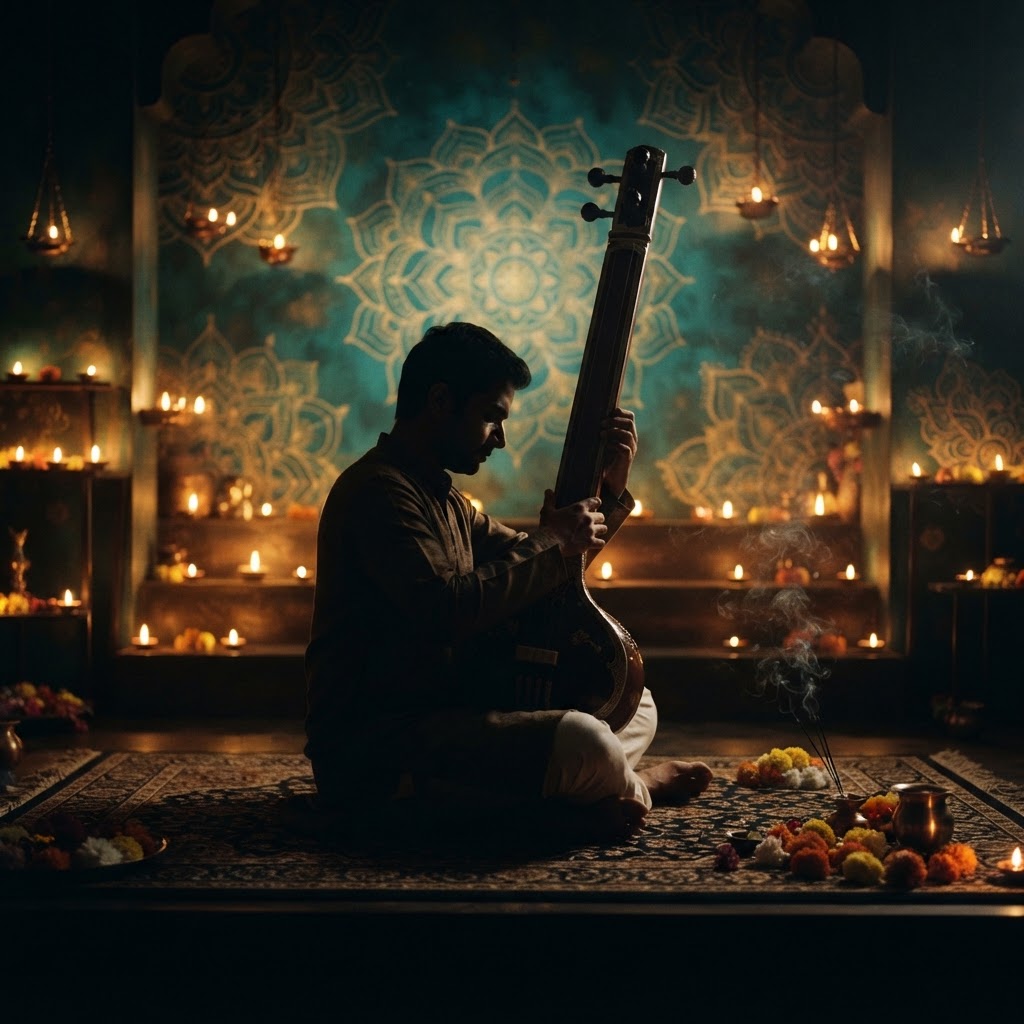
Seven Swaras
Indian classical music uses seven basic tones — Sa, Re, Ga, Ma, Pa, Dha, Ni — analogous to the Western do-re-mi. But unlike the fixed piano, these tones are not locked to absolute pitches. Sa (the tonic) is chosen freely by the musician, and every other tone is measured relative to it. There is no fixed pitch — only relative pitch, carefully tuned by ear.
Raga Explorer
Seven swaras — Sa Re Ga Ma Pa Dha Ni. Sa and Pa are fixed; Re, Ga, Dha, Ni can be lowered (komal), and Ma can be raised (tivra). Each combination is a different raga.
Indian classical music has no fixed absolute pitch — the musician chooses Sa freely and everything relates to it.
Komal and Tivra
Twelve semitones are available, but typically only seven appear in a given raga. The first (Sa) and fifth (Pa) scale degrees are fixed and cannot be altered. The other five can be: Re, Ga, Dha, and Ni can be lowered by a semitone (komal, like a flat), while Ma can be raised by a semitone (tivra, like a sharp). Each combination of alterations produces a different raga — a different tonal framework for composition and improvisation.
Raga Map by Time & Mood
A survey of ragas from the Raga Guide. Each raga belongs to a time of day and evokes a distinct mood — the living scale of Indian classical music.
What Is a Raga?
A raga is more than a scale — it is a tonal framework associated with a particular theme, time of day, and emotional quality. It tells the musician which notes to emphasize, which to avoid, how to approach and depart from each tone, and what mood to evoke. Indian musicians have a profound sense of pitch accuracy, yet there is no absolute pitch and no equal-tempered grid. The microtonal variations — the slides (meend), the ornaments (gamaka) — are not deviations from the scale; they are the scale, carefully shaped by the musician's ear in real time.
Reflect
A raga belongs to a time of day and evokes a mood. If you assigned a raga to this moment in your life, what time would it be — and what would it sound like?