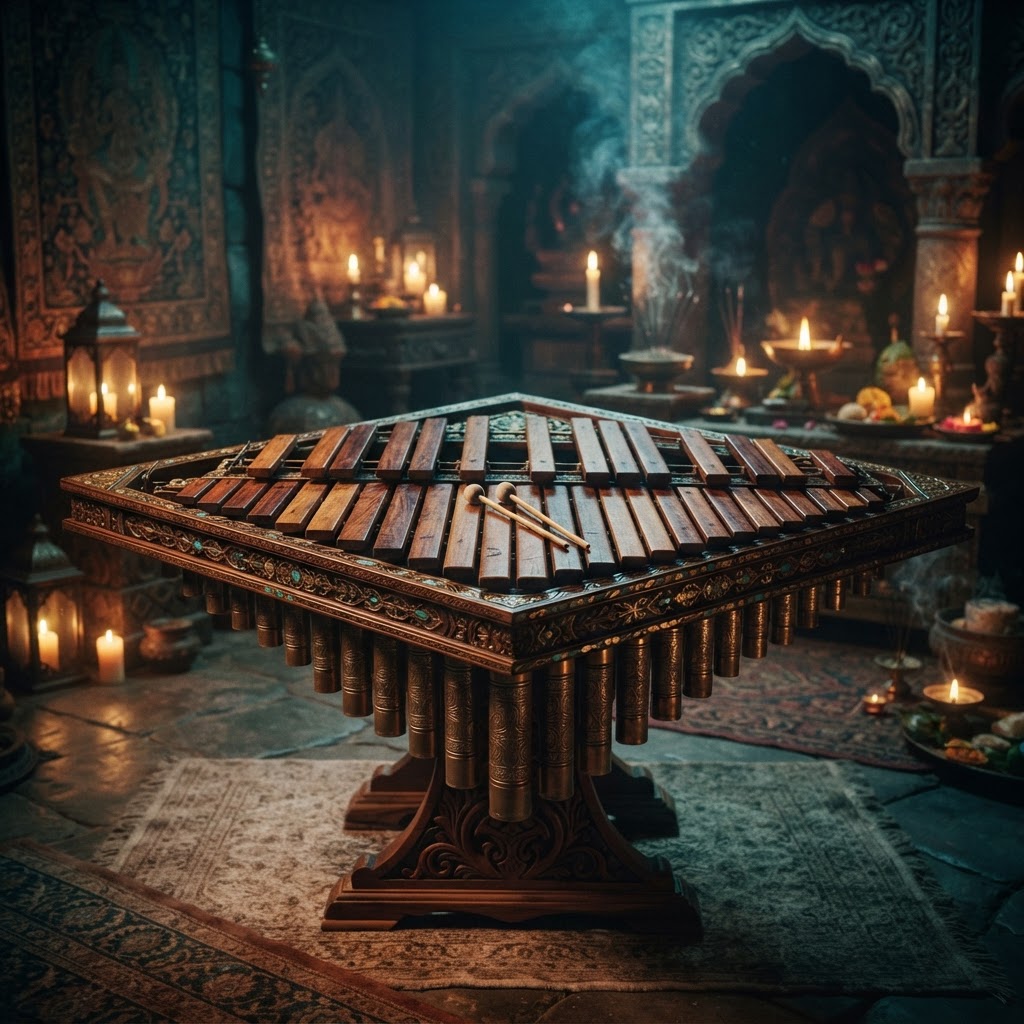
Harry Partch — 43 Tones
American composer Harry Partch (1901–1974) built his entire body of work on a scale of 43 tones per octave, tuned in extended just intonation using the prime factors 2, 3, 5, 7, and 11. Traditional just intonation stops at 5; Partch added 7 and 11, creating intervals no Western ear had heard before. He designed and built his own instruments — the diamond marimba, the chromelodeon — to play in this tuning, because no existing instrument could.
Temperament Explorer
Each system divides the octave differently. Watch the chromatic wheel re-divide and hear how intervals shift.
Twelve equal divisions of the octave: 2^(1/12). Good for every key, perfect for none.
19-TET and Adaptive Tuning
What happens when you divide the octave into 19 equal steps instead of 12? The distinction between timbre and harmony blurs — notes harmonized from different temperaments create "unusual nonharmonic sound textures," as composer William A. Sethares describes. In adaptive tuning, each note's pitch adjusts microtonally as it sounds, maximizing consonance with whatever is already playing — causing glides and microtonal adjustments that feel perceptually natural.
Bohlen-Pierce and the Tritave
The Bohlen-Pierce scale ignores the octave entirely. It repeats every tritave (a ratio of 3:1, an octave plus a fifth) instead, with 13 chromatic tones and 9 main scale notes. Its fundamental chord is the tetrad 3:5:7:9. It's an entirely different musical universe, built on the next harmonic up.
Gamelan — Intentionally Different
Balinese and Javanese gamelan orchestras are tuned to scales that are deliberately "out of tune" by Western standards. The shimmering beating between slightly detuned pairs of instruments is the desired sound — not a flaw. Each gamelan set has its own tuning, and notes cannot be meaningfully compared to the tempered scale.
Reflect
Twelve tones is a choice, not a law. What might music sound like in a culture that never settled on it?