The Modern Compromise
Equal temperament divides the octave into twelve equal multiplicative steps. Each semitone is 2^(1/12) = 1.05946. No interval is perfectly in tune — the fifth is slightly flat, the third slightly sharp — but every key sounds equally good (or equally imperfect). This made rapid key changes possible and led to an entirely new kind of music: symphonic modulation through distant keys, chromatic harmony, and eventually jazz.
Equal Temperament Fretboard
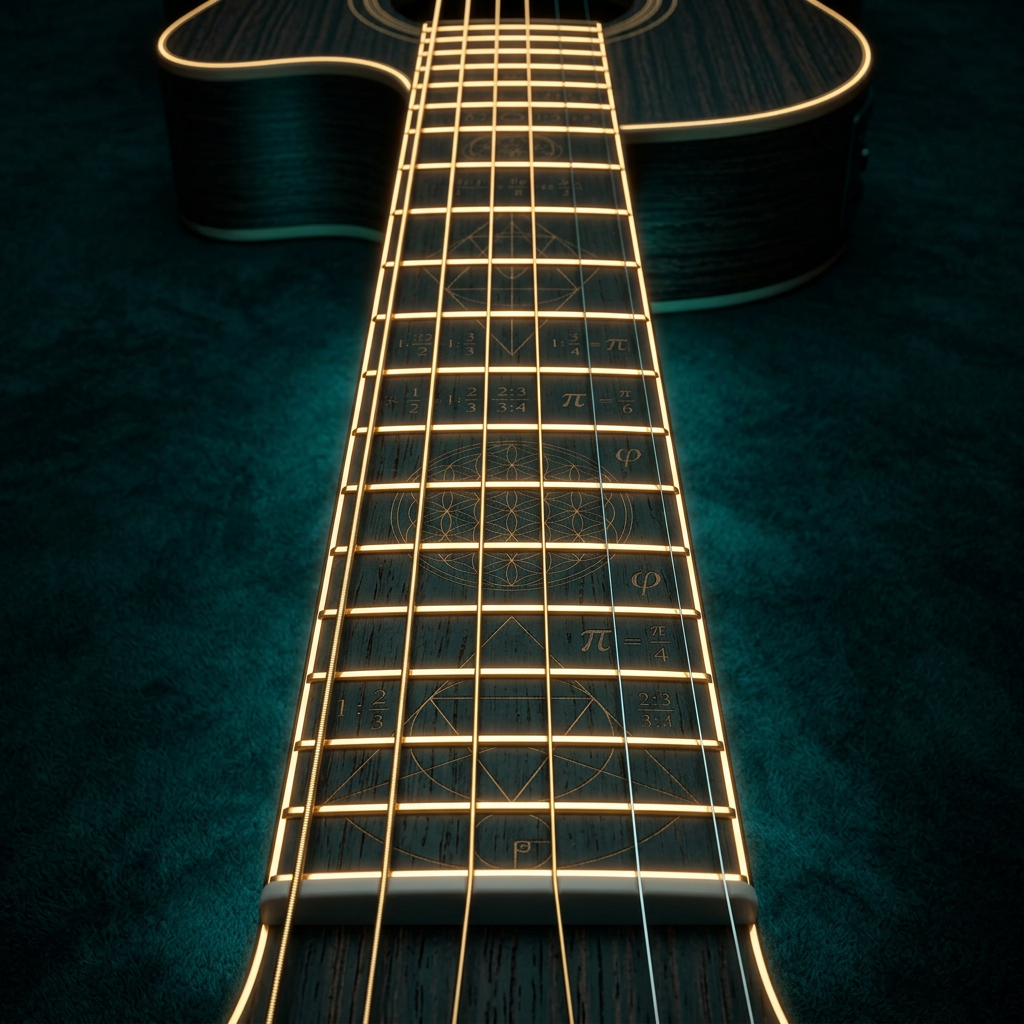
Equal division means frets crowd toward the bridge — each is 1.05946× the last. This is why all keys work on one guitar.
12th fret is exactly at the midpoint — an octave above the open string.
The Twelve Multipliers
Each note is the previous one multiplied by 1.05946. The frets on a guitar crowd together toward the bridge because the distances shrink geometrically, not linearly. A linear spacing (f × (1 + n/12)) sounds terrible and makes no sense in the next octave — only multiplicative (logarithmic) spacing preserves intervals across octaves.
C1.0000
C#1.0595
D1.1225
D#1.1892
E1.2599
F1.3348
F#1.4142
G1.4983
G#1.5874
A1.6818
A#1.7818
B1.8877
Reflect
Equal temperament lets you play in any key but sacrifices the pure ringing of just intonation. Was this the right trade-off for modern music?