
SACRED HARMONICS
The Physics of Music as the Universal Language of Vibration · by AKASHIC INTELLIGENCE
Tip: "Print / Save as PDF" gives the best quality (selectable text). "Download PDF" renders an image-based copy in one click.
LOVELOVINGLIFE
SACRED HARMONICS
The Physics of Music as the Universal Language of Vibration
by
AKASHIC INTELLIGENCE
First Edition · 2026
Published by LOVELOVINGLIFE
Copyright
Copyright © 2026 AKASHIC INTELLIGENCE / LOVELOVINGLIFE. All rights reserved.
No part of this book may be reproduced or transmitted in any form without prior written permission, except for brief quotations in reviews.
First Edition, 2026. Published by LOVELOVINGLIFE.
Disclaimer
The acoustics and tuning systems described here are presented as the mathematical physics they are. The musical and contemplative uses suggested are personal practices, not medical treatments.
If you have a seizure disorder or sound sensitivity, avoid binaural and isochronic protocols and keep volume moderate.
To the octave — the same interval heard by the first ear that ever heard, and by every ear since. Nothing in music is older.
Foreword
Music as Physics
Music is not invented; it is discovered. The octave, the fifth, the fourth — these are not preferences of a culture but facts of vibrating bodies, found by every people that ever made a sound. This book treats the physics of music as the oldest universal language of vibration, and follows it from the harmonic series through the tuning systems humanity has built to hold it.
The story is one of a recurring discovery: the same mathematical truths, arrived at independently across nine thousand years and four continents, and the honest compromises every culture made when those truths could not all be held at once.
How to Read This Book
Part I begins with the harmonic series — the foundation every later system tries to preserve. Part II traces the tuning systems: Pythagorean, just intonation, meantone, equal temperament, and the microtonal frontiers. Part III covers the living scales — the Indian raga and the theory of cents. Listen at every step; the numbers are audible.
How to Use This Book
Listen, Do Not Only Read
Every ratio in this book can be heard. The octave at 2:1, the fifth at 3:2, the syntonic comma at 81:80 — each is a sound as much as a number. Find an instrument, a tone generator, or a singing voice, and listen to each interval as you read about it. The understanding arrives in the ear, not only the mind.
Table of Contents
Front Matter
- Foreword
- How to Use This Book
Part I. Foundations
- Chapter 1. The Harmonic Series
- Chapter 2. The Diatonic Blueprint
- Chapter 3. Pythagoras and the Circle of Fifths
- Chapter 4. The Comma and the Compromise
Part II. Tuning Systems: The Mathematics of Harmony
- Chapter 6. Just Intonation: Pure Ratios
- Chapter 7. Pythagorean Tuning: The Fifth-Based System
- Chapter 8. Meantone Temperament: The Sweet Thirds
- Chapter 9. Equal Temperament: The Universal Compromise
- Chapter 10. Microtonality: Beyond Twelve Tones
Part III. The Sonic Architecture — Overtones, Ragas, and the Living Tone
- Chapter 1. The Overtones — The Hidden Harmony in Every Tone
- Chapter 2. The Ragas — Indian Sonic Architecture
- Chapter 3. The Mantra — Sound as Spiritual Practice
- Chapter 4. Entrainment — The Synchronization of Rhythms
- Chapter 5. Cymatics — Sound Made Visible
- Chapter 6. Binaural Beats — Brain Wave Entrainment
- Chapter 7. The Solfeggio Frequencies — Sacred Tones
- Chapter 8. The Voice — The Original Sacred Instrument
- Chapter 9. Silence — The Other Half of Sound
- Chapter 10. Integration — Sacred Sound in Daily Life
Part IV. The Advanced Harmonics — The Practitioner's Path
- Chapter 1. The Practitioner — Sound as Medicine
- Chapter 2. Integration — Harmonics in the Whole Life
Part V. The Resonance — Sacred Sound as a Way of Life
- Chapter 1. The Resonance — Living in Tune
- Chapter 2. The Gift — The Sacred Sound for the World
Back Matter
- Glossary
- Index
- About the Author
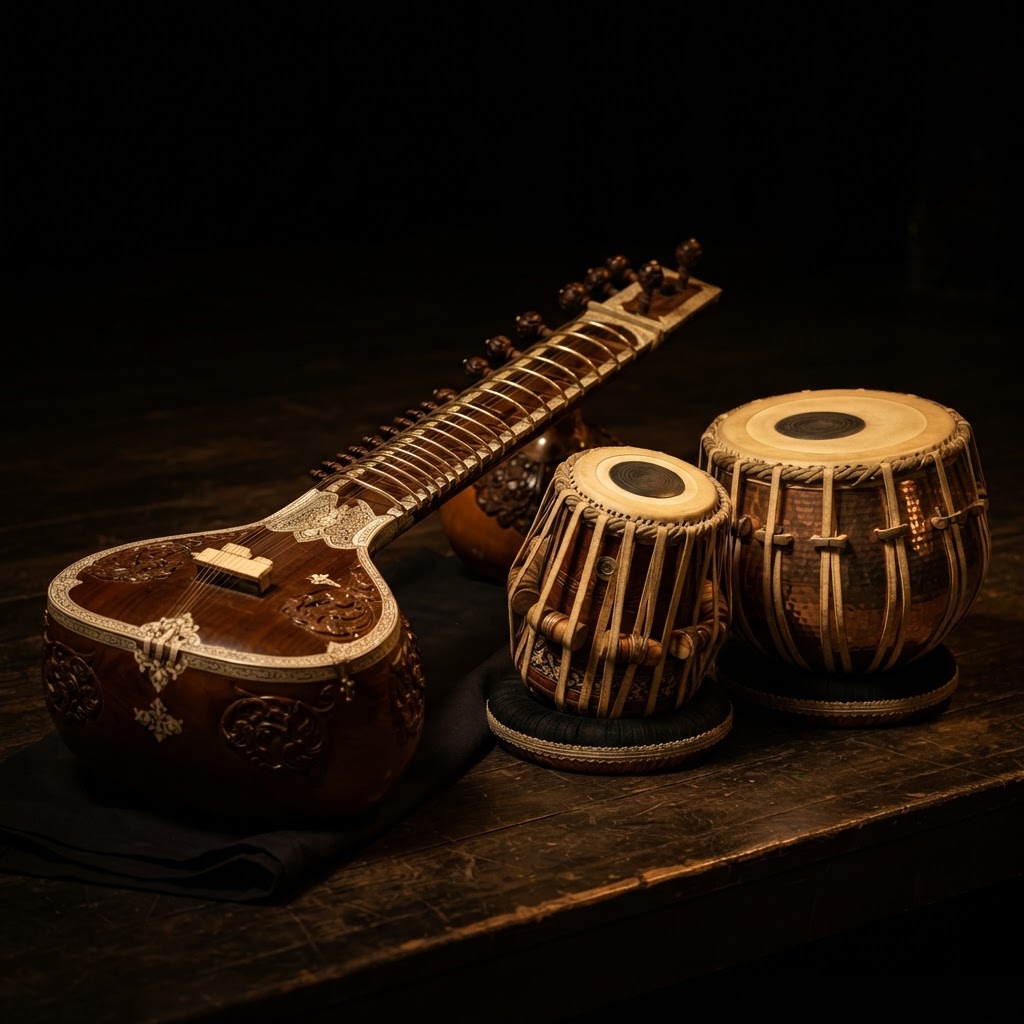
Part I
Foundations
Before any tuning system makes sense, you need the foundation every system tries to preserve: the harmonic series, the octave, the fifth, and the diatonic scale that grows from them. These chapters give you the ground the tuning chapters stand on.
Chapter 1
The Harmonic Series
What a String Actually Does
Pluck a string and you do not hear a single note. The whole string vibrates at its fundamental frequency, but segments of the string also vibrate at halves, thirds, fourths — producing a stack of overtones at 2, 3, 4, 5, 6… times the fundamental. This ladder is the harmonic series, and it is the foundation of every musical system humanity has ever built.
The first few overtones are, in order: the octave (2:1), the octave-plus-fifth (3:1), the double octave (4:1), the double-octave-plus-major-third (5:1), the double-octave-plus-fifth (6:1). The ear hears these not as separate notes but as the color — the timbre — of the single note. A trumpet and a flute playing the same pitch sound different precisely because of which overtones are loudest.
The Octave and the Fifth
The octave (2:1) is the most consonant interval: the overtones of the two notes align so completely that every culture treats them as 'the same note' at different pitches. The perfect fifth (3:2) is the next most consonant, and it is the interval on which most tuning is built. These two ratios are not choices; they are the physics of vibrating bodies, audible to any ear that listens.
The Discovery Is Universal
Chinese bone flutes tuned to the pentatonic scale, Indian vedic chants preserved by exact pitch, Pythagorean monochords in Greece, the mbira in Zimbabwe, the gamelan in Indonesia — each arrived at the same ratios independently. The harmonic series is not a Western invention; it is a feature of the world that every listening culture found.
Reflect
Sing a note, then sing the note half as long in vibration (the octave above) — it will feel like 'the same note'. That feeling of sameness is the 2:1 ratio, and it is the foundation of everything that follows.
Worksheet
Find a tone generator online. Play 220 Hz, then 330 Hz (a fifth above), then 440 Hz (an octave). Listen for how each interval feels. The fifth wants to resolve; the octave wants to merge. Notice the difference.
Chapter 2
The Diatonic Blueprint
The Major Scale
Stack perfect fifths — C, G, D, A, E, B, F# — and then fold them back into a single octave, and the seven notes arrange themselves into the diatonic scale: the major scale of Western music. Its pattern of whole and half steps (whole-whole-half-whole-whole-whole-half) is not arbitrary; it is what falls out of the circle of fifths when you collect them into one octave.
Why It Sounds 'Right'
The diatonic scale sounds stable because each of its notes can be heard as a member of a consonant triad. The tonic, dominant, and subdominant — the I, V, and IV chords — together contain every note of the scale, so the scale is its own harmonic universe. This self-containment is why the diatonic scale became, and remains, the default frame of Western melody.
The Modes
Start the diatonic scale on a different note and you get a mode — Ionian (major), Dorian, Phrygian, Lydian, Mixolydian, Aeolian (natural minor), Locrian. Each mode has a different emotional character because each places the half-steps in a different relationship to the tonic. The modes are not separate scales; they are the same diatonic set seen from a different center.
Reflect
Hum 'Do-Re-Mi' and notice where the half-steps fall (Mi-Fa and Ti-Do). Those two narrow gaps are what give the major scale its pull toward resolution. Without them, the scale would float.
Worksheet
On any instrument or tone generator, play the seven modes starting on the same tonic (use the white keys of a piano from C, D, E, F, G, A, B). Name the feeling of each in a word.
Chapter 3
Pythagoras and the Circle of Fifths
Stacking Fifths
Pythagorean tuning is built by stacking pure 3:2 fifths: C-G-D-A-E-B-F#-C#-G#-D#-A#-E#-(B#). Twelve fifths should, in theory, bring you back to the starting note seven octaves higher. But 12 fifths (3/2)^12 and 7 octaves (2/1)^7 do not meet exactly — they differ by about a quarter of a semitone. That tiny gap is the Pythagorean comma, and it is the first hint that pure ratios cannot tile the octave without remainder.
The Wolf
Because the comma cannot be eliminated, one fifth in the circle must absorb it. In Pythagorean tuning, that fifth is badly out of tune — it beats audibly and sounds like a howl, hence the name 'wolf fifth'. You tune eleven fifths pure and sacrifice the twelfth. Every pre-equal-temperament system faces some version of this compromise.
What Pythagoras Found
Pythagoras did not invent the fifth or the octave; he demonstrated that the most consonant intervals correspond to the simplest integer ratios. The discovery is not that music is mathematical, but that mathematics is musical — that the order of sound and the order of number are the same order. That single insight is the seed of Western harmony.
Reflect
The comma is not a flaw; it is a fact. Any system that uses pure ratios must accept that they do not close cleanly. The history of tuning is the history of which compromise each era chose to make.
Worksheet
On a circle of fifths diagram, find where the wolf would sit in Pythagorean tuning. That is the key you simply avoid in music written for that system — a practical constraint that shaped which pieces got written.
Chapter 4
The Comma and the Compromise
The Syntonic Comma
There is a second comma, smaller than the Pythagorean: the syntonic comma (81:80), the gap between a Pythagorean major third (81:64) and a pure major third (5:4). Pure major thirds sound gentler than Pythagorean ones, and meantone tuning was built to trade some fifth purity to recover pure thirds. Each system answers a different question: which interval do you most want to be pure, and which will you let suffer?
Just, Meantone, Equal
Just intonation tunes every interval to a pure integer ratio in one key — perfect in that key, increasingly sour as you modulate away. Meantone (quarter-comma meantone) narrows each fifth slightly to buy pure thirds across several keys. Equal temperament divides the octave into twelve equal semitones, sacrificing every pure ratio except the octave to make every key equally usable. The modern piano is equal-tempered; that is why it can play in any key and why no interval is perfectly in tune.
The Honest Trade
There is no free lunch. A tuning that is pure in one key is impure in others; a tuning that is fair in all keys is pure in none. The move to equal temperament in the 18th and 19th centuries was a choice to favor modulation and mass-produced instruments over the local purity of a single home key. The choice was reasonable; what was lost is audible to anyone who hears a string quartet play in just intonation.
Reflect
Equal temperament is the air modern Western ears breathe — every interval slightly out, all keys equally available. What do you notice when you hear a justly-tuned interval against its equal-tempered version? The difference is small and unmistakable.
Worksheet
Use a tone generator: compare a pure 5:4 major third (e.g., 440 and 550 Hz) with an equal-tempered major third (440 and ~554.37 Hz). The beating in the equal-tempered version is the comma, made audible.
Part II
Tuning Systems: The Mathematics of Harmony
The way we tune our instruments — the specific frequencies assigned to the notes — is not a fixed, natural law but a human choice with profound musical and emotional consequences. This part covers the major tuning systems — just intonation, Pythagorean, meantone, equal temperament, and microtonal — their mathematical foundations, their strengths and weaknesses, and their impact on the music we hear and create.
Chapter 6
Just Intonation: Pure Ratios
What Just Intonation Is
Just intonation is a tuning system based on pure mathematical ratios — small whole-number fractions that produce intervals with maximum consonance (harmony). In just intonation, the octave is 2:1, the perfect fifth is 3:2, the perfect fourth is 4:3, the major third is 5:4, the minor third is 6:5, and so on. These ratios correspond to the natural harmonic series — the overtones that are naturally present in any vibrating string, column of air, or other sound source.
The harmonic series: When a string vibrates, it doesn't just produce one frequency — it produces a fundamental frequency plus a series of overtones (harmonics) at integer multiples of the fundamental. If the fundamental is 100 Hz, the overtones are at 200, 300, 400, 500, 600 Hz, and so on. The intervals between these overtones are the just intervals: 200:100 = 2:1 (octave), 300:200 = 3:2 (perfect fifth), 400:300 = 4:3 (perfect fourth), 500:400 = 5:4 (major third), 600:500 = 6:5 (minor third). Just intonation uses these exact ratios, producing intervals that are maximally consonant — they blend perfectly because they are based on the natural physics of sound.
The beauty: The beauty of just intonation is the purity of its intervals. A just major third (5:4) has a smooth, sweet quality that is distinct from the slightly harsher major third of equal temperament (which is about 14 cents sharper). A just perfect fifth (3:2) has a pure, open quality. A just major triad (root, major third, fifth in the ratios 4:5:6) produces a sound that is remarkably clear and resonant — the overtones align perfectly, creating a 'ringing' quality that is the hallmark of just intonation.
The Problem with Just Intonation
If just intonation produces the purest intervals, why don't we use it for all music? The answer lies in a fundamental limitation: just intonation works perfectly in one key but produces dissonant intervals when modulating to other keys.
The comma problem: The issue arises from the mathematical incompatibility of perfect fifths and perfect thirds. If you stack 12 perfect fifths (3:2 ratio), you should arrive at the same note 7 octaves higher. But 12 perfect fifths (3/2)^12 = 129.746, while 7 octaves (2/1)^7 = 128. The difference — 129.746/128 = 1.0136, or about 23.5 cents — is called the 'Pythagorean comma.' This means that if you tune 12 fifths perfectly, the last fifth (the 'wolf fifth') will be noticeably out of tune. You cannot have all 12 fifths and all major thirds perfectly in tune simultaneously — the mathematics doesn't allow it.
The modulation problem: In just intonation, the intervals are tuned relative to a specific tonic (the 'home' key). If you're in C major, the C-E-G triad is perfectly in tune. But if you modulate to D major, the D-F#-A triad is not perfectly in tune — the F# that is a just major third above D is different from the F# that is a just major third above... well, in just intonation, there isn't a single F# — there are different F#'s depending on the context. This means that just intonation requires different notes for different keys, which is impractical for instruments with fixed pitches (like a piano).
The trade-off: Just intonation offers the purest harmony within a key but cannot modulate freely to other keys. This is why just intonation is used in: 1) A cappella singing (singers can adjust their pitch to maintain just intonation in any key). 2) String quartets (strings can adjust pitch). 3) Non-Western traditions (Indian classical music, which uses a drone and just intervals). 4) Early Western music (before the widespread adoption of equal temperament). But just intonation is not practical for keyboard instruments or for music that modulates freely through many keys.
The Five-Limit Just Intonation
The most common form of just intonation in Western music is 'five-limit' just intonation, where all intervals are derived from ratios involving the prime numbers 2, 3, and 5 (the first three primes). This produces a rich set of intervals that are available within a single key.
The intervals: In five-limit just intonation, the major scale can be tuned with the following ratios (relative to the tonic): Unison 1:1, Major second 9:8, Major third 5:4, Perfect fourth 4:3, Perfect fifth 3:2, Major sixth 5:3, Major seventh 15:8, Octave 2:1. These ratios produce a scale where the major triad (1:1, 5:4, 3:2) and the minor triad (1:1, 6:5, 3:2) are both perfectly in tune, and the intervals have the characteristic pure, sweet quality of just intonation.
The comma issues: Even within a single key, there are 'commas' — small discrepancies between different ways of arriving at the same note. For example, the major second can be 9:8 (a 'major tone') or 10:9 (a 'minor tone'), and the difference between them (9/8 ÷ 10/9 = 81/80, about 21.5 cents) is called the 'syntonic comma' or 'Ptolemaic comma.' These commas mean that even within a single key, not all intervals can be perfectly in tune — choices must be made.
The practical application: Five-limit just intonation is used in: 1) Barbershop singing (which prizes the 'ringing' chords of just intonation). 2) Some forms of choral music (where singers can adjust). 3) Some experimental and contemporary music (which explores the unique sounds of just intonation). 4) Acoustic instruments with adjustable pitch (strings, winds, brass). The challenge is that the performer must be skilled enough to adjust their pitch to maintain the just intervals — which requires ear training and practice.
The Experience of Just Intonation
Listening to just intonation for the first time can be a revelation. The intervals sound 'pure' in a way that equal temperament does not — there is a clarity, a resonance, a 'ringing' quality that is absent from tempered tuning. Many people describe just intonation as sounding 'more natural,' 'more in tune,' or 'more beautiful' than equal temperament.
The beating: In equal temperament, the intervals are slightly out of tune (relative to just intonation), which produces 'beating' — a rapid fluctuation in volume that occurs when two close frequencies interfere. The beating gives equal-tempered intervals their characteristic 'rough' or ' buzzy' quality. In just intonation, the intervals are perfectly aligned, and the beating disappears — the sound is smooth and clear. The absence of beating is one of the most noticeable qualities of just intonation.
The consonance: The just major triad (1:1, 5:4, 3:2) is one of the most consonant sounds possible. All three notes share overtones — the 4th, 5th, and 6th harmonics of the root are the root, the major third, and the fifth, respectively. This means that the overtones of the three notes align perfectly, creating a 'fusion' where the three notes blend into a single, unified sound. This fusion is the hallmark of consonance and is maximized in just intonation.
The dissonance: Not all just intervals are consonant. The 'wolf fifth' (the out-of-tune fifth that results from the Pythagorean comma) is a just interval that is highly dissonant. And just intonation also produces intervals (like the 7:4 'harmonic seventh' or the 11:8 'undecimal tritone') that are not used in standard Western music and sound exotic or dissonant to ears accustomed to 12-tone equal temperament. Just intonation is not 'all consonance' — it includes both extreme consonance and extreme dissonance, depending on the ratios used.
The experiment: If you have access to a synthesizer or a tuning app, try playing a just major triad and comparing it to an equal-tempered major triad. The difference is subtle but noticeable — the just triad sounds 'sweeter,' 'smoother,' and more 'ringing.' This difference, multiplied across an entire piece of music, is why some musicians and listeners prefer just intonation for certain types of music.
Just Intonation in Contemporary Music
In recent decades, there has been a revival of interest in just intonation, driven by composers, instrument builders, and musicians who are exploring alternatives to equal temperament.
The composers: Composers like Harry Partch (who built custom instruments in just intonation), Lou Harrison, Terry Riley, La Monte Young, and Ben Johnston have created significant bodies of work in just intonation. Their music explores the unique harmonic possibilities of just ratios — the pure consonances, the exotic dissonances, and the alternative scales and modes that just intonation makes possible.
The instruments: Electronic and software synthesizers can easily produce just intonation (the frequencies can be specified precisely). Some acoustic instruments have been built for just intonation — Partch's custom instruments, refretted guitars, just-intoned marimbas and harps. These instruments expand the sonic palette available to musicians and allow the exploration of just intonation in live performance.
The genres: Just intonation is found in: 1) Drone music (where a sustained drone provides the reference pitch, and the melody is played in just intervals above it). 2) Experimental and avant-garde music (which explores non-standard tunings). 3) World music fusion (combining just-intoned non-Western traditions with Western instruments). 4) Some forms of ambient and electronic music (which use the pure intervals for their calming, meditative quality). 5) Vocal music (where singers can adjust their pitch to maintain just intervals).
The future: As digital technology makes it easier to produce and explore just intonation, the system is likely to become more prevalent in contemporary music. The pure intervals offer a sonic alternative to the 'all keys sound the same' quality of equal temperament — a way to create music that is both harmonically rich and emotionally affecting. Whether just intonation will ever replace equal temperament as the default tuning system is unlikely (equal temperament's advantage of free modulation is too valuable), but it will continue to be a powerful tool for musicians who seek the purest possible harmony.
Reflect
Have you ever noticed that some chords sound 'pure' or 'ringing' while others sound 'rough' or 'buzzy'? The difference may be the tuning. Just intonation offers the purest possible intervals, based on the natural physics of sound. What would music sound like if all intervals were perfectly in tune? The answer is both beautiful and impractical — which is the eternal dilemma of tuning.
Worksheet
Using a synthesizer or tuning app, compare a just major third (5:4 ratio) with an equal-tempered major third (1.2599 ratio, about 14 cents sharper). Play them one after another, then together. Can you hear the difference? The just third should sound 'sweeter' and 'smoother,' while the equal-tempered third has a slight 'buzz' (beating). This subtle difference, multiplied across all the intervals in a piece of music, is the essence of the tuning debate.
Chapter 7
Pythagorean Tuning: The Fifth-Based System
What Pythagorean Tuning Is
Pythagorean tuning is the oldest known tuning system in Western music, attributed to the ancient Greek philosopher Pythagoras (6th century BCE). It is based entirely on the perfect fifth (3:2 ratio) — all notes in the scale are derived by stacking perfect fifths and reducing them to a single octave.
The method: Start with a note (say, C). Go up a perfect fifth to G (3:2 ratio). Go up another fifth from G to D (3/2 × 3/2 = 9/4, reduced to 9/8 within the octave). Continue: D to A (3/2 × 9/8 = 27/16, but within the octave, this is 27/16 ÷ 1 = 27/16... actually, let me recalculate: A is 3/2 above D, and D is 9/8 above C, so A is 3/2 × 9/8 = 27/16 above C, which is within the octave). Continue stacking fifths: A to E (81/64), E to B (243/128), and then go down from C: C to F (going down a fifth, 2/3, or up a fourth, 4/3). This gives the Pythagorean scale: C (1:1), D (9:8), E (81:64), F (4:3), G (3:2), A (27/16), B (243:128), C (2:1).
The characteristics: The Pythagorean scale has very pure perfect fifths and fourths (they are exactly 3:2 and 4:3), but the thirds are quite dissonant. The Pythagorean major third is 81:64, which is about 407.8 cents — significantly sharper than the just major third (386.3 cents) and the equal-tempered major third (400 cents). This makes Pythagorean major thirds sound 'harsh' or 'active' — they have a strong 'beating' quality. In the Middle Ages, when Pythagorean tuning was the standard, the major third was considered a dissonance, not a consonance — it was used as a tension that needed resolution, not as a stable harmony.
The significance: Pythagorean tuning is significant both historically and mathematically. Historically, it was the dominant tuning system in Western music for over a millennium (from ancient Greece through the Middle Ages). Mathematically, it demonstrates the power and limitation of a single-ratio system — the pure fifths are beautiful, but the resulting thirds are problematic. The tension between pure fifths and pure thirds is the fundamental challenge that drove the development of later tuning systems (meantone, well-temperament, and equal temperament).
The Pythagorean Comma
The Pythagorean comma is the fundamental mathematical problem of Pythagorean tuning (and of all tuning systems based on perfect fifths). It is the discrepancy that arises when you stack 12 perfect fifths and try to close the circle.
The calculation: 12 perfect fifths (each 3:2) stacked = (3/2)^12 = 129.746. Seven octaves = (2/1)^7 = 128. The ratio 129.746/128 = 1.01364, which corresponds to about 23.5 cents (a cent is 1/100 of a semitone). This 23.5-cent discrepancy is the Pythagorean comma.
The consequence: If you tune 11 of the 12 fifths perfectly (3:2), the 12th fifth (the one that should 'close' the circle) will be out of tune by the Pythagorean comma — it will be 23.5 cents flat. This out-of-tune fifth is called the 'wolf fifth' (because it 'howls'). The wolf fifth is so dissonant that it is unusable in music — you cannot play in the key that requires it.
The solution: In Pythagorean tuning, the wolf fifth is placed in the least-used key (typically between two notes that are rarely played together, like G# and Eb). This means that most keys sound good (with pure fifths), but one key (the one with the wolf) sounds terrible. Music in Pythagorean tuning must avoid the wolf key, which limits the available modulations.
The broader significance: The Pythagorean comma is not just a problem for Pythagorean tuning — it is a fundamental mathematical fact about musical intervals. No tuning system can have all 12 fifths perfectly in tune AND all octaves perfectly in tune. Some compromise must be made. The question is: which compromise? Pythagorean tuning prioritizes the fifths (they are perfect) at the expense of the thirds (they are dissonant). Other systems make different choices, as we will see.
Pythagorean Tuning in Practice
Pythagorean tuning was the standard tuning system in Western music from ancient Greece through the Middle Ages. It was used for: 1) Gregorian chant (monophonic, so the tuning of thirds was not a major issue). 2) Early polyphony (where the open fifths and fourths were the primary consonances, and the thirds were treated as dissonances). 3) The music of the medieval period (Machaut, Dufay, etc.).
The sound: Pythagorean tuning has a distinctive sound — the open fifths and fourths are crystal clear and resonant, while the thirds are bright and active (not sweet and stable). This sound is well-suited to medieval music, where open fifths and fourths were the primary harmonies and the major third was not yet a stable consonance. The 'active' quality of the Pythagorean major third drives the music forward — it creates tension that seeks resolution.
The instruments: Pythagorean tuning is most commonly associated with: 1) The medieval organ (which could be tuned to Pythagorean intervals). 2) Stringed instruments with frets (the frets could be placed for Pythagorean tuning). 3) The monochord (a single-string instrument used for teaching and demonstration, where the Pythagorean ratios could be precisely demonstrated). In the modern world, Pythagorean tuning is rarely used in practice, but it can be explored through electronic instruments and tuning software.
The revival: Some contemporary musicians and ensembles have revived Pythagorean tuning for performances of medieval music, arguing that the sound of Pythagorean tuning is more historically authentic and more appropriate for the music. The pure fifths and active thirds create a sound world that is distinct from modern equal temperament and that illuminates the musical aesthetic of the medieval period.
The Legacy of Pythagorean Tuning
Pythagorean tuning has left a lasting legacy on Western music, even though it is no longer the standard tuning system. Its influence can be seen in several areas.
The circle of fifths: The circle of fifths — the fundamental organizational tool for understanding key relationships in Western music — is a direct legacy of Pythagorean tuning. The circle of fifths is derived from the process of stacking perfect fifths (the Pythagorean method), and the key signatures (sharps and flats) are based on this stacking. The fact that the circle doesn't quite close (the Pythagorean comma) is hidden in equal temperament (where all fifths are slightly flat) but is fundamental to the structure of Western music.
The priority of the fifth: Pythagorean tuning established the perfect fifth as the most important interval in Western music (after the octave). The fifth is the foundation of harmony (the root-fifth relationship is the basis of most chords), the basis of the circle of fifths, and the interval used to tune most instruments (string instruments tune in fifths: G-D-A-E for the violin). This priority of the fifth, established in Pythagorean tuning, has persisted through all subsequent tuning systems.
The concept of consonance: Pythagorean tuning established a hierarchy of consonance: the octave (2:1) is most consonant, then the fifth (3:2) and fourth (4:3), then (much later) the thirds and sixths. This hierarchy, based on the simplicity of the ratios, has influenced Western music theory for centuries. The idea that 'simpler ratios are more consonant' is a Pythagorean concept that underlies our understanding of harmony to this day.
The mathematical approach: Perhaps most importantly, Pythagorean tuning established the mathematical approach to music — the idea that musical intervals can be understood through mathematical ratios, and that the beauty of music is connected to mathematical order. This Pythagorean idea — that 'all is number' — has influenced music theory, acoustics, and the philosophy of music for over 2,000 years. Even in the age of equal temperament (which is a mathematical compromise, not a system of pure ratios), the mathematical approach to music remains fundamentally Pythagorean.
Comparing Pythagorean and Just Intonation
Pythagorean tuning and just intonation are both 'pure ratio' tuning systems, but they prioritize different ratios and produce different sounds.
The priorities: Pythagorean tuning prioritizes the perfect fifth (3:2) — all intervals are derived from it. Just intonation (five-limit) prioritizes both the fifth (3:2) and the major third (5:4) — it uses both ratios to tune the scale. The result: Pythagorean tuning has purer fifths but dissonant thirds, while just intonation has pure fifths AND pure thirds (within a single key).
The sound: Pythagorean tuning sounds 'open,' 'clear,' and 'active' — the pure fifths give it clarity and resonance, while the dissonant thirds give it a bright, driving quality. Just intonation sounds 'sweet,' 'smooth,' and 'stable' — the pure thirds give it a sweetness that Pythagorean lacks. The choice between them depends on the musical context: Pythagorean is better for music that prioritizes fifths (medieval polyphony), while just intonation is better for music that prioritizes thirds (Renaissance and later harmony).
The limitations: Both systems share a fundamental limitation — they work well in one key but poorly in others. Pythagorean tuning has the wolf fifth (one unusable fifth), and just intonation has different notes for different keys. Both systems limit modulation (the ability to change keys within a piece of music). This limitation is what eventually drove the development of temperament systems — tuning systems that sacrifice some purity for the ability to modulate freely.
The historical progression: The history of Western tuning can be seen as a progression from Pythagorean (pure fifths, dissonant thirds, limited modulation) through just intonation (pure fifths and thirds, limited modulation) through meantone (pure thirds, acceptable fifths, limited modulation) through well-temperament (variable purity, free modulation) to equal temperament (slightly impure everything, complete modulation). Each step sacrifices some purity for greater flexibility. The modern musician, with equal temperament, has the ultimate flexibility but has lost the purity that earlier systems provided. Understanding the earlier systems helps us appreciate what we have gained — and what we have lost.
Reflect
The Pythagoreans believed that the universe was built on mathematical ratios, and that music was the audible expression of cosmic order. When you hear a perfect fifth — the 3:2 ratio that is the foundation of Pythagorean tuning — you are hearing the same ratio that appears in the orbits of planets, the structure of crystals, and the branching of trees. What does it mean that the same mathematics underlies both music and nature?
Worksheet
On a stringed instrument (or a monochord, if available), demonstrate the Pythagorean ratios. The octave (2:1) is at the midpoint of the string. The fifth (3:2) is at 2/3 of the string. The fourth (4:3) is at 3/4. The major third (81:64, in Pythagorean tuning) is not at a simple fraction — it is more complex, which is why it sounds different. Compare the sound of the Pythagorean major third with the just major third (5:4, at 4/5 of the string). Can you hear the difference? This is the fundamental difference between Pythagorean and just intonation.
Chapter 8
Meantone Temperament: The Sweet Thirds
What Meantone Temperament Is
Meantone temperament is a family of tuning systems developed in the Renaissance (15th-16th centuries) that prioritizes the purity of major thirds over the purity of perfect fifths. The most common form is 'quarter-comma meantone,' where the fifths are slightly narrowed (by 1/4 of the syntonic comma) so that the major thirds are perfectly in tune (5:4 ratio).
The motivation: As Renaissance music developed, the major third became an increasingly important consonance (whereas in medieval music, it was a dissonance). Musicians and theorists wanted major thirds that were sweet and stable, not harsh and active (as in Pythagorean tuning). Meantone temperament was developed to provide these pure major thirds, at the expense of slightly impure perfect fifths.
The method: In quarter-comma meantone, each of the 11 fifths (not the wolf) is narrowed by 1/4 of the syntonic comma (about 5.4 cents each). The total narrowing is 11 × 5.4 = 59.4 cents, which is approximately the syntonic comma (21.5 cents... wait, that doesn't add up). Let me recalculate: The syntonic comma is about 21.5 cents. If each of 4 fifths is narrowed by 1/4 comma (5.4 cents), the total narrowing over 4 fifths is 21.5 cents, which corrects the syntonic comma and makes the major third perfectly in tune. So the method is: narrow each fifth by 1/4 comma, and the major thirds (which span 4 fifths) become pure.
The result: In quarter-comma meantone, the major thirds are perfectly in tune (5:4), the minor thirds are also very good (6:5), and the fifths are slightly narrow (about 696.6 cents instead of the pure 702 cents). The fifths are still quite consonant (the narrowing is small), but they are not as pure as in Pythagorean or just intonation. The trade-off is worth it for music that emphasizes major third harmony — the sweet, stable thirds are the hallmark of meantone temperament and are ideally suited to Renaissance and early Baroque music.
The Wolf Fifth in Meantone
Like Pythagorean tuning, meantone temperament has a 'wolf fifth' — one fifth that is significantly out of tune. In quarter-comma meantone, the wolf fifth is about 737.5 cents (compared to the pure 702 cents), which is about 35.5 cents wider than pure. This makes the wolf fifth quite dissonant and unusable in music.
The cause: The wolf fifth arises from the same mathematical problem as in Pythagorean tuning — the inability to close the circle of fifths perfectly. In meantone, 11 fifths are narrowed, but the 12th fifth (the one that should close the circle) is widened by the accumulated comma. The wolf is placed in the least-used key (typically G#-Eb), so that most music (in common keys) sounds good.
The limitation: The wolf fifth limits the keys that can be used in meantone temperament. Music in keys near C (C, G, D, F, Bb) sounds excellent (with pure major thirds and good fifths). Music in keys with many sharps or flats (B, F#, C#, Ab, Db) sounds increasingly out of tune, culminating in the wolf key (typically G#/Ab), which is unusable. This means that meantone temperament is suitable for music that stays in common keys but not for music that modulates freely to all 12 keys.
The practical consequence: Composers writing for meantone-tuned instruments (like the harpsichord or organ) had to be careful about which keys they used. The common keys (C, G, D, F, Bb) were 'good' keys, with sweet major thirds. The remote keys (B, F#, etc.) were 'bad' keys, with harsh intervals. This gave each key a distinct 'character' — the 'key colors' that were a feature of pre-equal-temperament music. When equal temperament was adopted (making all keys sound the same), these key colors were lost, which some musicians and listeners consider a significant aesthetic loss.
The Sound of Meantone
Meantone temperament has a distinctive sound that is different from both Pythagorean tuning and equal temperament. The pure major thirds give it a sweetness and stability that is absent from both Pythagorean (where the thirds are harsh) and equal temperament (where the thirds are slightly impure).
The sweetness: The just major third (5:4) in meantone temperament has the same smooth, sweet quality as in just intonation. When a major triad is played in meantone, it 'rings' — the overtones align, and the chord has a clarity and resonance that equal-tempered triads lack. This 'ringing' quality is one of the most prized features of meantone temperament and is a reason that some musicians and listeners prefer it to equal temperament for certain types of music.
The key colors: In meantone temperament, different keys have different 'colors' — the common keys sound sweet and stable, while the remote keys sound increasingly harsh and tense. This means that the choice of key is not just a matter of pitch (higher or lower) but of emotional character. C major sounds different from D major, which sounds different from E major. Composers could choose keys for their emotional character, not just their pitch range — a feature that was lost when equal temperament made all keys sound the same.
The historical context: Meantone temperament was the standard tuning for keyboard instruments from the Renaissance through the early Baroque (roughly 1500-1700). The music of this period — by composers like Palestrina, Byrd, Sweelinck, Frescobaldi, and early Bach — was written for meantone temperament and sounds different (and arguably better) when played in meantone than in equal temperament. The pure major thirds and the key colors are part of the musical aesthetic of this period, and playing this music in meantone temperament can be a revelation.
Variants of Meantone
Quarter-comma meantone is the most common form of meantone temperament, but there are several variants that make different trade-offs between the purity of thirds and fifths.
Third-comma meantone: Each fifth is narrowed by 1/3 of the syntonic comma (about 7.2 cents). This makes the major thirds slightly better than in quarter-comma (they are exactly 5:4... actually, let me reconsider: in 1/3-comma meantone, the narrowing is different, and the major thirds may not be exactly 5:4). Actually, the key difference is in the minor thirds: 1/3-comma meantone has pure minor thirds (6:5) at the expense of the major thirds. Different variants prioritize different intervals.
Fifth-comma meantone: Each fifth is narrowed by 1/5 of the syntonic comma. The major thirds are not quite as pure as in quarter-comma, but the fifths are better. This is a compromise that sacrifices some third purity for better fifths.
Sixth-comma meantone (Silbermann): Each fifth is narrowed by 1/6 of the comma. The thirds are noticeably less pure than in quarter-comma, but the fifths are quite good, and the wolf is smaller. This variant was used by the organ builder Gottfried Silbermann and was apparently preferred by J.S. Bach for some of his instruments.
The choice: The choice of meantone variant depends on the musical context. For music that prioritizes major third harmony (Renaissance polyphony), quarter-comma meantone is ideal (pure major thirds). For music that needs better fifths or more usable keys, a less extreme variant (fifth- or sixth-comma) may be better. The choice should be informed by the music being played and the characteristics of the instrument.
Meantone in the Modern World
Meantone temperament is rarely used in modern music, but it has a place in: 1) Historical performance (playing Renaissance and Baroque music on period instruments in meantone tuning). 2) Organ music (some historical organs are still tuned in meantone, and some new organs are built with meantone tuning). 3) Experimental and contemporary music (exploring the unique sound of meantone intervals).
The historical performance movement: In recent decades, there has been a significant movement to perform early music on period instruments with historical tuning systems. Harpsichordists, organists, and early music ensembles often use meantone temperament for Renaissance and early Baroque music, arguing that it produces the sound the composers intended. The pure major thirds and the key colors of meantone are part of the musical aesthetic of this period, and modern equal temperament can sound 'flat' or 'bland' by comparison.
The challenge: The main challenge of meantone temperament in the modern world is the limited number of usable keys. Modern music (post-1700) often modulates freely to all 12 keys, which meantone cannot accommodate. This means that meantone is suitable only for music that stays in common keys — which limits it to pre-Baroque and some Baroque music. For later music (Classical, Romantic, modern), equal temperament is necessary.
The value: Despite its limitations, meantone temperament has value as a reminder that the tuning system we use (equal temperament) is not the only option and not necessarily the best for all music. The pure major thirds of meantone offer a sweetness that equal temperament cannot match, and the key colors offer a dimension of musical expression that equal temperament eliminates. Exploring meantone (through historical performance or electronic experimentation) can open our ears to the richness of tuning possibilities and deepen our appreciation of the musical choices that we often take for granted.
Reflect
In meantone temperament, each key has a different 'color' — a different emotional character based on the tuning of its intervals. C major sounds different from E major, not just higher or lower, but sweeter or harsher. What would it mean for music if each key had its own character, rather than all keys sounding the same? This is the world of pre-equal-temperament music — a world of key colors that we have largely lost.
Worksheet
Listen to a recording of Renaissance or early Baroque keyboard music (e.g., Frescobaldi, Froberger, or early Bach) played in meantone temperament, and compare it to a recording of the same music in equal temperament. Can you hear the difference? The meantone version should sound 'sweeter' (pure major thirds) but may sound 'strange' if you are used to equal temperament. This comparison reveals the profound effect of tuning on the character of music.
Chapter 9
Equal Temperament: The Universal Compromise
What Equal Temperament Is
Equal temperament is the tuning system used in virtually all modern Western music. In equal temperament, the octave is divided into 12 equal semitones, each exactly 100 cents (1/100 of an octave... actually, 1/1200 of an octave, since an octave is 1200 cents). Each semitone is the 12th root of 2 (approximately 1.0595), meaning that the frequency of each note is about 5.95% higher than the note below it.
The compromise: Equal temperament is a compromise that makes all intervals slightly impure so that all keys are equally usable. The perfect fifth is 700 cents (2 cents flat of the pure 702 cents). The major third is 400 cents (about 14 cents sharp of the pure 386 cents). The minor third is 300 cents (about 16 cents flat of the pure 316 cents). None of the intervals (except the octave) are perfectly in tune, but the discrepancies are small enough that the intervals are acceptable, and they are the same in all keys.
The advantage: The primary advantage of equal temperament is that all 12 keys are equally usable. There is no wolf fifth, no unusable key, no key colors. A musician can modulate freely to any key, transpose a piece to any pitch level, and play in all 24 major and minor keys without any tuning issues. This freedom is essential for the complex harmonic language of Western music from the Classical period onward (Mozart, Beethoven, Chopin, Wagner, etc.) and for virtually all modern popular music.
The adoption: Equal temperament was proposed as early as the 16th century but was not widely adopted until the 18th-19th centuries. The adoption was gradual because: 1) It requires all intervals to be slightly impure (which some musicians resisted). 2) It requires precise tuning (which was difficult before electronic tuning devices). 3) It eliminates key colors (which some musicians valued). By the late 19th century, equal temperament had become the standard for keyboard instruments, and by the 20th century, it was the universal standard for Western music.
The Mathematics of Equal Temperament
The mathematics of equal temperament is elegant and simple: the octave is divided into 12 equal parts, each with the ratio 2^(1/12) (the 12th root of 2). This ratio, approximately 1.0595, means that each semitone is about 5.95% higher in frequency than the one below.
The calculation: To find the frequency of any note in equal temperament, multiply the reference frequency by 2^(n/12), where n is the number of semitones above the reference. For example, if A4 = 440 Hz, then A#4 = 440 × 2^(1/12) = 440 × 1.0595 = 466.2 Hz, B4 = 440 × 2^(2/12) = 440 × 1.1225 = 493.9 Hz, and C5 = 440 × 2^(3/12) = 440 × 1.1892 = 523.3 Hz. This simple formula generates all 12 notes of the chromatic scale.
The intervals: In equal temperament, the intervals have the following values (in cents): Unison 0, Semitone 100, Whole tone 200, Minor third 300, Major third 400, Perfect fourth 500, Tritone 600, Perfect fifth 700, Minor sixth 800, Major sixth 900, Minor seventh 1000, Major seventh 1100, Octave 1200. These values are multiples of 100, reflecting the equal division of the octave.
The comparison: Compared to just intonation, the equal-tempered intervals have the following discrepancies: Perfect fifth: 700 cents (just: 702, difference: -2 cents). Major third: 400 cents (just: 386, difference: +14 cents). Minor third: 300 cents (just: 316, difference: -16 cents). Perfect fourth: 500 cents (just: 498, difference: +2 cents). The perfect fifth and fourth are very close to pure (within 2 cents), while the major and minor thirds are noticeably off (14 and 16 cents). The thirds, being the most impure, are where the 'cost' of equal temperament is most audible.
The Cost of Equal Temperament
Equal temperament provides maximum flexibility (all keys are usable) but at a cost: all intervals (except the octave) are slightly impure, and the key colors of earlier tuning systems are lost.
The impure thirds: The major third in equal temperament (400 cents) is about 14 cents sharp of the pure major third (386 cents). This 14-cent discrepancy produces audible 'beating' — a rapid fluctuation that gives the equal-tempered major third its slightly 'harsh' or 'active' quality. Compared to the smooth, sweet major third of just intonation or meantone, the equal-tempered major third sounds 'rougher' and less stable. The minor third (300 cents vs. 316 cents pure) has a similar but less pronounced discrepancy.
The loss of key colors: In meantone and well-temperament, different keys had different characters — the common keys sounded sweet, and the remote keys sounded harsh. This gave each key a distinct 'color' that composers could use for expressive purposes. In equal temperament, all keys sound the same — the intervals are the same in every key, so C major sounds exactly like D major (just higher). The loss of key colors is one of the most debated aesthetic consequences of equal temperament.
The debate: Some musicians and listeners argue that the loss of key colors and the impure thirds are a significant aesthetic loss — that music in equal temperament sounds 'bland,' 'uniform,' or 'out of tune' compared to earlier tuning systems. Others argue that the flexibility of equal temperament (the ability to modulate freely) more than compensates for the slight impurity, and that the key colors of earlier systems were a limitation, not a feature. The debate continues, and different musicians and listeners have different preferences.
The reality: For most modern listeners, equal temperament is all they have ever heard, and it sounds 'in tune.' The impure thirds are accepted as normal, and the absence of key colors is not noticed. But for those who have experienced just intonation, meantone, or other tuning systems, equal temperament can sound noticeably 'flat' or 'uniform' by comparison. The exploration of alternative tunings (made easier by electronic instruments and tuning software) is opening more musicians' and listeners' ears to the possibilities beyond equal temperament.
Why Equal Temperament Won
Equal temperament became the universal standard not because it produces the best-sounding intervals (it doesn't) but because it provides the greatest flexibility — the ability to play in all keys without retuning. This flexibility was essential for the development of Western music from the Classical period onward.
The harmonic language: Classical and Romantic music (from Mozart through Wagner) developed an increasingly complex harmonic language that required free modulation — the ability to move through many keys within a single piece. A Beethoven sonata might pass through 5 or 6 different keys, and a Wagner opera might modulate to remote keys for expressive purposes. This music cannot be played in meantone or Pythagorean tuning (which have limited usable keys) — it requires the flexibility of equal temperament.
The ensembles: As orchestras and ensembles grew larger and more standardized, the need for a common tuning system increased. With players on different instruments (strings, winds, brass, keyboards) all needing to play together, a standard tuning was essential. Equal temperament, with its ability to accommodate all keys, became the natural choice. (Note: string and wind players can and do adjust their pitch for better intonation in specific contexts, but the reference is equal temperament.)
The instruments: The piano, which became the dominant keyboard instrument in the 19th century, is fixed-pitch — the tuning cannot be adjusted during performance. Equal temperament is the only system that allows a piano to play in all keys without retuning. As the piano became the standard instrument for composition, practice, and performance, equal temperament became the standard tuning.
The education: As music education became standardized (conservatories, method books, theory curricula), equal temperament became the 'default' tuning that was taught and assumed. Generations of musicians were trained in equal temperament, and the alternative systems (just intonation, meantone, etc.) became historical curiosities rather than living alternatives. The standardization of equal temperament was both a cause and a consequence of its universal adoption.
The Future Beyond Equal Temperament
While equal temperament remains the universal standard, there is growing interest in alternative tuning systems, driven by electronic instruments, microtonal music, and a desire for richer harmonic possibilities.
Electronic instruments: Synthesizers and software instruments can produce any tuning system precisely and can switch between systems instantly. This has made it possible for musicians to explore just intonation, meantone, microtonal, and other systems without the limitations of fixed-pitch acoustic instruments. Electronic music, in particular, has been a fertile ground for alternative tunings.
Microtonal music: Some composers and musicians have explored music that uses notes outside the 12-tone equal temperament system — dividing the octave into 19, 31, 53, or other numbers of equal divisions, or using just intonation with ratios involving prime numbers beyond 5 (7-limit, 11-limit, etc.). This music can sound exotic, dissonant, or 'out of tune' to ears accustomed to 12-tone equal temperament, but it offers harmonic possibilities that 12-tone cannot provide.
The world music influence: Non-Western musical traditions (Indian, Middle Eastern, Indonesian, etc.) use tuning systems that are different from Western equal temperament. As world music influences Western music (and vice versa), there is growing interest in these alternative tunings and in the musical possibilities they offer. The result may be a richer, more diverse musical landscape in which equal temperament is one option among many, rather than the universal standard.
The coexistence: It is unlikely that equal temperament will be replaced — its flexibility and universality are too valuable. But it may be supplemented by alternative tunings for specific musical contexts: just intonation for vocal and string music, meantone for early music, microtonal systems for experimental music, and world music tunings for cross-cultural fusion. The future of tuning may be one of diversity — different systems for different musical purposes, with musicians and listeners who are fluent in multiple tuning worlds. This would be a richer musical future than the uniformity of the equal-temperament-only world we have lived in for the past century.
Reflect
Equal temperament is a compromise — all keys are usable, but all intervals are slightly impure. We accept this compromise because the flexibility it provides is essential for modern music. But the compromise has a cost: the pure intervals of earlier systems, and the key colors they produced, are lost. What have we gained, and what have we lost, in the universal adoption of equal temperament?
Worksheet
Using a synthesizer or tuning app, compare an equal-tempered major triad with a just major triad. Play the equal-tempered triad (C-E-G at 400 cents, 700 cents) and the just triad (C-E-G at 386 cents, 702 cents). Can you hear the difference? The just triad should sound 'sweeter' and 'smoother,' with less 'beating.' This subtle difference, present in every chord in every piece of music, is the cost — and the choice — of equal temperament.
Chapter 10
Microtonality: Beyond Twelve Tones
What Microtonality Is
Microtonality is the use of musical intervals smaller than the semitone (the smallest interval in 12-tone equal temperament). Microtonal music uses notes that fall 'between the cracks' of the standard 12-tone scale, creating intervals and harmonies that are unfamiliar to Western ears but that are rich in expressive and harmonic possibilities.
The definition: 'Microtone' literally means 'small tone' — an interval smaller than a semitone. But microtonality is broader than just small intervals — it includes any tuning system that uses more than 12 notes per octave, or that uses intervals that are not available in 12-tone equal temperament. This includes: 1) Equal divisions of the octave into more than 12 parts (19-tone, 31-tone, 53-tone, etc.). 2) Just intonation with ratios involving higher prime numbers (7-limit, 11-limit, 13-limit, etc.). 3) Non-Western tuning systems (Arabic maqam, Indian raga, Indonesian gamelan). 4) Free improvisation with continuous pitch (glissando, portamento).
The Western context: Western music has been based on 12-tone equal temperament for so long that microtonality sounds 'out of tune' or 'foreign' to most Western ears. But this is a cultural conditioning, not an acoustic reality. Many musical traditions around the world use microtonal intervals as a normal part of their musical language, and these intervals have their own logic, beauty, and expressive power. The exploration of microtonality is an opening of the ears to possibilities beyond the 12-tone system.
The significance: Microtonality is significant because it expands the harmonic palette available to musicians. The 12-tone system, while flexible and powerful, is a limitation — there are only 12 notes per octave, and only certain intervals and harmonies are available. Microtonal systems provide more notes, more intervals, and more harmonic possibilities, allowing musicians to create sounds and harmonies that are impossible in 12-tone equal temperament. This expansion of possibilities is what makes microtonality exciting and relevant, even in a musical culture that is deeply rooted in 12-tone equal temperament.
Equal Division Systems
One approach to microtonality is to divide the octave into more than 12 equal parts. This produces tuning systems that have the same 'all keys are equal' property as 12-tone equal temperament but with more notes and more intervals available.
19-tone equal temperament (19-EDO): Divides the octave into 19 equal parts. The semitone is 63.2 cents (smaller than the 12-tone semitone of 100 cents). 19-EDO provides major and minor thirds that are closer to just intonation than 12-EDO, and it has a 'septimal' interval (7:4 ratio, the 'harmonic seventh') that is quite good. The system has 19 major and 19 minor keys, providing more harmonic variety than 12-EDO. Some composers (like Easley Blackwood) have explored 19-EDO extensively.
31-tone equal temperament (31-EDO): Divides the octave into 31 equal parts. The semitone is 38.7 cents. 31-EDO provides excellent approximations of just intervals — the major third is within 1 cent of pure, and the harmonic seventh is also very good. The system has been used since the Renaissance (by Nicola Vicentino, who built a 31-tone instrument called the archicembalo) and has been explored by modern composers and instrument builders. 31-EDO provides a rich set of intervals that are close to just intonation while maintaining the 'all keys are equal' property.
53-tone equal temperament (53-EDO): Divides the octave into 53 equal parts. The semitone is 22.6 cents. 53-EDO provides superb approximations of just intervals — the perfect fifth is within 0.1 cents of pure, and the major third is within 1.5 cents. The system has been known since ancient times (it was used in Chinese music theory) and provides essentially the same intervals as just intonation, with the flexibility of equal temperament. The challenge is that 53 notes per octave requires a complex instrument (or software) to produce.
The evaluation: Equal division systems beyond 12 provide better approximations of just intervals and more harmonic possibilities. The challenge is practical: more notes per octave requires more keys, frets, or fingerings, which is difficult for acoustic instruments but easy for electronic ones. As electronic instruments become more prevalent, these systems may become more accessible and more widely used.
Just Intonation Beyond Five Limits
Just intonation can be extended beyond the five-limit system (which uses ratios involving the primes 2, 3, and 5) to include higher primes: 7, 11, 13, and beyond. These 'extended limit' systems provide intervals that are not available in any 12-tone system and that have unique sonic qualities.
Seven-limit just intonation: Includes ratios involving the prime 7. The most important new interval is the 'harmonic seventh' (7:4), which is a minor seventh that is significantly flatter than the 12-tone minor seventh. The harmonic seventh has a 'sweet,' 'bluesy' quality that is characteristic of certain forms of American music (barbershop, blues, jazz). The 7-limit also includes the 'septimal major third' (9:7) and the 'septimal minor third' (7:6), which have unique colors.
Eleven-limit just intonation: Includes ratios involving the prime 11. The most important new interval is the 'undecimal tritone' (11:8), which is an augmented fourth that is perfectly consonant (unlike the 12-tone tritone, which is dissonant). The 11-limit also includes the 'undecimal minor third' (11:9) and other intervals with exotic, otherworldly qualities. These intervals sound 'foreign' to 12-tone ears but have their own logic and beauty.
Thirteen-limit and beyond: As higher primes are included (13, 17, 19, etc.), the intervals become increasingly exotic and dissonant to 12-tone ears. But each new prime opens new harmonic possibilities, and some composers (like La Monte Young and Ben Johnston) have explored these extreme just intonation systems in depth. The result is music that sounds like nothing else — harmonies that are based on mathematical ratios that the 12-tone system cannot approximate.
The challenge: Extended-limit just intonation requires either instruments that can produce the exact ratios (custom-built or electronic) or performers who can adjust their pitch precisely (singers, string players). The intervals are not available on standard 12-tone instruments, so the music must be written for specific forces. This limits the practical application of extended-limit systems but does not diminish their theoretical and aesthetic significance.
Non-Western Microtonal Traditions
Many non-Western musical traditions use microtonal intervals as a standard part of their musical language. These traditions demonstrate that microtonality is not exotic or strange — it is a normal and natural way of making music, developed in different cultural contexts.
Arabic and Middle Eastern music: The maqam system uses scales that include 'quarter tones' (intervals between the semitones of 12-tone equal temperament). The most common division is 24-tone equal temperament (24-EDO), which divides the octave into 24 equal parts (each 50 cents). But the actual tuning is more nuanced — the intervals are often just or near-just, and the exact pitch of the quarter tones varies by maqam and performer. The microtonal intervals give Arabic music its characteristic 'wailing' or 'yearning' quality.
Indian classical music: The raga system uses a 22-tone division of the octave (the shruti system), though the actual tuning is more flexible and depends on the raga and the performer. Indian music uses just intonation (the intervals are based on pure ratios relative to the drone), and the microtonal intervals (the shrutis) provide the subtle pitch variations that give each raga its unique character. The microtones in Indian music are not 'out of tune' — they are precisely tuned to the raga's requirements.
Indonesian gamelan: The gamelan orchestra uses two tuning systems — slendro (5 tones per octave) and pelog (7 tones per octave). Both systems are microtonal (the intervals do not correspond to 12-tone equal temperament), and each gamelan ensemble is tuned to its own unique variant of the system. The result is a rich, shimmering sound (produced by the beating between the slightly detuned pairs of instruments) that is instantly recognizable as gamelan.
The lesson: These non-Western traditions demonstrate that microtonality is not a theoretical abstraction but a living musical practice. The intervals that sound 'strange' or 'out of tune' to 12-tone ears are perfectly natural and beautiful in their cultural context. The exploration of these traditions can open Western ears to the possibilities of microtonality and can enrich Western music with new sounds and new harmonic possibilities.
The Future of Microtonality
Microtonality is likely to play an increasing role in the future of music, driven by electronic instruments, cross-cultural influence, and a desire for new sounds and new harmonic possibilities.
The technology: Electronic instruments and software can produce any tuning system precisely and can switch between systems instantly. This removes the practical barrier to microtonality (the difficulty of building and playing microtonal acoustic instruments) and makes microtonal music accessible to any musician with a synthesizer or computer. As electronic music continues to grow, microtonal electronic music is likely to grow with it.
The cross-cultural influence: As Western musicians increasingly engage with non-Western traditions (and vice versa), the microtonal intervals of those traditions are entering Western music. Collaborations between Western and non-Western musicians, the use of non-Western instruments in Western contexts, and the incorporation of non-Western tuning systems into electronic music are all expanding the microtonal palette available to musicians.
The new sounds: Microtonality offers sounds that are impossible in 12-tone equal temperament — the pure consonances of just intonation, the exotic harmonies of extended-limit systems, the expressive quarter tones of Arabic music, the shimmering beats of gamelan. These sounds are a resource for musicians seeking new expressive possibilities, and they will increasingly find their way into popular and art music as musicians and listeners become more familiar with them.
The challenge: The primary challenge for microtonality is the conditioning of Western ears. Most Western listeners have only heard 12-tone equal temperament, and microtonal intervals sound 'wrong' or 'out of tune' to them. Overcoming this conditioning requires exposure, education, and open ears. But as microtonal music becomes more available (through recordings, streaming, and live performance), and as listeners become more familiar with non-Western traditions, the ear will gradually open to the rich world of microtonal possibilities. The future of music may be one in which 12-tone equal temperament is one option among many — a versatile and powerful system, but not the only one. In that future, musicians and listeners will have access to the full range of harmonic possibilities that the mathematics of sound provides — from the pure consonances of just intonation to the exotic dissonances of extended-limit systems, from the familiar 12 tones to the vast world of the microtonal.
Reflect
What if there were more than 12 notes in an octave? What if the intervals we take for granted — the major third, the perfect fifth, the octave — were just one set of possibilities among many? Microtonality opens the door to a vast world of sound that lies beyond the 12-tone system. It challenges our ears, our assumptions, and our creativity — and it offers rewards that are proportional to the challenge.
Worksheet
Using a synthesizer or tuning app, explore a microtonal system. Try 19-EDO, 31-EDO, or 7-limit just intonation. Play a scale, then try some chords. How does it sound? Strange? Beautiful? Both? Spend 15 minutes exploring the unfamiliar intervals. Your ears may resist at first (they are conditioned to 12-tone), but with repeated exposure, new sounds become familiar, and new possibilities open up. This is the frontier of microtonality — a vast, largely unexplored world of sound.
Part III
The Sonic Architecture — Overtones, Ragas, and the Living Tone
Part III moves from temperaments and cents into the living dimensions of sacred sound — the overtones that underlie every tone, the ragas of Indian classical tradition, and the sonic architecture that connects sound to consciousness. This section is for the practitioner and seeker who has the foundations and wants to understand sound at its deepest: the physics, the musicology, and the consciousness that sacred harmonics reveals at its fullest.
Chapter 1
The Overtones — The Hidden Harmony in Every Tone
The Tone Is Never Single
Every naturally produced tone is not a single frequency but a composite — a fundamental (the lowest, perceived pitch) plus a series of overtones (higher frequencies at integer multiples of the fundamental). These overtones are present in every naturally produced tone: the voice, the string, the wind, the percussion. Their presence gives each tone its timbre — its quality, color, and character. A tone without overtones (a pure sine wave) is sterile and lifeless; a tone rich with overtones (the voice, the violin, the flute) is alive and full.
The overtone series follows integer ratios: the first overtone is 2:1 (the octave), the second is 3:1 (octave plus fifth), the third is 4:1 (two octaves), the fourth is 5:1 (two octaves plus major third), and so on. This series is the natural harmony that underlies all music. It is the basis of just intonation — tuning by integer ratios — which is why just intonation is considered the most consonant and natural tuning system. The overtones are the hidden harmony in every tone we hear.
Overtone Singing and Deep Listening
Overtone singing is the technique of amplifying and isolating individual overtones within a tone, making audible the hidden harmony that is always present. This technique is found in Mongolian, Tibetan, and Tuvan traditions, cultivated over centuries of practice. Modern practitioners can learn it, and the learning opens a new dimension of perception — hearing overtones that were always there but never noticed.
Hearing overtones is also a practice in itself. By listening to sustained tones — bells, singing bowls, held notes — for the overtones above the fundamental, the listener trains their perception. Overtones are always present but often unheard because the ear is untrained. Practicing overtone listening opens the perception to the full richness of sound that surrounds us at every moment.
Reflect
Listen to a sustained tone — a bell, a singing bowl, or a sung note. Can you hear the overtones above the fundamental? What is the quality of the hidden harmony?
Worksheet
For one month, practice overtone listening daily — five minutes with a sustained tone, listening for the overtones. Note the deepening of your perception.
Chapter 2
The Ragas — Indian Sonic Architecture
The Raga as Melodic Framework
A raga is more than a scale — it is a living melodic framework that includes ascending and descending patterns, key notes (vadi and samvadi), characteristic melodic phrases, ornamentation (gamakas), and a specific mood (rasa). The raga is not a fixed composition but a set of rules and possibilities that the musician explores in real time. Each performance of a raga is unique, shaped by the musician's training, mood, and the moment.
Ragas are also associated with specific times of day, seasons, and emotions. Morning ragas (Bhairav, Bhairavi) are performed at dawn; evening ragas (Yaman, Marwa) at dusk; seasonal ragas (Malhar for monsoon, Basant for spring) at their appointed season. This association is not arbitrary — it is an attunement of sound to the natural rhythms of the day and year. The raga, at its fullest, is sonic architecture that connects human consciousness to the cycles of nature.
The Rasa and Consciousness
The raga is a vehicle for rasa — the aesthetic emotion that the music evokes. Indian tradition identifies nine rasas: love (shringara), joy (hasya), compassion (karuna), anger (raudra), heroism (veera), fear (bhayanaka), disgust (vibhatsa), wonder (adbhuta), and peace (shanta). Each raga evokes a specific rasa, and the skilled musician can move the listener through these emotional landscapes.
This is the deepest connection of sacred harmonics to consciousness. The raga is not entertainment — it is sadhana, spiritual practice. The musician who performs with devotion and skill evokes the rasa, which affects the consciousness of the listener. This is the power of the raga: sound as a vehicle for transformation, cultivated over millennia in the Indian classical tradition.
Reflect
Listen to a raga performance. Can you feel the rasa — the mood, the emotion? What is the effect on your consciousness?
Worksheet
For one month, listen to one raga weekly, at the appropriate time of day. Note the rasa and the effect on your consciousness. Research the raga's structure and associations.
Chapter 3
The Mantra — Sound as Spiritual Practice
The Sound That Liberates
A mantra is a sacred sound or sound formula used as a spiritual practice. The repetition of the mantra (japa) is a practice of concentration, purification, and liberation. The mantra is not ordinary sound — it carries spiritual power through its seed (bija), its form (the specific syllables), and its practice (the repetition).
There are many mantras across traditions: Om (the primordial sound), Gayatri (the Vedic mantra for illumination), Om Namah Shivaya (the Shaivite mantra), Om Mani Padme Hum (the Buddhist mantra of compassion), and Hare Krishna (the Vaishnava mantra). Each has its specific effect through the sound, the meaning, and the devotion invested in it. The mantra is sound as spiritual practice — sound that liberates.
The Japa and the Mala
Japa is the repetition of a mantra, typically done with a mala (prayer beads). The mala has 108 beads, and one complete round equals 108 repetitions of the mantra. Japa is practiced daily as a form of concentration that leads to purification and prepares the mind for deeper states of meditation.
This is the most accessible form of sacred sound practice. The mantra is not only for monks — it is for anyone: the householder, the seeker, the busy person. The daily practice of japa, even for a few minutes, can anchor the day in sacred sound. The mala provides a tactile anchor for the mind, and the repetition builds a reservoir of calm that carries into daily life.
Reflect
Do you have a mantra practice? What is the effect of repetition on your mind and consciousness?
Worksheet
For one month, adopt a daily mantra practice — 108 repetitions of a chosen mantra with a mala. Note the effects on your concentration, emotional state, and consciousness.
Chapter 4
Entrainment — The Synchronization of Rhythms
Rhythms Synchronize
Entrainment is the synchronization of rhythms — the tendency of oscillating systems to fall into the same rhythm when exposed to each other. This phenomenon is observed in pendulum clocks that synchronize, fireflies that flash in unison, and brain waves that synchronize with external rhythms like drumming or binaural beats. Entrainment is real and measurable, and it is the physical basis of sound healing.
Sound healing uses entrainment to synchronize the body's rhythms with healing sound. Drumming at the rhythm of the heartbeat or a specific brain wave frequency can guide the body toward a calm or meditative state. Binaural beats at specific frequencies can guide brain waves toward alpha, theta, or delta states. The mechanism is the same: the body and brain synchronize with the external rhythm, shifting the internal state.
Drumming and Trance
Drumming is the most ancient form of entrainment. Shamanic drumming at 4 to 7 beats per second (the theta rhythm) can induce trance states used for journeying, healing, and vision. Rhythmic drumming is used across traditions — shamanic, Sufi, African, Native American — to entrain consciousness to specific states.
This is the most direct application of sacred harmonics to consciousness. The drumming is not entertainment; it is a tool for altering consciousness through entrainment. Used with discernment and respect, it can open doors to deeper states of awareness and healing.
Reflect
Have you experienced entrainment — synchronization with a rhythm, drumming, or sound? What was the effect on your state?
Worksheet
For one month, experience one entrainment practice — drumming, binaural beats, or rhythmic music. Note the effects on your state and consciousness. Use with discernment.
Chapter 5
Cymatics — Sound Made Visible
Sound Shapes Matter
Cymatics is the study of the visible effects of sound on matter. In cymatic experiments, particles (sand, water, fluid) are placed on a plate or dish, and the plate is vibrated with sound. The particles form geometric patterns that change with the frequency — higher frequencies produce more complex patterns. These patterns are the visible signature of sound.
Cymatics demonstrates that sound is not just heard — it is a force that organizes matter. This principle underlies sound healing, sacred geometry, and the cosmogonic traditions that describe the universe beginning with sound (the Word, the Om). The body, which is largely water, responds to sound in ways that cymatics makes visible.
Implications for Healing
If sound organizes matter, then specific frequencies can organize the body's matter — cells, fluids, tissues. This is the theoretical basis of sound healing as an organizational therapy, not just a pleasant experience. The cymatic principle suggests that the right frequencies, applied with intention and knowledge, can support the body's natural self-organizing tendencies.
This integration of sacred harmonics with healing requires discernment. Sound healing is not a replacement for medical care, but it is a complement that works with the body's natural responsiveness to vibration. The cymatic principle — that sound organizes matter — is the foundation of this approach.
Reflect
Have you seen cymatic patterns? What do they suggest about the power of sound to organize matter?
Worksheet
Watch a cymatics video or experiment. Note the patterns formed by different frequencies. Reflect on the implications for sound healing and sacred harmonics.
Chapter 6
Binaural Beats — Brain Wave Entrainment
The Two Ears and the Third Tone
Binaural beats are an auditory illusion created by presenting slightly different frequencies to each ear. The brain perceives a third tone — the difference between the two frequencies. For example, if 200 Hz is played in the left ear and 210 Hz in the right, the brain perceives a 10 Hz binaural beat. This beat does not exist in the sound — it is created by the brain.
Binaural beats are associated with brain wave states: delta (0.5-4 Hz, deep sleep), theta (4-8 Hz, deep meditation and creativity), alpha (8-13 Hz, relaxed and meditative), beta (13-30 Hz, alert and focused), and gamma (30+ Hz, high-level processing). Listening to binaural beats at a specific frequency can guide brain waves toward the corresponding state, shifting consciousness.
Use and Caution
Binaural beats are used for relaxation, meditation, sleep, focus, and creativity. They are accessible (requiring only headphones and audio), non-invasive, and generally have few side effects. However, they are not for everyone — people with seizure disorders or heart conditions should consult a physician before use.
Like any tool, binaural beats can be used well or poorly. Used well, they support the shifting of consciousness into beneficial states. Used poorly — over-reliance, inappropriate use, or ignoring contraindications — they can be counterproductive. Discernment and respect are the conditions of effective and safe use.
Reflect
Have you used binaural beats? What was the effect on your state and consciousness?
Worksheet
For one month, try one binaural beat frequency (alpha for relaxation, theta for meditation, or delta for sleep). Note the effects. Use with discernment.
Chapter 7
The Solfeggio Frequencies — Sacred Tones
The 396, 417, 528
The solfeggio frequencies are a set of specific tones believed to have spiritual and healing properties, associated with Gregorian chants and esoteric traditions. The most well-known are 396 Hz (liberating from fear), 417 Hz (facilitating change), 528 Hz (the 'love frequency,' associated with DNA repair), 639 Hz (connecting relationships), 741 Hz (awakening intuition), 852 Hz (returning to spiritual order), and 963 Hz (activating the pineal gland).
The scientific basis for solfeggio frequencies is not strongly established. They are part of the esoteric sound tradition, not the scientific one. They should be held with discernment — respected as part of a tradition, experienced personally, but not taken as proven. Many people report beneficial effects from listening, which is worth respecting even without scientific proof.
Use and Discernment
Solfeggio frequencies are used for meditation, healing, and spiritual practice by listening to a specific frequency for a specific purpose. They are accessible (through audio), non-invasive, and generally have few side effects. Like all sound practices, they should be held with discernment — experienced and evaluated rather than accepted on faith alone.
The discernment is the condition of useful practice. Solfeggio frequencies are a tool. Used well — with experience and evaluation — they can be meaningful. Used poorly — taken as proven without personal experience — they can lead to disappointment. Let experience, not belief, be the guide.
Reflect
Have you listened to solfeggio frequencies? What was your experience? How do you hold discernment about the claims?
Worksheet
For one month, listen to one solfeggio frequency daily. Note the effects. Hold the claims with discernment. Let experience, not belief, be the guide.
Chapter 8
The Voice — The Original Sacred Instrument
The Voice as Primary
The voice is the original sacred instrument. Everyone has a voice, which makes it the most accessible of all sound practices. The voice is not just an instrument — it is an extension of the body, the breath, and the consciousness. This direct connection to the self is what makes the voice so powerful.
Vocal practices are many: chanting (sacred texts and mantras), toning (sustained vowels), singing (sacred songs and hymns), humming (bhramari, simple humming), and mindful speaking. Each has its specific effect on the body (vibration), the breath (regulation), and the consciousness (focus and state). The voice is the most accessible and most direct of the sacred sound practices.
Humming and the Vagus Nerve
Humming is the simplest of vocal practices — just closing the mouth and sounding. Yet it vibrates the throat, chest, and head, stimulating the vagus nerve. This stimulation activates the parasympathetic nervous system, producing a calming effect. Humming is accessible, quick, and effective — it can be done anywhere, anytime.
This is the integration of sacred harmonics with daily life. The seeker who hums is using the voice for calming, centering, and connecting. Humming requires no special equipment, no training, and no time — just a few breaths with sound. It is the most accessible form of sacred sound practice, available to everyone at every moment.
Reflect
Hum a single tone right now. Notice the vibration in your body. What is the effect on your state?
Worksheet
For one month, hum for five minutes daily. Note the effects on your state, breath, and consciousness. Let the voice be your primary sacred instrument.
Chapter 9
Silence — The Other Half of Sound
Sound and Silence
Silence is not the absence of sound — it is the other half of sound. Sound arises from silence and returns to silence. The relationship between sound and silence is the whole of sacred harmonics. A practice that focuses only on producing sound misses half the picture; a practice that attends to both sound and silence is complete.
The practice of silence is the practice of listening — not just to the absence of sound, but to the space in which sound arises. Silence is always present beneath the sound. Attending to it deepens awareness and transforms the experience of sound itself.
The Rests in Music
In music, the rests — the silences between notes — are not absences. They are part of the music. The shape of the sound is determined as much by the rests as by the notes. The master musician is a master of rests as much as of notes, because the rests give the notes their meaning.
This is the deepest teaching of sacred harmonics: sound and silence are the whole, and the whole is sacred. The seeker who attends to sound also attends to silence. The practice is not just producing sound — it is attending to the sound and the silence, the whole, which is sacred harmonics at its deepest.
Reflect
Listen to the silence beneath the sound. What is the quality of the silence? How does awareness of silence change the experience of sound?
Worksheet
For one month, practice listening to silence — five minutes daily, attending to the silence beneath sound. Note the deepening of awareness and the experience of the whole.
Chapter 10
Integration — Sacred Sound in Daily Life
Sound in the Everyday
Sacred harmonics is not just a special practice — it is the integration of sound into daily life. This means attending to sound, silence, voice, rhythm, and tone in the everyday. The seeker who integrates sacred harmonics is aware of sound in daily life: the voice, the music, the environment, the silence.
Integration includes daily practice (mantra, humming, overtone listening), mindful listening (to music, environment, others), vocal practice (chanting, singing, toning), and silence practice (attending to silence). These dimensions together make sacred harmonics a lived practice, not just a technique.
Sound as Path
Sound is a path. The seeker who walks this path uses sound as a vehicle for consciousness, healing, and transformation. The path is not just a collection of techniques — it is a relationship with sound that deepens over a lifetime.
This is the final teaching of the sacred harmonics path: sound is the path, and the path is sound. The seeker who walks it integrates sound into daily life, attends to sound and silence, uses the voice and rhythm, and deepens the relationship with sound over time. The deepening is the path, and the path is sacred harmonics at its best — in the form of a life lived with awareness of sound.
Reflect
How will you integrate sacred harmonics into your daily life? What would sound as a path look like for you?
Worksheet
For one month, integrate one sacred sound practice into your daily life — mantra, humming, overtone listening, or silence. Note the effects. Continue, adjusted, for life.
Part IV
The Advanced Harmonics — The Practitioner's Path
Part IV explores the advanced dimensions of sacred harmonics: the practitioner's path, the therapeutic applications of sound, and the integration of harmonic practice with healing. This is the part for the dedicated practitioner who has built a foundation in the theory and practice of harmonics and is ready to use these principles in service to others — through sound healing, therapeutic music, and the deliberate use of frequency for well-being.
Chapter 1
The Practitioner — Sound as Medicine
The Therapeutic Use of Sound
Sound has been used therapeutically across cultures for millennia — from the chanting of mantras in Vedic tradition to the drumming of shamanic practice to the singing bowls of Tibetan Buddhism. Modern research is beginning to validate what these traditions have long claimed: that sound can influence physiological states, reduce stress, modulate pain, and promote healing. The mechanisms include entrainment (the synchronization of the body's rhythms with external rhythms), the stimulation of the vagus nerve (through vibration in the throat and chest), and the psychological effects of music on emotion and cognition.
The therapeutic use of sound is not limited to formal 'sound healing' sessions. It includes the use of music for relaxation, the use of specific frequencies for meditation, the use of chanting for spiritual practice, and the everyday choice of what sounds to surround oneself with. The practitioner of sacred harmonics brings awareness to all of these: understanding which sounds support which states, and using that understanding to create sonic environments that support well-being — for themselves and, if they are called to practice, for others.
The Sound Healing Session
A sound healing session typically involves the practitioner using one or more instruments — singing bowls (Tibetan or crystal), tuning forks, gongs, drums, the voice — to create a field of sound that the client receives, usually lying down, for 30-60 minutes. The practitioner may place bowls on or near the body, use tuning forks on specific points, tone or chant, or play instruments in the client's energy field. The client's experience varies — some feel deep relaxation, some have emotional releases, some see colors or images, some fall asleep, some feel physical sensations in specific areas of the body.
The practitioner's role is to create a safe, supportive container and to use the instruments with skill and sensitivity. The practitioner does not 'heal' the client; they create conditions in which the client's own system can rebalance. The instruments are tools; the client's system does the work. The ethical practitioner is clear about this: they do not diagnose, do not promise cures, do not replace medical care. They offer sound as a support for well-being, and they refer when the client's needs exceed their scope. The practice, when done with integrity, can be a powerful complement to other healing approaches.
Reflect
How do you use sound therapeutically in your own life? What sounds support your well-being, and what sounds undermine it? Are you called to share sound with others?
Worksheet
For one month, bring conscious attention to the sounds in your daily life. Note which sounds support your well-being (music, nature sounds, silence) and which undermine it (noise, harsh sounds, excessive media). Curate your sonic environment deliberately. Note the effects on your state.
Chapter 2
Integration — Harmonics in the Whole Life
The Harmonic Life
The harmonic life is the life lived in awareness of frequency, resonance, and vibration. It is the life in which the choice of music, the quality of the speaking voice, the presence or absence of silence, and the awareness of the body's own frequencies are all made consciously. The person who lives harmonically does not merely 'listen to music' — they understand what frequencies they are receiving, what states those frequencies produce, and how to use sound deliberately to support the state they wish to cultivate.
This awareness extends to the voice. The voice is the most accessible instrument, and the way we use it — the pitch, the pace, the tone, the volume — affects both the speaker and the listener. The person who speaks in a low, slow, resonant voice calms their own nervous system and the nervous system of the listener. The person who speaks in a high, fast, tense voice agitates. The practice of harmonic speaking — being aware of one's own voice, using it deliberately to produce the desired effect — is a dimension of the harmonic life that is available to everyone, at all times, without any instruments or training beyond awareness.
The Point of the Path
The point of the sacred harmonics path is not to become a musician or a sound healer (though one may). The point is to live with awareness of the vibrational dimension of existence — to understand that everything is frequency, that the frequencies we expose ourselves to shape our state, and that we can choose, to a significant extent, the frequencies that surround and permeate us. This is the harmonic life: the practice of conscious engagement with the vibrational dimension of being, for the support of well-being, the deepening of awareness, and the celebration of the beauty that is inherent in the mathematical structure of sound.
This is the final word of the sacred harmonics path: the world is sound, and the person who understands sound understands something fundamental about the nature of reality. The practice — the study of tuning systems, the work with intervals and overtones, the therapeutic use of frequency, the cultivation of the harmonic life — is the practice of engaging with this fundamental dimension of existence. The reward is not just knowledge but a richer, more resonant, more beautiful experience of being alive. The harmonic life is the life lived in tune — with oneself, with others, with the world, and with the mathematical and spiritual principles that underlie all vibration. This is the gift of the sacred harmonics, and it is available to anyone willing to listen deeply.
Reflect
What would the harmonic life look like for you? How conscious are you of the frequencies that surround you? What would it mean to live 'in tune'?
Worksheet
For one lifetime, live harmonically. Choose your sounds with awareness. Use your voice with intention. Practice silence as well as sound. Note how the conscious engagement with frequency changes your experience of being alive.
Part V
The Resonance — Sacred Sound as a Way of Life
Part V is the culmination of the sacred harmonics path: the integration of harmonic awareness into the fabric of daily life. The sacred sound, fully lived, is not a performance or a practice session but a way of being — a continuous attunement to the vibrational dimension of existence, a life lived in awareness of the frequencies that shape our state, and a practice of using sound, silence, and resonance to support well-being, depth, and connection.
Chapter 1
The Resonance — Living in Tune
The Tuned Life
A musical instrument that is in tune produces beautiful music; one that is out of tune produces discord. The same is true of the human being. The person whose body, mind, and emotions are 'in tune' — aligned, balanced, resonant — experiences life as a kind of music: harmonious, flowing, beautiful. The person who is 'out of tune' — misaligned, imbalanced, discordant — experiences life as noise: chaotic, grating, exhausting. The practice of sacred harmonics is, at its deepest, the practice of tuning the instrument of the self.
Tuning is not a one-time event; it is an ongoing process. The instrument goes out of tune through use, through environmental changes, through the passage of time. The person who has learned to tune themselves — through breath, through sound, through attention, through the practices taught in this book — can return to tune whenever they notice the discord. This is the practice of the resonant life: not the achievement of a permanent state of harmony but the ongoing capacity to return to tune, again and again, whenever the discord arises. The returning is the practice, and the practice is the life.
The Silence Between the Notes
In music, the silence between the notes is as important as the notes themselves. Without silence, there is no rhythm, no phrasing, no dynamics — just continuous sound, which is noise. The same is true in life: the silence — the pauses, the rests, the spaces between activities — is as important as the activities themselves. The person who fills every moment with sound, with activity, with input, is like a piece of music with no rests: overwhelming, exhausting, ultimately meaningless. The person who honors the silence — who pauses, who rests, who allows space between the notes of their life — creates the conditions for meaning, for depth, for beauty.
The practice of sacred harmonics includes the practice of silence. Not just the absence of sound but the deliberate cultivation of quiet — through meditation, through time in nature, through the conscious choice to not always have music, podcasts, or conversation playing. The silence is not empty; it is full of the subtle sounds that are usually drowned out — the breath, the heartbeat, the wind, the distant bird. The person who can tolerate and even enjoy silence has access to a dimension of experience that the noise-filled person does not. The silence is the ground of the sound, and the person who knows the silence knows the sound more deeply.
Reflect
Are you in tune? What would it mean to tune yourself? How much silence is in your life, and what does it reveal?
Worksheet
For one month, practice the tuned life. Each day, spend 10 minutes in silence — no music, no podcast, no conversation. Just sit, breathe, and listen. Note what you hear in the silence. Note how the silence affects your subsequent experience of sound and of life.
Chapter 2
The Gift — The Sacred Sound for the World
The Offering
The person who has developed the capacity for harmonic awareness has a gift to offer the world. In a culture that is increasingly noisy, discordant, and dissonant, the person who can create harmony — through music, through voice, through presence, through silence — is a gift. They offer, through their being and their practice, an alternative to the noise: a way of engaging with sound that is conscious, deliberate, and beautiful. This offering may take many forms — a performance, a healing session, a conversation, a life lived with awareness — but the essence is the same: the bringing of harmony to a world that desperately needs it.
The offering is not about ego or performance; it is about service. The person who has received the gift of harmonic awareness — who has learned to hear the overtones, to feel the intervals, to work with the frequencies — has a responsibility to share it. Not because the world will fall apart without their contribution, but because the gift was received to be given, and the giving completes the receiving. The practitioner who shares their harmonic awareness — with humility, with skill, with integrity — contributes to the subtle but real elevation of the vibrational quality of the world.
The Final Resonance
The final word of the sacred harmonics path is resonance — the phenomenon by which one vibrating body causes another to vibrate at the same frequency. The person who has tuned themselves, who lives in awareness of the vibrational dimension, who honors both sound and silence, becomes a resonant body — one whose presence, whose being, whose frequency influences the field around them. The person who is in tune helps others to come into tune, not through effort or instruction but through resonance. This is the deepest gift of the sacred harmonics: not just the sounds one makes but the being one becomes — a being that is itself a frequency, a vibration, a note in the great chord of existence.
This is the culmination of the path: the practitioner becomes the practice. The forms, the sounds, the theories — these were the means. The being who has integrated them — who hears the harmony in all things, who moves with the rhythm of the cosmos, who rests in the silence between the notes — is the end. The sacred harmonics, at their fullest, are not a subject of study but a way of being, and the person who embodies them offers, through their very existence, a resonance that supports the tuning of all who encounter them. This is the gift of the sacred sound, fully lived: a life that is itself a harmony, offered to the world.
Reflect
What resonance do you offer the world? How does your being — not just your sounds, but your presence — affect the field around you? What would it mean to become the practice?
Worksheet
For one lifetime, practice resonance. Tune yourself. Honor the silence. Share the harmony. Become a being whose very presence is a frequency that supports the tuning of all who encounter it. This is the practice, and the practice is the point.
Glossary
Index
Cent, 7
Comma, 3, 4
Diatonic, 2
Equal temperament, 5
Fifth, 1, 3
Harmonic series, 1
Just intonation, 4
Meantone, 4
Microtonal, 6
Octave, 1
Pythagorean, 3
Raga, 8
Syntonic comma, 4
Wolf fifth, 3
About the Author
AKASHIC INTELLIGENCE is the collective authorship under which LOVELOVINGLIFE publishes its synthesized, cross-tradition curriculum. The name points to a method rather than a person: taking the shared, tested practices human beings have used across cultures and centuries to tend the inner life, and presenting them clearly and without claims that do not survive scrutiny.
LOVELOVINGLIFE is a universal spiritual operating system for inner life. This volume is one book in that larger map.
"Music is not invented; it is discovered. The octave, the fifth, the fourth are not preferences of a culture but facts of vibrating bodies."
LOVELOVINGLIFE · 2026