The Source Code
Music, Geometry & Mathematics — how 2, 3, and 5 build the world. All content is closed-loop mathematical data; no generative AI text or voice.
The primes 2, 3, and 5 build the world
The octave, the polygon, the solid, and the Gods — one source code
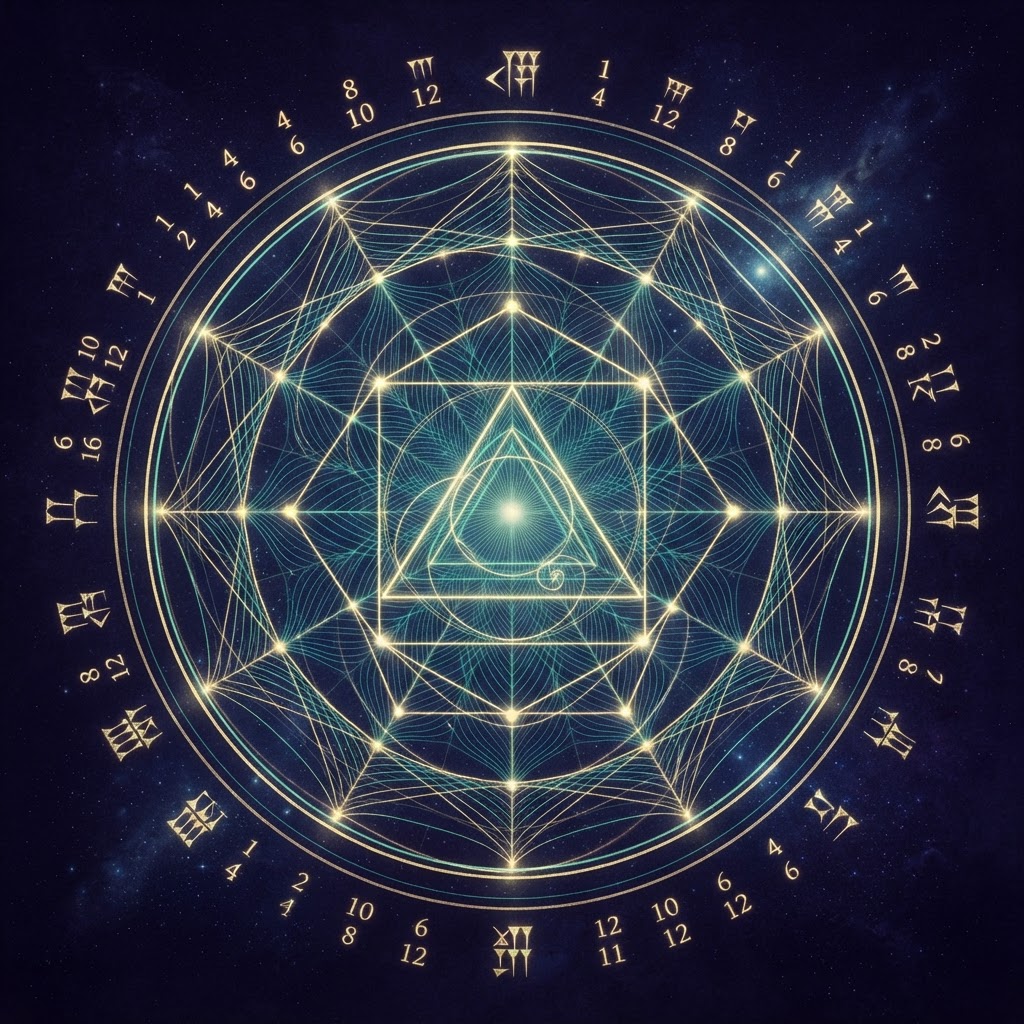
Platonic Resonator · Infinite Cycle
The 5 solids rotate, each sounding its regular-number chord, forever
The Thread
A regular number is a number whose only prime divisors are 2, 3, and 5. These numbers are the ratios behind the smoothest musical intervals, the sides of the polygons that divide a circle and a sphere evenly, and the measures the Sumerians and Babylonians chose for time and the heavens. Once you notice that one arithmetic underlies sound, shape, and cosmology, the world begins to rhyme with itself.
Interactive Source Code
Harmonic → Polygon Mapper
Each harmonic of a resonant drop forms a polygon with that many sides — 1 circle, 2 oval, 3 triangle… Hear the interval, see the shape.
Harmonic 5 = hexagon
Why this: Harmonic 5: the hexagon. The cymatic drop divides into 5 equal parts at the 5/1 interval — a regular number, so this shape divides the circle evenly and sounds consonant.
Regular Number Explorer
5-smooth numbers (only 2, 3, 5 as prime factors). Click to hear as Hz. Gold = divides 60, teal = divides 360.
Why this: 24 = 2^3 × 3. It is a regular number (only 2, 3, 5). As a divisor of 360 it divides the circle evenly.
Platonic Solid Vibrator
The only ways to evenly divide a sphere — the 5-limit geometry. Plato assigned each an element.
Icosahedron
Element: Water
Faces: 20 (triangles)
Vertices (nodes): 12
Why this: Icosahedron has 20 triangle faces in a regular-number count. Only triangle, square, and pentagon faces — the 3-4-5 major chord — can divide a sphere, and only in regular-number amounts. Plato's element assignment (Water) is the ancient reading of these five limits of spherical space.
Deity-Number Chord
The Babylonian pantheon by number. The top three (40-50-60) form a major chord — the 5-limit source. Toggle deities to build your chord.
Why this: Every deity here carries a regular number. The top three (Enki 40, Enlil 50, Anu 60) are not divisors of 60 — they stand above the younger pantheon — and together they form a 4-5-6 major chord: the same 2-3-5 chord that builds the 5-limit scale, the Platonic solids, and the regular numbers. The Gods, the book argues, carry the construction kit of the world.
The Levitated Drop — Original Research
Related Reading
The Full Book
Read the whole source code
Sacred Harmonics
The companion tuning book
Sacred Geometry
The shapes themselves
Sacred Sound
The sound engine
A note on sources: The mathematics here — ratios, regular numbers, polygon and solid geometry, and the Babylonian base-60 and deity-number systems — are fixed, verifiable data. The companion visuals are generated at runtime (SVG, Canvas, Three.js, WebAudio). No generative AI authors the text or the voice; read-aloud uses your browser's speech synthesis.