
THE SACRED ARTS
A Field Manual for Sound, Geometry, Number, and the Technologies of Consciousness · by AKASHIC INTELLIGENCE
Tip: "Print / Save as PDF" gives the best quality (selectable text). "Download PDF" renders an image-based copy in one click.
LOVELOVINGLIFE
THE SACRED ARTS
A Field Manual for Sound, Geometry, Number, and the Technologies of Consciousness
by
AKASHIC INTELLIGENCE
First Edition · 2026
Published by LOVELOVINGLIFE
Copyright
Copyright © 2026 AKASHIC INTELLIGENCE / LOVELOVINGLIFE. All rights reserved.
No part of this book may be reproduced or transmitted in any form without prior written permission, except for brief quotations in reviews.
First Edition, 2026. Published by LOVELOVINGLIFE.
Disclaimer
The sacred arts are presented as a cross-tradition study of symbol, number, and sound — not as medical treatment or as a substitute for professional care.
Approach each practice as a discipline of attention, not as a literal mechanism. Keep what serves your life; leave what does not.
To the ancient mapmakers — who drew the same circles in sand, stone, and starlight long before any of us were here to wonder at them.
Foreword
What the Sacred Arts Are
Every tradition has held certain patterns to be sacred: the ratio of the golden mean, the spiral of a shell, the interval of the fifth, the geometry of a flower, the turning of the heavens. These are not beliefs imposed on nature; they are patterns found in it. The sacred arts are the disciplines of attending to them.
Sound, geometry, number, and the cycle of the sky form a shared grammar across cultures that never shared a language. This book treats that grammar as a field of practice — something to be explored with the hands and the attention, not merely believed.
How to Read This Book
Part I grounds the field: the harmonic series, sacred geometry, the cycle of number, and the wheel of the sky. Part II walks the practical tools — sound instruments, crystals, the altar, and the practitioner's presence. Part III covers the lightbody map. Do the exercises; the sacred arts train attention, and attention trains only by being directed.
How to Use This Book
A Discipline of Attention
The sacred arts are not magic that works on the world without you; they are disciplines that work on the one who practices them. A mandala drawn slowly steadies the hand and the mind. A bowl struck and listened to refines the ear. Treat each tool as a mirror for attention, and the field opens.
Table of Contents
Front Matter
- Foreword
- How to Use This Book
Part I. Foundations
- Chapter 1. The Harmonic Series
- Chapter 2. Sacred Geometry
- Chapter 3. The Cycle of Number
- Chapter 4. The Wheel of the Sky
Part II. Sacred Geometry: The Architecture of Form
- Chapter 6. The Circle and the Sphere
- Chapter 7. The Platonic Solids: The Five Elements of Form
- Chapter 8. The Pentagram, Hexagram, and Other Sacred Symbols
- Chapter 9. Sacred Architecture: Building as Prayer
- Chapter 10. Number Symbolism: The Mathematics of Meaning
Part III. The Esoteric Arts — Astrology, Crystals, and the Human Design
- Chapter 1. Astrology — The Reading of the Cosmic Pattern
- Chapter 2. The Planets — The Archetypal Functions
- Chapter 3. The Houses — The Areas of the Life
- Chapter 4. Crystal Work — The Mineral Kingdom
- Chapter 5. Human Design — The Synthesis System
- Chapter 6. Radionics — The Subtle Energy at a Distance
- Chapter 7. The Subtle Body — The Energetic Anatomy
- Chapter 8. The Power of Intention — The Directed Mind
- Chapter 9. Synchronicity — The Meaning in the Coincidence
- Chapter 10. Integration — The Sacred Arts in the Everyday
Part IV. The Advanced Sacred Arts — The Practitioner's Path
- Chapter 1. The Practitioner — Working with the Subtle
- Chapter 2. The Sacred Arts in Healing — Sound, Form, and Intention
Part V. The Sacred Life — The Arts as a Way of Being
- Chapter 1. The Sacred in the Ordinary — Seeing the Hidden Geometry
- Chapter 2. The Gift — The Sacred Arts for the World
Back Matter
- Glossary
- Index
- About the Author
Part I
Foundations
Before any tool, you need the shared grammar: the harmonic series, the geometry of proportion, the cycle of number, and the wheel of the sky. These chapters give you the ground the practical chapters stand on.
Chapter 1
The Harmonic Series
The Oldest Language
When any body vibrates — a string, a column of air, a drumhead — it produces not one tone but a ladder of overtones at integer multiples of a fundamental. The octave at 2:1, the fifth at 3:2, the fourth at 4:3, the major third at 5:4. These ratios are not invented; they are heard in every sound that has ever existed.
Every musical tradition humanity has built — Chinese bone flutes nine thousand years old, Indian ragas, Pythagorean monochords, the modern piano — rests on this same ladder. The harmonic series is the closest thing the world has to a universal language.
Why It Is Called Sacred
The ancients did not call the ratios sacred because they were mystical. They called them sacred because they were discovered — found in the world rather than imposed on it, and found identically by cultures that never met. A truth that precedes you and survives you, visible to anyone who listens, is the oldest definition of the sacred.
Listening as Practice
The practice begins with listening. Strike a bowl, a bell, a tuning fork. Do not name the note; listen for the overtones stacked above it. The more you listen, the more you hear. The training is not in the instrument; it is in the ear that attends.
Reflect
Strike any resonant object near you and listen past the fundamental. How many overtones can you distinguish? The ear that hears more was always capable of it; it simply had not been asked.
Worksheet
Find three resonant objects — a glass, a pot, a bell. Strike each and note what you hear beyond the main tone. The notes become a small map of your current ear.
Chapter 2
Sacred Geometry
Pattern Before Plan
Sacred geometry is the study of the patterns that recur in natural growth: the spiral of a shell and a galaxy, the hexagon of a honeycomb and a snowflake, the branching of a river and a lung. These forms are not designed; they are the shapes that efficient growth takes. Geometry becomes sacred when we notice that beauty and efficiency arrive together.
The Flower of Life
The Flower of Life — nineteen overlapping circles in a hexagonal lattice — appears in temples in Egypt, China, and medieval Europe. From it can be derived the Platonic solids, the golden ratio, and the Metatron's Cube. Whether you read it as a cosmological diagram or simply as a beautiful coincidence of circles, drawing it slowly is a practice that steadies the hand and the mind.
The Golden Ratio
The golden ratio, phi (~1.618), appears in the spiral of a nautilus, the arrangement of seeds in a sunflower, the proportions of the human body, and the façades of classical architecture. It is the ratio at which a whole relates to its larger part as the larger part relates to the smaller — a self-similar proportion that lets things grow without changing shape.
Reflect
Where in your own body or home can you find a spiral, a hexagon, a self-similar branching? The patterns are not rare; the noticing is.
Worksheet
Draw a simple Flower of Life with a compass: one circle, then six circles placed on its circumference, then the outer ring. Let the slowness of the drawing be the practice.
Chapter 3
The Cycle of Number
Number as Rhythm
Number, in the sacred-arts sense, is not arithmetic; it is rhythm. The doubling sequence (1, 2, 4, 8, 16…) describes how things grow by bifurcation. The Fibonacci sequence (1, 1, 2, 3, 5, 8, 13…), whose ratios converge on phi, describes how things grow by accretion. The 3-6-9 pattern, made famous by Tesla's remark that these numbers held the key to the universe, describes the rhythm of rotation and the ternary logic of balance.
Vortex Math
Vortex math traces the doubling sequence modulo nine, producing the loop 1-2-4-8-7-5 (and back to 1). Drawn on a circle, these six digits form the shape that gives the system its name. Whether you read it as a profound discovery or as a numerological curiosity, drawing the loop by hand reveals a rhythm that the eye and the hand can feel.
The Practice Is the Pattern
The point of working with number in this way is not to predict the future or decode hidden messages. It is to feel, in the hand and the eye, that the same rhythms run through the shell, the galaxy, and the breath. That felt recognition is the entire value of the practice.
Reflect
Count the petals of a flower, the scales of a pinecone, the segments of a citrus. Fibonacci numbers appear more often than chance would explain — and noticing them is the practice.
Worksheet
Trace the vortex loop 1-2-4-8-7-5 on a circle, then trace the Fibonacci sequence. Note where each appears in something growing near you. The map is the world you already live in.
Chapter 4
The Wheel of the Sky
The Sky as Calendar
Before clocks, the sky was the calendar. The phases of the moon, the rising of stars before dawn, the sun's height at noon — each marked a time for planting, harvesting, fasting, feasting, and ceremony. Astrology, in its oldest sense, is the discipline of reading those cycles. Whatever you make of its predictive claims, the observational skill is real and ancient.
Time-Lord Systems
Several traditions assign periods of life to planetary rulers — the medieval firdaria, the Hellenistic decennials, the Indian dashas. In each, a sequence of years is handed, one at a time, to a planet that colors the period with its themes. Whether you use these as a literal timing tool or as a framework for reflecting on your own life's chapters, they organize a life into readable arcs.
Using the Wheel Honestly
The honest use of the wheel is reflective, not deterministic. The chart does not compel; it suggests. Read it the way you read weather — a pattern to be prepared for, not a fate to be surrendered to. The dignity of the practice is in the quality of attention you bring to the pattern, not in the claim that the pattern controls you.
Reflect
What season of your life are you in? The wheel, whatever its source, is a way of asking that question with more nuance than 'good' or 'bad'. What is this period for?
Worksheet
Mark the major turning points of your life on a timeline. Looking back, what theme ran through each period? That is your own private version of the time-lord's assignment.
Part II
Sacred Geometry: The Architecture of Form
Sacred geometry is the study of the geometric patterns that underlie the natural world — the spiral of a shell, the branching of a river, the petals of a flower, the proportions of the human body. These patterns are not invented but discovered, found identically across cultures and millennia. This part covers the fundamental forms, their mathematical relationships, and their application in art, architecture, and spiritual practice.
Chapter 6
The Circle and the Sphere
The Most Perfect Form
The circle is the most fundamental geometric form — every point on the circumference equidistant from the center. It appears in every culture's sacred art, from the mandalas of Tibetan Buddhism to the rose windows of Gothic cathedrals to the medicine wheels of indigenous traditions. The circle represents unity, wholeness, infinity, and the cyclical nature of time. It is the form from which all other sacred geometry is derived.
The sphere is the three-dimensional expression of the circle — the most efficient form in nature, enclosing the maximum volume with the minimum surface area. Every drop of water in zero gravity forms a sphere. Every planet and star is a sphere. The sphere represents completeness, self-containment, and the totality of a system. The study of sacred geometry begins with the circle and the sphere because they are the fundamental patterns from which all other forms emerge.
The number pi (π) — the ratio of a circle's circumference to its diameter — is an irrational number that has fascinated mathematicians and mystics for millennia. Approximately 3.14159, pi cannot be expressed as a simple fraction and its digits never repeat. The Egyptians approximated pi as 3.16; the Babylonians as 3.125; the Chinese as 3.1622. The true value was not precisely calculated until the development of calculus. The infinite, non-repeating nature of pi has been taken as a symbol of the infinite and unknowable — the circle, which appears perfectly simple, contains within it a number that cannot be fully expressed.
Vesica Piscis: The Birth of Form
The vesica piscis is the lens-shaped area created when two circles of equal diameter overlap, with each circle's center on the other's circumference. This form is one of the most important in sacred geometry because it is the geometric 'birth' of form from unity. One circle represents unity; two circles represent duality; the vesica piscis is the space where they meet — the place where new form is born from the interaction of opposites.
The vesica piscis contains within it the foundations of geometry. The height-to-width ratio of the vesica piscis is the square root of 3 (approximately 1.732). The equilateral triangle, the square, and the hexagon can all be constructed from the vesica piscis. The form has been used in Christian art (as the 'mandorla' or almond-shaped halo surrounding Christ), in Islamic art, and in the proportions of Gothic architecture.
The symbolic meaning of the vesica piscis is the birth of form from the meeting of opposites. It represents the creative moment — the moment when two things interact and produce something new. In spiritual terms, it can represent the meeting of spirit and matter, of conscious and unconscious, of masculine and feminine, of heaven and earth. The form that emerges from this meeting is not identical to either parent but is a new creation — a third thing that expresses both and transcends both.
The Flower of Life
The Flower of Life is a geometric pattern composed of multiple evenly-spaced, overlapping circles arranged in a six-fold symmetry. The pattern looks like a flower with six petals at its center, surrounded by more circles that create a larger flower, and so on. The complete Flower of Life contains 19 circles, though the pattern extends infinitely in all directions.
The Flower of Life is found in temples and sacred sites around the world — at the Temple of Osiris in Abydos, Egypt (at least 2,000 years old), in the Golden Temple in Amritsar, India, in the Forbidden City in Beijing, and in medieval European churches. The consistency of the pattern across cultures that had no contact suggests that it is not invented but discovered — a fundamental pattern that anyone working with compass and straight line will find.
The Flower of Life contains within it many other sacred geometric forms. The Seed of Life — the first seven circles — is the foundation. The Tree of Life (the Kabbalistic diagram of the ten sefirot) can be derived from the Flower of Life. The Platonic solids can be projected from it. Metatron's Cube — a complex geometric figure containing all five Platonic solids — is derived from the Flower of Life's structure. The pattern is a geometric 'source code' from which other fundamental forms can be extracted.
The symbolic meaning: the Flower of Life represents the fundamental interconnectedness of all things. Each circle is separate but overlapping, contributing to a pattern that is larger than any single circle. The six-fold symmetry reflects the hexagonal patterns found throughout nature (honeycombs, snowflakes, crystal structures), suggesting that the pattern is not arbitrary but reflects the organizing principles of the natural world.
The Golden Ratio (Phi)
The golden ratio, denoted by the Greek letter phi (φ), is approximately 1.6180339887... Like pi, it is an irrational number with non-repeating digits. The golden ratio is defined as the proportion where the ratio of the whole to the larger part equals the ratio of the larger part to the smaller part. Expressed algebraically: (a+b)/a = a/b = φ.
The golden ratio appears throughout nature and art. The spiral of a nautilus shell follows the golden ratio. The arrangement of leaves on a stem (phyllotaxis) often follows golden ratio spacing. The proportions of the human face and body approximate the golden ratio. The Parthenon, the Great Pyramid, and Renaissance paintings (particularly those by Leonardo da Vinci) incorporate golden ratio proportions. The frequency of its appearance has led to its being called 'the divine proportion' — a ratio that is somehow fundamental to beauty and natural structure.
The Fibonacci sequence — 1, 1, 2, 3, 5, 8, 13, 21, 34, 55, 89, 144... (each number is the sum of the two preceding) — is intimately connected to the golden ratio. As the sequence progresses, the ratio of consecutive Fibonacci numbers converges to phi: 2/1 = 2, 3/2 = 1.5, 5/3 = 1.667, 8/5 = 1.6, 13/8 = 1.625, 21/13 = 1.615, 34/21 = 1.619... The sequence appears in the spiral arrangements of sunflower seeds, pinecone scales, and pineapple skin.
The spiritual significance of the golden ratio is that it represents the principle of self-similar growth — the pattern where the whole is reflected in the parts, and the parts grow in proportion to the whole. This is the principle of 'as above, so below' expressed in mathematics. The same ratio that governs the spiral of a galaxy governs the spiral of a seashell. The cosmos is self-similar across scales, and the golden ratio is the mathematical expression of this self-similarity.
The Spiral: The Path of Growth
The spiral is the geometric form of growth and evolution. Unlike a circle, which returns to its starting point, a spiral moves forward while also cycling. It combines the cyclical nature of time (the circle) with the linear nature of progress (the line). The spiral is found in the growth patterns of shells, horns, galaxies, weather systems, and DNA. It is the form that nature uses when something must grow while maintaining its structure.
The logarithmic spiral (also called the equiangular spiral or the golden spiral) is a specific type of spiral where the distance between turns increases by a constant ratio. This is the spiral of the nautilus shell, the spiral of galaxies, and the spiral that approximates the golden ratio. The logarithmic spiral is significant because it is self-similar — any portion of the spiral, when scaled, looks like any other portion. This self-similarity is the mathematical expression of 'as above, so below.'
The spiritual significance of the spiral is that it represents the path of growth and transformation. We do not grow in a straight line — we cycle through experiences, returning to similar challenges at higher levels. The person who faced fear at age 20 faces fear again at 30, but at a higher level of the spiral — with more awareness, more tools, more capacity. The challenge is the same; the person is different. This is the spiral path of growth, and it is the most natural and sustainable form of development.
Reflect
The circle, the sphere, the spiral — these forms appear everywhere in nature and in sacred art. What does it mean that the same patterns are found in a galaxy and a seashell? What does it suggest about the fundamental nature of reality? How might your life look if you understood it as a spiral rather than a line?
Worksheet
Find examples of sacred geometry in your environment. Look for circles, spirals, hexagonal patterns, golden ratio proportions. Check architecture, nature, art, and everyday objects. You will be surprised how often these fundamental forms appear. Document at least five examples and note where you found them.
Chapter 7
The Platonic Solids: The Five Elements of Form
What the Platonic Solids Are
The Platonic solids are the five three-dimensional geometric forms whose faces are all identical regular polygons and whose vertices are all identical. They are: the tetrahedron (4 triangular faces), the cube (6 square faces), the octahedron (8 triangular faces), the dodecahedron (12 pentagonal faces), and the icosahedron (20 triangular faces). These five — and only these five — satisfy the conditions of regular, convex polyhedra.
The Platonic solids were known to the ancient Greeks and are named after Plato, who associated each solid with one of the five classical elements. The tetrahedron was associated with fire (the sharpest, most piercing form), the cube with earth (the most stable, grounded form), the octahedron with air, the icosahedron with water (the most fluid, rolling form), and the dodecahedron with aether or spirit (the most complex, representing the cosmos as a whole).
The significance of the Platonic solids is that they are the only five regular polyhedra possible in three-dimensional space. This mathematical fact — that there are exactly five, no more and no less — has been taken as evidence that these forms are fundamental to the structure of reality. They appear in the crystalline structures of minerals, in the molecular structures of certain compounds, and in the geometric arrangements found throughout nature.
The Tetrahedron: Fire
The tetrahedron has 4 faces (equilateral triangles), 4 vertices, and 6 edges. It is the simplest of the Platonic solids — the form with the fewest faces that can enclose a three-dimensional space. The tetrahedron is associated with the element of fire because of its sharp, piercing points and its dynamic, unstable quality (it is the only Platonic solid that does not have a face parallel to the ground when resting on a face).
In nature, the tetrahedron appears in the molecular structure of water (H2O molecules have a tetrahedral arrangement) and in certain crystal structures. The carbon atom, which forms the backbone of all organic chemistry, naturally forms tetrahedral bonds. The tetrahedron is also the structural basis for many architectural and engineering designs, because its triangular faces provide maximum rigidity with minimum material.
Spiritually, the tetrahedron represents the principle of focused, directed energy — the fire of will, of passion, of transformation. It is the form of initiative, of the spark that ignites change. The person who is working with the tetrahedron energy is working with the transformative power of fire — the power to burn away what is no longer needed, to forge something new, to illuminate the dark. Meditation on the tetrahedron can support courage, motivation, and the will to act.
The Cube: Earth
The cube has 6 faces (squares), 8 vertices, and 12 edges. It is the most stable of the Platonic solids, with all faces parallel to the ground in its resting position. The cube is associated with the element of earth because of its grounded, stable, foundational quality. It represents matter, structure, and the physical foundation of reality.
In nature, the cube appears in the crystal structure of salt (halite) and in certain metallic crystals. The cubic structure is also fundamental to architecture — most buildings are based on cubic or rectangular geometry because the cube is the most efficient form for enclosing space with right angles. The cube is the form of the physical world — the 'building block' of material reality.
Spiritually, the cube represents stability, grounding, and the material foundation of life. It is the form of patience, of endurance, of the capacity to hold firm. The person working with cube energy is working with the grounding power of earth — the power to remain stable in the face of change, to build lasting structures, to be a foundation for others. Meditation on the cube can support grounding, patience, and material stability.
The Octahedron: Air
The octahedron has 8 faces (equilateral triangles), 6 vertices, and 12 edges. It can be visualized as two square-based pyramids joined at their bases. The octahedron is associated with the element of air because of its light, balanced, freely-moving quality. It is the dual of the cube — if you place a vertex at the center of each face of a cube and connect them, you get an octahedron, and vice versa.
In nature, the octahedron appears in the crystal structure of diamond and fluorite. The octahedral cleavage of diamond is one of the reasons it can be cut into gemstones with precisely angled facets. The octahedron is also the form of the molecular arrangement in certain metallic crystals.
Spiritually, the octahedron represents the principle of balance, communication, and freedom. It is the form of the breath, of the circulating energy that connects all parts of the system. The person working with octahedron energy is working with the connecting power of air — the power to communicate, to move freely, to find balance between opposites. Meditation on the octahedron can support clarity, balance, and the free flow of ideas.
The Icosahedron and Dodecahedron
The icosahedron has 20 faces (equilateral triangles), 12 vertices, and 30 edges. It is the Platonic solid with the most faces and is the most spherical — the form that most closely approximates a sphere. The icosahedron is associated with the element of water because of its flowing, fluid, round quality. It is the dual of the dodecahedron.
In nature, the icosahedron appears in the structure of many viruses (the protein shells of viruses are often icosahedral), in radiolarian skeletons, and in the molecular structure of certain compounds. The icosahedral structure provides maximum strength with minimum material, which is why nature uses it for protective shells.
Spiritually, the icosahedron represents the principle of flow, emotion, and adaptability. It is the form of feeling, of the capacity to take many shapes while maintaining essential structure. The person working with icosahedron energy is working with the flowing power of water — the power to adapt, to feel, to connect emotionally. Meditation on the icosahedron can support emotional intelligence, adaptability, and the capacity to flow with change.
The dodecahedron has 12 faces (regular pentagons), 20 vertices, and 30 edges. It is the most complex of the Platonic solids and is associated with aether, spirit, or the cosmos as a whole. The pentagonal faces incorporate the golden ratio, making the dodecahedron a three-dimensional expression of the divine proportion. In nature, the dodecahedron is rarer than the other solids but appears in certain crystal structures and in the molecular arrangements of some compounds. Spiritually, the dodecahedron represents the universal, the spiritual, the transcendent — the element that encompasses and transcends the other four.
Metatron's Cube
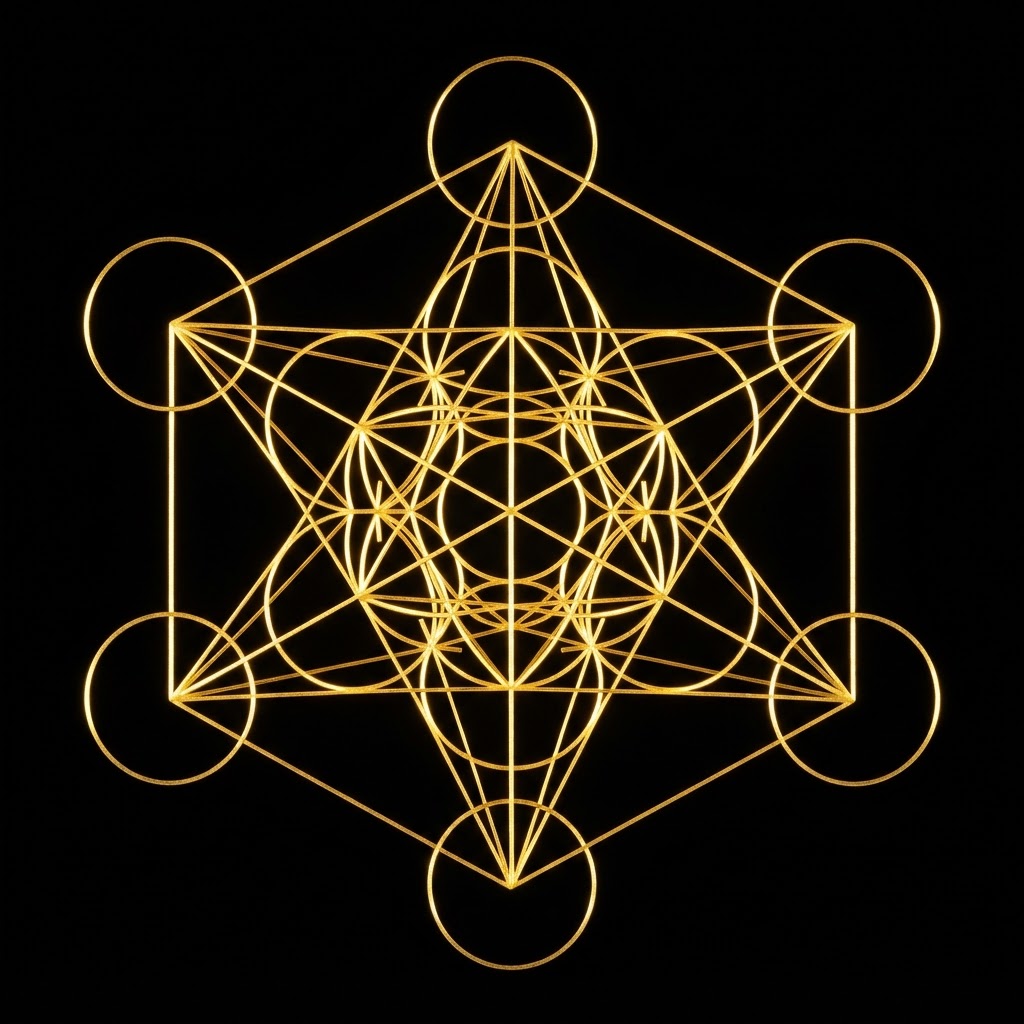
Metatron's Cube is a geometric figure derived from the Flower of Life. It is constructed by connecting the centers of the 13 circles in the Fruit of Life (a subset of the Flower of Life containing 13 circles). When all possible lines are drawn between these 13 points, the resulting figure contains within it all five Platonic solids. The tetrahedron, cube, octahedron, dodecahedron, and icosahedron can all be found as two-dimensional projections within Metatron's Cube.
The name 'Metatron' comes from the Jewish mystical tradition, where Metatron is an angelic figure associated with the mediation between the divine and the material worlds. The geometric figure named after him represents the same principle — the pattern from which all fundamental forms can be derived. It is a 'source code' of three-dimensional geometry.
The spiritual significance of Metatron's Cube is that it represents the unity underlying all form. The five elements — fire, earth, air, water, aether — are not separate but are all derived from the same fundamental pattern. The person meditating on Metatron's Cube contemplates the unity of all things — the way that all the diverse forms of reality emerge from a single, unified source. This is the ultimate teaching of sacred geometry: the many emerge from the one, and the one is present in the many.
Reflect
The five Platonic solids correspond to the five classical elements. How do these forms appear in your experience of the world? When you think of fire, earth, air, water, and spirit, do you sense the geometric forms that underlie them? What would it mean to see the world as geometric at its foundation?
Worksheet
Choose one Platonic solid that resonates with you. Find or draw an image of it. Meditate on it for 5 minutes — let your eyes follow its lines, notice its symmetry, feel its quality. What emotion or state does it evoke? How might working with this form support something you need in your life right now?
Chapter 8
The Pentagram, Hexagram, and Other Sacred Symbols
The Pentagram
The pentagram — the five-pointed star — is one of the most ancient and widely used sacred symbols. It is constructed by drawing the diagonals of a regular pentagon, and it contains within it the golden ratio. The ratio of the total length of a pentagram's arm to the length of the outer segment is phi (1.618). This mathematical property has made the pentagram a symbol of the divine proportion and of the hidden mathematical order underlying reality.
The pentagram has been used in many traditions. In Pythagorean mysticism, it was a symbol of health and wholeness, representing the five elements (earth, water, air, fire, and the quintessence or aether). In Christian tradition, it was associated with the five wounds of Christ and was used as a protective symbol. In Wicca and neopagan traditions, it represents the four elements plus spirit, with the point-up orientation representing spirit ascending over matter.
The pentagram's association with the human body comes from Leonardo da Vinci's 'Vitruvian Man' drawing, which shows a human figure inscribed in both a circle and a square, with arms and legs extended in the pattern of a pentagram. The five-pointed form maps onto the human body: head, two arms, two legs. The pentagram thus represents the divine proportion inherent in the human form — the human as a microcosm of cosmic order.
The Hexagram
The hexagram — the six-pointed star, also known as the Star of David or the Seal of Solomon — is constructed from two interlocking equilateral triangles. One triangle points up (representing the ascending, spiritual, or masculine principle), and one points down (representing the descending, material, or feminine principle). The hexagram thus represents the union of opposites — the reconciliation of spirit and matter, of heaven and earth, of masculine and feminine.
In Jewish tradition, the hexagram is associated with King Solomon and is used as a symbol of Jewish identity (the Magen David, 'Shield of David'). In Hindu and Tantric traditions, the hexagram represents the union of Shiva (the upward triangle) and Shakti (the downward triangle), the cosmic masculine and feminine whose union creates all of reality. In alchemical tradition, the hexagram represents the union of fire (upward triangle) and water (downward triangle), the fundamental opposites whose interaction transforms matter.
The hexagram can be constructed by connecting alternate vertices of a regular hexagon. The six points of the star correspond to the six directions (up, down, north, south, east, west), making it a symbol of spatial totality. The central hexagon formed by the intersection of the triangles is associated with the heart or center — the place where the opposites meet and unite. The hexagram is a symbol of integration, balance, and the creative tension of opposites.
The Ankh and the Cross
The ankh is an ancient Egyptian symbol consisting of a cross with a loop at the top. It is one of the most recognizable symbols of ancient Egypt and represents life — specifically, the divine gift of life and the eternal nature of the soul. The ankh was carried by gods and pharaohs in Egyptian art, symbolizing their power to give and sustain life. The loop at the top represents the sun rising over the horizon (the horizontal bar), and the vertical bar represents the path of the sun — making the ankh a solar symbol of daily rebirth.
The cross, in its simplest form (two intersecting lines), is one of the most universal sacred symbols. It appears in cultures worldwide long before Christianity — in the Egyptian ankh, in the Hindu swastika (a cross with bent arms, representing the sun and good fortune), in the Celtic cross (a cross with a circle, similar to the ankh), and in the Native American medicine wheel (a cross within a circle, representing the four directions). The cross represents the intersection of the material and the spiritual — the horizontal bar representing the material world (time, earth, mortality), and the vertical bar representing the spiritual dimension (eternity, heaven, transcendence).
In Christian tradition, the cross takes on the specific meaning of sacrifice and redemption — the instrument of Christ's death becomes the symbol of salvation. The empty cross (without a figure on it) emphasizes the resurrection; the crucifix (with a figure on it) emphasizes the sacrifice. Both forms carry the universal meaning of the cross — the intersection of the human and the divine, the meeting of matter and spirit, the point where mortal and eternal meet.
The Sri Yantra
The Sri Yantra is one of the most complex and revered sacred geometric figures in the Hindu and Tantric traditions. It consists of nine interlocking triangles — four upward-pointing (representing Shiva, the masculine principle) and five downward-pointing (representing Shakti, the feminine principle) — surrounded by two rings of lotus petals (8 and 16 petals) and enclosed in a square frame with four 'doors' at the cardinal directions.
The nine triangles create 43 smaller triangles, which together form a complex pattern that is both mathematically precise and visually stunning. The central point (bindu) represents the unified source from which all form emanates. The surrounding triangles represent the stages of creation — the progressive differentiation of unity into multiplicity. The lotus petals represent the unfolding of consciousness, and the outer square represents the material world.
The Sri Yantra is used as an object of meditation in Tantric practice. The meditator begins at the outer square (the material world) and gradually moves inward through the layers of petals and triangles, retracing the path of creation back to its source. The practice represents the spiritual journey — moving from the multiplicity of the material world back to the unity of the source. The geometric precision of the Sri Yantra is remarkable — it is one of the most difficult geometric figures to draw correctly, and the correct proportions have been the subject of mathematical study.
The Labyrinth
The labyrinth is a geometric path — a single, winding route from the entrance to the center and back out again. Unlike a maze, which has multiple paths and dead ends designed to confuse, a labyrinth has only one path — the walker cannot get lost, only walk the path that is laid out. This makes the labyrinth a meditation tool: the mind, freed from the need to make navigational decisions, can settle into contemplation.
The most famous labyrinth pattern is the seven-circuit labyrinth found at Chartres Cathedral in France (13th century). The pattern consists of seven concentric paths, connected so that the walker moves from the outer edge to the center and back, covering all seven circuits. The Chartres labyrinth is approximately 42 feet in diameter and is set into the cathedral floor as a substitute for pilgrimage to Jerusalem.
Walking the labyrinth is a practice of meditation in motion. The walk to the center is a process of release — letting go of the concerns, thoughts, and tensions carried in from the world. The time in the center is a moment of stillness — receiving, reflecting, resting. The walk out is a process of return — integrating what was received in the center and carrying it back into the world. The labyrinth is a physical metaphor for the spiritual journey: the path inward to the true self, and the path outward to express that self in the world.
Reflect
Symbols carry power — they speak to the unconscious in a language older than words. Which sacred symbol resonates most with you? What does it evoke? How might working with a symbol — meditating on it, drawing it, wearing it — support your inner life?
Worksheet
Choose one sacred symbol and work with it for a week. Draw it (or print it) and place it where you will see it daily. Spend 2 minutes each day contemplating it — not analyzing it, but simply looking at it and noticing what arises. At the end of the week, note any shifts in your awareness or inner state.
Chapter 9
Sacred Architecture: Building as Prayer
The Temple as Microcosm
Sacred architecture — whether temple, cathedral, mosque, or pyramid — is not merely a building for worship; it is a physical embodiment of cosmic order. The proportions, orientation, geometry, and materials of sacred structures are designed to mirror the structure of the cosmos, creating a space where the human and the divine can meet. The temple is a microcosm — a small model of the universal — and entering it is an act of entering the cosmic order.
The principle of orientation: Most sacred structures are oriented to the cardinal directions, to celestial events (solstices, equinoxes), or to specific geographic features. The Great Pyramid of Giza is aligned to true north with an accuracy that modern surveyors find remarkable. Stonehenge is aligned to the summer solstice sunrise. Gothic cathedrals are typically oriented with the altar at the east end, facing the rising sun. These alignments are not arbitrary — they connect the building to the cosmic cycles that govern life on earth.
The principle of proportion: Sacred buildings almost universally employ sacred geometric proportions — the golden ratio, the vesica piscis, the proportions of the human body. The Parthenon's facade incorporates the golden ratio. The interior proportions of Gothic cathedrals are based on the vesica piscis and the square root of 3. The Hindu temple's plan is based on the mandala — a geometric diagram that represents the cosmic order. These proportions are not aesthetic choices; they are believed to create a resonance between the building and the cosmic order it represents.
The Gothic Cathedral
The Gothic cathedral represents one of the highest achievements of sacred architecture. Built between the 12th and 16th centuries, these structures — Chartres, Notre Dame, Canterbury, Cologne — incorporated geometric proportions, structural innovations, and symbolic programs that made the building itself a theological statement. The cathedral was a 'Bible in stone' — its every proportion, sculpture, and stained-glass window designed to teach and elevate.
The structural innovation of the Gothic cathedral was the pointed arch, the ribbed vault, and the flying buttress. These three elements allowed for taller, lighter structures with larger windows than the earlier Romanesque style. The pointed arch (unlike the round Romanesque arch) directs weight downward rather than outward, allowing taller walls. The ribbed vault distributes weight along ribs rather than across a solid surface, reducing the mass of the ceiling. The flying buttress transfers the outward thrust of the vault to external supports, freeing the walls from structural function and allowing them to be filled with stained glass.
The result is a space filled with colored light — the light filtered through stained glass representing the divine illuminating the material world. The height of the cathedral draws the eye (and the spirit) upward. The geometric proportions create a sense of harmony and order that is felt physically. The cathedral is designed not just to house worship but to produce a state of consciousness — awe, reverence, and the sense of being in the presence of something larger than the self.
The symbolic program of the cathedral extends to every detail. The rose window at the west end represents the cosmic order (the circle, with radiating elements like the sun or like the Flower of Life). The labyrinth on the floor represents the spiritual path. The sculptures on the portals teach biblical stories and moral lessons. The overall cruciform plan (the building shaped like a cross) embodies the central symbol of Christian theology. Nothing in the cathedral is merely decorative — every element carries symbolic meaning.
The Hindu Temple
The Hindu temple is designed as a model of the cosmos, built according to precise geometric principles laid out in ancient texts (the Shilpa Shastras). The temple's plan is based on the mandala — a geometric diagram representing the cosmic order. The most common mandala used for temple plans is the 64-square (8x8) or 81-square (9x9) mandala, with each square associated with a specific deity or cosmic principle.
The temple is oriented to the cardinal directions, with the main entrance typically facing east (the direction of the rising sun). The innermost sanctum (garbha griha, 'womb chamber') is a small, dark, windowless room that houses the main deity. This chamber is the spiritual heart of the temple — the place where the divine presence is most concentrated. The darkness and smallness of the chamber create a sense of interiority and intimacy with the divine.
The tower (shikhara or vimana) above the sanctum represents the cosmic mountain — the axis mundi, the center of the world that connects heaven and earth. The tower's upward sweep, often covered with sculptural decoration, draws the eye and the spirit upward. The external walls of the temple are covered with sculptures depicting deities, mythological scenes, and symbolic figures — making the temple a library of stone that teaches through visual imagery.
The Hindu temple is not just a building but a ritual instrument. The circumambulation (pradakshina) — walking clockwise around the sanctum — is a physical enactment of the cosmic cycle. The temple's geometry is designed to concentrate and direct spiritual energy, making the divine presence accessible to the worshipper. The temple is a machine for consciousness — a structure designed to produce a specific state of awareness in those who enter it.
The Islamic Mosque
Islamic sacred architecture is characterized by its emphasis on geometric patterns, calligraphy, and the absence of figurative images (aniconism). Because Islamic theology discourages the representation of living beings in religious contexts, Islamic artists developed geometric and calligraphic arts to extraordinary sophistication. The mosque becomes a space of pure pattern and proportion, where the infinite is suggested through the repetition and variation of geometric forms.
The mosque is oriented toward Mecca (the qibla), with a niche (mihrab) in the wall indicating the direction of prayer. This orientation creates a unified direction of worship — regardless of where in the world a mosque is located, the worshippers all face the same point, creating a global unity of orientation. The minbar (pulpit) and the minaret (tower from which the call to prayer is made) are the other major architectural features.
The dome is a central feature of many mosques, representing the dome of heaven over the earth. The mihrab is often elaborately decorated with geometric patterns, creating a focal point of beauty and complexity. The prayer hall is typically a large, open space — flexible and uncluttered, allowing for the physical postures of Islamic prayer (standing, bowing, prostrating, sitting). The overall effect is one of spaciousness, order, and the contemplation of infinite pattern — a physical environment designed to support the remembrance of God (dhikr).
Building as Spiritual Practice
The principles of sacred architecture are not limited to great temples and cathedrals. Any space can be designed with sacred intent — a home, a garden, a room, an altar. The principles are universal: orientation (aligning the space with natural forces or directions), proportion (using geometric ratios that create harmony), simplicity (removing unnecessary clutter), beauty (incorporating elements that elevate the spirit), and intention (designing the space for a specific spiritual purpose).
A home altar or meditation space can be created using these principles. Choose a direction (east for sunrise, or whatever direction has personal meaning). Use natural materials (wood, stone, plants). Include objects that carry meaning (candles, crystals, sacred images, natural objects). Keep the space clean and uncluttered. Use it consistently — the repeated use of a space for spiritual practice creates an energetic accumulation that makes the practice easier each time.
The ultimate lesson of sacred architecture is that the spaces we inhabit shape our consciousness. The person who lives in a cluttered, chaotic, ugly environment will tend toward a cluttered, chaotic state of mind. The person who lives in an ordered, beautiful, intentional environment will tend toward order, beauty, and intentionality of mind. We build our spaces, and then our spaces build us. This is the deepest teaching of sacred architecture — that form and consciousness are inseparable, and that the way we shape our physical world is also the way we shape our inner world.
Reflect
Think about the spaces where you feel most peaceful, most elevated, most connected to something larger. What is it about those spaces — their proportions, their light, their orientation, their beauty — that produces that effect? How could you bring elements of sacred architecture into your own living space?
Worksheet
Choose one room or corner in your home. Apply the principles of sacred architecture: 1) Clear all clutter. 2) Orient the main furniture to a direction that feels right. 3) Add one element of natural beauty (a plant, a crystal, a natural object). 4) Add one element of light (a candle, a lamp with warm light). 5) Use the space for 5 minutes of meditation daily. Note how the space changes over time.
Chapter 10
Number Symbolism: The Mathematics of Meaning
Why Numbers Are Sacred
Across cultures, numbers have carried symbolic meaning beyond their quantitative function. The number 1 represents unity, origin, the source. The number 2 represents duality, opposition, partnership. The number 3 represents trinity, synthesis, creativity. The number 4 represents stability, earth, the four directions. The number 7 represents completeness, the spiritual, the cosmic. This symbolic association of numbers is not arbitrary — it reflects the way that numerical relationships appear in nature and in the structure of reality.
The Pythagoreans, a philosophical school founded by Pythagoras in the 6th century BCE, considered numbers to be the ultimate reality — the archetypes from which all things are derived. 'All is number,' they taught, meaning that the structure of reality is fundamentally mathematical. Modern physics, with its mathematical description of fundamental forces and particles, can be seen as a vindication of this ancient insight — the deepest level of reality is described not by words or images but by equations.
The sacredness of numbers does not mean that numbers are magical or supernatural. It means that numerical relationships are fundamental to the structure of the cosmos, and that understanding these relationships provides access to the underlying order of reality. The person who studies number symbolism is studying the mathematical architecture of the world — the same architecture that the physicist studies with equations and the geometer studies with diagrams.
The Numbers One Through Ten
One (Unity): The source, the origin, the indivisible. In monotheistic traditions, one represents God. In philosophy, one represents the monad — the ultimate, unified reality from which multiplicity emerges. One is the number of beginnings, of potential, of the seed from which all else grows. It is both the most simple and the most profound number — the starting point of all counting and the end point of all reduction.
Two (Duality): The first division, the emergence of otherness. Two represents yin and yang, masculine and feminine, light and dark, positive and negative. Two is the number of relationship — the recognition that self exists in relation to other. It is also the number of tension and conflict — the opposition that drives change and creation. Without two, there is no movement, no growth, no story. Two is the engine of becoming.
Three (Trinity): The synthesis of duality, the resolution of tension, the emergence of something new from the interaction of opposites. Three represents the child of the two parents, the thesis-antithesis-synthesis of dialectical thinking, the beginning-middle-end of narrative structure. Three is the number of creativity, of dynamic process, of the creative moment when something new emerges. In many traditions, three is sacred — the Christian Trinity, the Hindu Trimurti, the three jewels of Buddhism.
Four (Foundation): Stability, structure, the material world. Four represents the four directions, the four elements, the four seasons. Four is the number of the earth, of the stable foundation on which things are built. The square (four sides) is the most stable geometric form, and four is the number of the square. Four is the number of order, of system, of the framework that supports life.
Five (Transformation): The number of the human (five fingers, five toes, five senses), of change, of the midpoint. Five represents the pivot — the turning point between the lower numbers (1-4, the foundation) and the higher numbers (6-10, the return to unity). Five is associated with the pentagram, with the golden ratio, and with the transformative moment when the established order is challenged and something new is born.
Six Through Ten
Six (Harmony): The number of balance and beauty. Six is the number of the hexagram (Star of David), of the honeycomb, of the snowflake. Six-fold symmetry is one of the most common patterns in nature, and six represents the harmony of interlocking opposites. Six is also the first perfect number (1+2+3=6), meaning it equals the sum of its divisors — a mathematical property that was considered significant by the ancients.
Seven (Completeness): The number of cosmic completeness. Seven days of creation, seven days of the week, seven chakras, seven classical planets, seven deadly sins, seven heavenly virtues. Seven is the number of the full cycle — the completion of a process from beginning to end. It is associated with the spiritual, the mystical, and the transcendent. The prevalence of seven in myth and ritual across cultures suggests that it represents a fundamental pattern of completion.
Eight (Regeneration): The number of infinity (the figure-8 on its side), of rebirth, of the new beginning after completion. Eight follows seven (completion) and represents the start of a new cycle — not a return to the beginning but a new beginning at a higher level. In Chinese tradition, eight is the luckiest number, associated with prosperity and good fortune. In Christianity, eight represents the resurrection (the eighth day, the new creation).
Nine (Fulfillment): The number of completion and fulfillment. Nine is the highest single digit, and it represents the culmination of the numerical cycle. Nine is associated with the nine months of human gestation, the nine muses of Greek mythology, the nine-pointed star of the Bahá'í faith. Nine is the number of wisdom, of the fullness of experience, of the ripeness that precedes the fall (return to the source).
Ten (Return): The number of the completed cycle and the return to unity. Ten is 1 followed by 0 — the return to the beginning (1) with the experience of the cycle (0). Ten represents the totality of the manifested world (the ten sefirot of the Kabbalistic Tree of Life) and the completion of the cycle of manifestation. Ten is both the end and the beginning — the place where one cycle ends and the next begins.
The Fibonacci Sequence and Phi
The Fibonacci sequence — 1, 1, 2, 3, 5, 8, 13, 21, 34, 55, 89, 144... — is a numerical sequence where each number is the sum of the two preceding. This sequence, first described by the Italian mathematician Leonardo Fibonacci in 1202, appears throughout nature: in the spiral arrangements of sunflower seeds, in the branching patterns of trees, in the spiral of a nautilus shell, in the arrangement of leaves on a stem (phyllotaxis). The sequence is so prevalent in nature that it has been called 'nature's numbering system.'
The Fibonacci sequence is intimately connected to the golden ratio (phi, approximately 1.618). As the sequence progresses, the ratio of consecutive Fibonacci numbers converges to phi: 2/1=2, 3/2=1.5, 5/3=1.667, 8/5=1.6, 13/8=1.625, 21/13=1.615, 34/21=1.619... The higher the numbers, the closer the ratio comes to phi. This means that the Fibonacci sequence and the golden ratio are two expressions of the same fundamental mathematical relationship — the relationship of self-similar growth.
The spiritual significance of the Fibonacci sequence is that it represents the mathematics of natural growth. Things that grow by adding the previous to the current — the pattern of life itself — follow the Fibonacci sequence. The sequence is not invented but discovered, found in the growth patterns of everything from galaxies to embryos. The person who meditates on the Fibonacci sequence contemplates the fundamental mathematics of life — the way that nature grows, unfolds, and develops.
Number as Universal Language
Numbers are the only truly universal language. A mathematical truth that is true here is true everywhere — on Earth, on Mars, in another galaxy. The ratio of a circle's circumference to its diameter is pi, regardless of where or when you measure it. The Fibonacci sequence describes the growth patterns of organisms on Earth, but if life exists elsewhere, it would likely follow similar mathematical patterns, because the mathematics is a property of the universe, not of Earth.
This universality has led some thinkers — from the Pythagoreans to modern physicists like Eugene Wigner (who wrote about 'the unreasonable effectiveness of mathematics in the natural sciences') — to suggest that mathematics is not a human invention but a human discovery. The mathematical structure of reality exists independent of human minds; we discover it, we do not create it. This view makes the study of mathematics a form of sacred inquiry — the contemplation of the deepest, most universal structure of reality.
The practical application: numbers can be used as meditation objects, as design principles, and as tools for understanding the patterns of one's own life. The person who notices that their life follows cycles of seven (seven-year cycles of personal development, seven-day cycles of energy) is using number symbolism to understand their experience. The person who designs a garden with golden-ratio proportions is using sacred number to create beauty and harmony. The person who meditates on a specific number, contemplating its qualities and meanings, is using number as a gateway to the mathematical structure of reality.
Reflect
What number keeps appearing in your life? What patterns or cycles do you notice that follow specific numerical rhythms? What does the mathematical structure of reality — the Fibonacci sequence in a sunflower, the golden ratio in a shell — suggest about the nature of the world we live in?
Worksheet
Choose a number between 1 and 10 that resonates with you. Contemplate its qualities for 10 minutes: What does it represent? Where does it appear in nature, in culture, in your life? How might understanding this number support something you are working on? Write down your reflections. This is the practice of number meditation — using mathematics as a spiritual language.
Part III
The Esoteric Arts — Astrology, Crystals, and the Human Design
Part III moves from the geometry, the sound, and the number into the esoteric arts that apply the sacred principles to the individual life. Astrology, the reading of the cosmic patterns in the natal chart; the crystal work, the use of the mineral kingdom for healing and alignment; the human design, the synthesis of the astrological, the chakra, and the genetic; and the radionics, the use of the subtle energies for distant healing. These are the applied sacred arts, the practices that bring the cosmic principles to the personal life, and the practices that have, in the modern revival, found new expression and new seekers.
Chapter 1
Astrology — The Reading of the Cosmic Pattern
As Above, So Below
Astrology is the practice of reading the cosmic patterns — the positions of the planets and the signs at the moment of the birth — as a map of the individual's nature, potentials, and challenges. The principle, 'as above, so below,' is the core axiom: the macrocosm (the cosmic pattern) and the microcosm (the individual life) are linked, and the pattern of the one is reflected in the pattern of the other. The natal chart, the map of the heavens at the moment of the birth, is the astrological reading of the individual's cosmic blueprint, and the blueprint, read, is the guide to the self-understanding.
The astrological framework includes the twelve signs (the zodiac), the ten planets (including the sun and the moon), the twelve houses, and the aspects (the angular relationships between the planets). The signs describe the 'how' — the quality of the energy; the planets describe the 'what' — the function of the energy; the houses describe the 'where' — the area of the life; and the aspects describe the 'relationship' — how the energies interact. The natal chart, with all these elements, is a complex, layered map, and the astrologer's skill is in the synthesis — the reading of the chart as a whole, not just the parts.
The Signs and the Elements
The twelve signs are grouped by the elements — fire (Aries, Leo, Sagittarius), earth (Taurus, Virgo, Capricorn), air (Gemini, Libra, Aquarius), and water (Cancer, Scorpio, Pisces) — and the elements describe the fundamental quality of the sign's energy. The fire signs are active, enthusiastic, and visionary; the earth signs are practical, grounded, and material; the air signs are intellectual, social, and communicative; the water signs are emotional, intuitive, and sensitive. The elements are the broad classification, and the signs within each element have their specific qualities — the cardinal signs (Aries, Cancer, Libra, Capricorn) are the initiators; the fixed signs (Taurus, Leo, Scorpio, Aquarius) are the stabilizers; the mutable signs (Gemini, Virgo, Sagittarius, Pisces) are the adapters.
For the seeker, the astrology is a tool for the self-understanding: the natal chart, read, reveals the natural tendencies, the strengths, the challenges, and the potentials, and the revelation is the guide to the self-acceptance and the growth. The astrology is not a determinism — the chart does not dictate the life — but a map of the energies and the tendencies, and the map, used with awareness, supports the conscious living. The seeker who knows their chart, and who works with its energies rather than against them, is the seeker who lives more fully the potential that the chart describes, and the living, conscious, is the point of the astrological inquiry.
Reflect
What is your sun sign, and what is its element and quality? Does the description resonate with your nature?
Worksheet
Obtain your natal chart (many free online calculators). Identify your sun, moon, and rising signs. Read about each. Note what resonates and what does not.
Chapter 2
The Planets — The Archetypal Functions
The Ten Lights and Their Functions
In the astrological tradition, the 'planets' include the sun, the moon, and the eight planets of the solar system (Mercury, Venus, Mars, Jupiter, Saturn, Uranus, Neptune, Pluto), and each represents an archetypal function in the psyche. The sun is the core self, the identity, the essential nature; the moon is the emotional nature, the instinct, the subconscious; Mercury is the mind, the communication, the intellect; Venus is the love, the values, the aesthetics; Mars is the will, the drive, the action; Jupiter is the expansion, the meaning, the philosophy; Saturn is the structure, the discipline, the limitation; Uranus is the innovation, the freedom, the revolution; Neptune is the imagination, the spirituality, the dissolution; Pluto is the transformation, the power, the death-and-rebirth.
The planets, in the natal chart, are in signs (which color their expression), in houses (which show where in the life they operate), and in aspect to each other (which show how they interact). The sun in Leo, for example, expresses the core self with warmth, creativity, and a need for recognition; the sun in Virgo expresses the core self with precision, service, and a need for usefulness. The aspects — the conjunction (the blending), the opposition (the tension), the trine (the flow), the square (the challenge) — show how the functions relate, and the relating is the dynamic of the psyche that the chart describes.
The Outer Planets and the Generations
The outer planets — Uranus, Neptune, Pluto — move slowly, spending years in a sign, and they describe the generational patterns, the collective themes that shape the cohorts. The Pluto in Scorpio generation (1984-1995), for example, has a collective theme of transformation, depth, and the confrontation with the shadow; the Uranus in Aquarius generation (1996-2003) has a theme of revolution, technology, and the collective. The outer planets, because they are generational, do not describe the individual as specifically as the personal planets (sun, moon, Mercury, Venus, Mars), but they do describe the collective context in which the individual lives, and the context is important for the understanding of the generation's shared experiences and challenges.
For the seeker, the planetary understanding is the deepening of the self-knowledge: the natal chart, read with the planets, reveals the archetypal functions at play in the psyche, and the revelation is the map of the inner life. The seeker who knows, for example, that they have a strong Saturn (structure, discipline) and a weak Jupiter (expansion, meaning) can work to strengthen the Jupiterian — to seek the meaning, to cultivate the faith, to allow the expansion — and the working, conscious, is the use of the astrology for the growth. The chart is the map; the growth is the journey; and the map, used, supports the journey.
Reflect
Which planet is strongest in your chart, and which is weakest? What does this suggest about your inner dynamics?
Worksheet
Identify the planetary placements in your natal chart. Note which planets are strong (well-aspected, in their home signs) and which are challenged. Consider how to work with the challenges.
Chapter 3
The Houses — The Areas of the Life
The Twelve Sectors
The twelve houses of the astrological chart represent the twelve areas of the human life, and the planets and the signs in each house show where in the life the energies are focused. The first house is the self, the appearance, the approach to the life; the second is the resources, the values, the money; the third is the communication, the siblings, the short trips; the fourth is the home, the family, the roots; the fifth is the creativity, the children, the play; the sixth is the work, the health, the service; the seventh is the partnerships, the marriage, the others; the eighth is the transformation, the shared resources, the death; the ninth is the philosophy, the higher education, the long journeys; the tenth is the career, the public role, the reputation; the eleventh is the community, the friends, the aspirations; the twelfth is the unconscious, the solitude, the spirituality.
The houses are determined by the birth time and the birth place, and the ascendant (the rising sign) is the sign on the cusp of the first house, the sign that was rising on the eastern horizon at the moment of the birth. The ascendant is one of the three most important placements in the chart (along with the sun and the moon), and it describes the approach to the life — the way the person meets the world, the first impression, the persona. The ascendant, with the sun and the moon, forms the core of the astrological self-portrait, and the three, together, describe the essential nature.
Reading the Chart
The reading of the chart is the synthesis of the signs, the planets, the houses, and the aspects, and the synthesis is the astrologer's art. A planet in a sign in a house, aspected by other planets, is a specific, layered statement about a dimension of the life, and the chart, with all its placements, is a complex portrait of the individual. The reading is not a prediction — the astrology does not dictate the life — but a description of the energies, the tendencies, and the potentials, and the description, used with awareness, supports the conscious living.
This is the proper use of the astrology: as a tool for the self-understanding, not as a fortune-telling. The chart reveals the tendencies, and the tendencies, known, can be worked with — the challenging aspects can be addressed, the flowing aspects can be developed, the latent potentials can be activated. The astrology, used this way, is a powerful tool for the self-knowledge, and the self-knowledge, pursued, is the growth. The chart is the map; the life is the journey; and the map, used, supports the journey, but the map is not the journey, and the living, not the chart, is the point.
Reflect
What house is most active in your chart (which house has the most planets)? What does this say about the focus of your life?
Worksheet
Identify the houses in your chart that have planets. Note the themes of those houses. Reflect on whether the life has, in fact, been focused on those themes.
Chapter 4
Crystal Work — The Mineral Kingdom
The Stones and Their Energies
Crystal work is the practice of using the mineral kingdom — the stones and the crystals — for healing, alignment, and the support of the spiritual practice. The tradition holds that each stone has a specific energetic signature, a vibration, that can interact with the human energy field, and the interaction — the stone placed on or near the body, or held in the hand, or placed in the environment — can support the balance, the clarity, or the specific intention. The clear quartz, for example, is the 'master healer,' the amplifier of the intention and the energy; the amethyst is the stone of the spirituality and the calm; the rose quartz is the stone of the love and the heart; the black tourmaline is the stone of the protection and the grounding.
The crystal work is, in the modern revival, a widespread practice, and the practice, though often dismissed by the mainstream, has a long history in the esoteric traditions. The stones, the tradition holds, are the most stable forms in the material world, the crystallized geometries that hold the vibrational patterns, and the patterns, stable, can be used to stabilize the less stable human energy. The scientific basis of the crystal work is, at best, suggestive (the piezoelectric effect, the lattice structures), but the practice, for many, is effective, and the effectiveness, experienced, is the justification for the continued use.
Selecting and Using the Stones
The selection of the stones is, in the tradition, guided by the intention: the stone is chosen for its correspondence to the need. The stone for the calming, the stone for the grounding, the stone for the heart, the stone for the protection — each has its traditional correspondence, and the correspondence, known, guides the selection. The use of the stone is also guided by the tradition: the stone may be placed on the chakra (the clear quartz on the crown, the rose quartz on the heart), held in the hand during the meditation, placed in the environment for the ongoing effect, or used in the elixir (the stone placed in the water, which is then drunk, though this requires caution with the toxic stones).
The cleaning and the charging of the stones is part of the practice, because the stones, the tradition holds, absorb the energies they encounter, and the absorbed energies need to be cleared. The clearing is done by the running water, the salt, the moonlight, the sunlight, or the smudging, and the clearing, done regularly, keeps the stone's energy clean. The charging is done by the intention, the sunlight, the moonlight, or the placement on a cluster, and the charging, done, amplifies the stone's effect. The practice, done with care, is the maintenance of the stones, and the maintenance is the condition of the stones' continued effectiveness.
Reflect
Have you worked with crystals? What was your experience? What stone are you most drawn to, and what does its traditional correspondence suggest?
Worksheet
Choose one stone to work with for a month. Cleanse it. Hold it in meditation daily. Note any effects on your state. Research its traditional correspondences.
Chapter 5
Human Design — The Synthesis System
The Synthesis of the Systems
Human Design is a modern synthesis system, received in 1987 by Ra Uru Hu, that combines the astrology, the I Ching, the chakra system, the Kabbalah, and the quantum physics into a single framework for the self-understanding. The system uses the birth data (the date, the time, the place) to calculate the 'body graph,' a map of the centers (the nine centers, derived from the chakras), the channels, and the gates (derived from the I Ching), and the map, read, reveals the individual's 'design' — the energetic makeup, the strategy, and the authority.
The core teaching of the Human Design is the distinction between the 'type' (the energetic type: the Manifestor, the Generator, the Manifesting Generator, the Projector, the Reflector), the 'strategy' (the way each type is designed to interact with the life: to inform, to respond, to wait for the invitation, to wait a lunar cycle), and the 'authority' (the inner decision-making process: the emotional, the sacral, the splenic, the ego, the self-projected, the lunar). The system's claim is that living according to the type, the strategy, and the authority — rather than according to the mind's conditioning — aligns the individual with their true nature, and the alignment is the source of the ease, the flow, and the fulfillment.
The Experiment
The Human Design is presented not as a belief system but as an experiment: the system invites the individual to try living according to their strategy and their authority for a period (often seven years, the cycle of the cell renewal), and to observe the results. The experiment, the system holds, will demonstrate the value of the alignment — the reduction of the resistance, the increase of the synchronicity, the deepening of the ease — and the demonstration, experienced, is the validation that the system does not ask to be taken on faith.
For the seeker, the Human Design is one of the many modern frameworks for the self-understanding, and its value, like the value of any framework, is in the experiment — the testing, the observation, the honest assessment of whether the framework supports the living. The seeker who is drawn to the system can obtain their chart (many free online calculators), learn their type, strategy, and authority, and experiment with the living according to the design. The experiment, done honestly, is the test, and the test, not the belief, is the basis of the engagement with the system.
Reflect
If you know your Human Design, what is your type and strategy? If not, are you willing to experiment with the system as a tool for the self-discovery?
Worksheet
Obtain your Human Design chart. Identify your type, strategy, and authority. For one month, experiment with living according to them. Note the effects.
Chapter 6
Radionics — The Subtle Energy at a Distance
The Principle of the Resonance
Radionics is the practice of working with the subtle energies — the 'frequencies' or the 'rates' — for the healing and the balancing, often at a distance, using the principle that all things have a unique energetic signature (a rate of vibration), and that the signature, identified and broadcast, can influence the thing at a distance. The practice was developed in the early 20th century by Albert Abrams and others, and it has been, throughout its history, controversial — the mainstream science has not validated the underlying mechanisms, and the practice has been associated with the fringe. Within the esoteric community, however, the radionics and the related practices (the broadcasting of the intentions, the distant healing) have a place, and the place is part of the broader exploration of the subtle energies.
The radionic practitioner, in the traditional form, uses a device (the radionic instrument) with dials, and the dials are turned (with the focus on the sample — a photograph, a hair, a name) until the 'stick' is felt (the tactile feedback on the rubbing plate), and the dial reading is the 'rate' that corresponds to the condition or the intention. The rate, once identified, can be broadcast — the instrument, set to the rate, is left to run, and the broadcasting, the tradition holds, influences the target at a distance, through the principle of the resonance.
The Question of the Evidence
The radionics, like many of the subtle energy practices, faces the question of the evidence, and the question is important. The mainstream science, with its emphasis on the controlled, the double-blind, and the reproducible, has not validated the radionic claims, and the not-validation is a fact that the honest practitioner must acknowledge. The practice, however, persists, and the persistence is based on the anecdotal reports — the practitioners and the clients who report the effects, the healings, the shifts, that they attribute to the radionic work. The tension between the lack of the mainstream validation and the persistence of the reports is the context in which the radionics, and the broader subtle energy work, is practiced and evaluated.
For the seeker, the radionics is one of the most fringe of the sacred arts, and the engagement should be undertaken with the discernment: the practices should be approached as experiments, not beliefs; the claims should be held loosely; the effects should be observed honestly; and the radionics should not replace the medical care, but, at most, complement it. The seeker who engages with the radionics, or any of the subtle energy practices, is engaging at the frontier of the human understanding of the subtle, and the frontier, by its nature, is uncertain, and the uncertainty is the condition of the exploration, and the exploration, done with the discernment, is the engagement with the edges of the known.
Reflect
What is your view of the subtle energy practices like radionics? Are you open to experimenting with them, or do you view them with skepticism?
Worksheet
If drawn, research one radionic or subtle energy practice. Approach it as an experiment, not a belief. Note any effects, honestly. Hold the conclusions loosely.
Chapter 7
The Subtle Body — The Energetic Anatomy
The Layers of the Energy
The sacred arts, across the traditions, work with the concept of the subtle body — the energetic anatomy that underlies the physical body, and that is the medium of the subtle energy practices. The most widely known version is the chakra system (the seven major centers), but the traditions also describe the aura (the layers of the energy field surrounding the body), the meridians (the channels of the qi), the nadis (the channels of the prana), the dan tians (the fields of the qi in the Chinese traditions), and the other structures. The subtle body, the traditions hold, is the interface between the physical and the spiritual, and the work with the subtle body is the work with the energetic dimension of the human.
The sacred arts — the crystal work, the radionics, the astrology (in its energetic reading), the sound healing, the energy healing — all work, in one way or another, with the subtle body, and the work is the balancing, the clearing, the aligning of the energetic structures. The clear quartz on the crown, for example, is the placement on the subtle-body structure (the crown chakra), and the effect, the tradition holds, is the balancing of the energy at that center. The sound healing, with the specific frequency, is the use of the vibration to clear or to strengthen the subtle-body structure, and the clearing, the tradition holds, supports the physical and the psychological well-being.
The Map, Not the Territory
The subtle body, it should be noted, is a map, not a territory — the different traditions describe the structures differently, and the descriptions, while overlapping, are not identical. The seven chakras, the twelve meridians, the three dan tians, the layers of the aura — these are different maps of the same terrain, the energetic dimension of the human, and the maps, useful as they are, should not be confused with the terrain itself. The terrain, the actual energetic anatomy, is more complex and more subtle than any single map can capture, and the seeker who works with the subtle body is well-served by holding the maps loosely, using them as guides, not as dogmas, and remaining open to the direct experience, which is the true teacher.
This is the discernment that the sacred arts, at their best, cultivate: the use of the maps without the reification, the openness to the direct experience without the dismissal of the tradition, and the balance, held, is the mature engagement with the subtle. The seeker who has this discernment is neither the naive believer who takes every map as literal truth nor the dismissive skeptic who rejects the subtle because the maps do not match; the seeker with the discernment is the experimenter, the one who uses the maps to explore, and the exploration, honest and open, is the path to the direct knowing that the sacred arts, at their best, offer.
Reflect
What is your experience of the subtle body — the chakras, the aura, the energy? Have you felt it, or do you work with it primarily through the maps?
Worksheet
For one month, choose one subtle-body practice (a chakra meditation, a crystal placement, a sound healing). Approach it as an experiment. Note any direct experiences, beyond the map.
Chapter 8
The Power of Intention — The Directed Mind
The Mind as the Shaper
Across the sacred arts, the intention (the directed mind) is the central active principle — the mind, focused, is the shaper of the energy, and the energy, shaped, is the act. The crystal is 'programmed' with the intention; the radionic rate is set with the focus; the sound is directed with the intention; the ritual is performed with the intention. The intention, the traditions hold, is not a mere thought; it is the active principle, the will, that shapes the subtle energies, and the shaping, done with clarity and focus, is the effective act.
This is the deeper teaching of the sacred arts: the mind is not a passive observer; the mind is an active shaper, and the shaping, conscious, is the practice. The seeker who works with the sacred arts is, in effect, training the mind — the focus, the clarity, the sustained attention — and the training, done over time, is the development of the capacity to direct the mind, and the directed mind, the traditions hold, is a power, and the power, used with the wisdom and the ethics, is the effective practice. The intention is the tool; the mind is the instrument; and the training of the mind is the core of the sacred arts.
The Ethics of the Intention
The power of the intention, like any power, raises the question of the ethics, and the sacred-arts traditions, at their best, emphasize the ethics of the practice. The intention should be for the highest good, not for the harm; the practice should be with the consent, not without it; the power should be used with the humility, not with the inflation. The traditions warn, repeatedly, against the use of the subtle powers for the ego, the manipulation, or the harm, and the warnings reflect the understanding that the power, misused, recoils on the user, and the recoil is the consequence that the ethics is meant to prevent.
This is the discernment that the sacred arts, at their best, cultivate: the power is real, and the power should be used with the wisdom, the compassion, and the humility. The seeker who works with the sacred arts is working with powers that are not fully understood, and the working, done with the ethics, is the safeguard against the misuse. The intention, directed with the highest good, is the practice; the power, used with the wisdom, is the fruit; and the ethics, held, is the condition of the fruit being a blessing and not a curse.
Reflect
How do you understand the power of the intention? Have you experienced the effect of a directed, focused intention?
Worksheet
For one month, practice one intention-directed sacred art (a crystal programmed with an intention, a ritual performed with a clear focus). Note the effects, and reflect on the ethics of your practice.
Chapter 9
Synchronicity — The Meaning in the Coincidence
The Coincidence That Is Not a Coincidence
Synchronicity, a term coined by Carl Jung, is the 'meaningful coincidence' — the coincidence that is not merely random, but that carries a meaning, that points to a connection between the inner and the outer, the psyche and the world. The synchronicity is a central concept in the sacred arts, because the sacred arts work with the principle that the inner and the outer are linked, and the linking is revealed in the synchronicity — the dream that is answered by the waking event, the thought of a friend who then calls, the symbol that appears at the meaningful moment.
The synchronicity, the traditions hold, is the evidence of the interconnectedness — the principle that the mind and the world are not separate, but linked, and the link is revealed in the moments of the meaningful coincidence. The sacred arts, by working with the symbols, the intentions, and the rituals, are, in effect, working with the synchronicity — the cultivating of the awareness of the link, and the working with the link, consciously, is the practice. The synchronicity is not a proof of any particular doctrine; it is an experience, and the experience, had, opens the door to the understanding that the world is more interconnected than the materialist view suggests.
The Discernment of the Synchronicity
The discernment of the synchronicity is important, because the human mind, which is a pattern-seeking machine, can find meaning in any coincidence, and the finding does not make the meaning real. The discernment asks: is this coincidence truly meaningful, or am I imposing the meaning? The test, the traditions suggest, is the felt quality — the synchronicity has a felt quality of significance, a 'numinosity,' that the ordinary coincidence does not, and the felt quality, attended to, is the guide. The synchronicity also, the traditions suggest, tends to cluster around the meaningful moments — the transitions, the decisions, the crises — and the clustering is another sign that the coincidence is not merely random.
For the seeker, the synchronicity is one of the experiences that the sacred arts cultivate and interpret, and the cultivation, done with the discernment, is the opening to the understanding that the world is more than the material. The seeker who attends to the synchronicity, with the discernment, begins to see the patterns, the links, the meaningful coincidences, that suggest the interconnectedness, and the seeing, done with the honesty, is the experiential basis for the sacred-arts worldview. The synchronicity is not a proof, but it is an experience, and the experience, had and interpreted with the discernment, is one of the ways the sacred arts open the door to the larger view.
Reflect
Have you experienced a synchronicity that felt meaningful? What was the felt quality that distinguished it from an ordinary coincidence?
Worksheet
For one month, keep a synchronicity journal. Note the meaningful coincidences, with the felt quality. Review at the end of the month. Note any patterns or clusters.
Chapter 10
Integration — The Sacred Arts in the Everyday
Not an Escape but an Engagement
The sacred arts, at their best, are not an escape from the everyday but an engagement with the everyday at a deeper level. The astrology, read, supports the self-understanding that guides the daily choices; the crystal, carried, is the reminder of the intention; the ritual, performed, is the alignment of the day with the sacred; the synchronicity, noted, is the awareness of the interconnectedness that pervades the ordinary. The sacred arts, integrated, are the practices that bring the sacred into the everyday, and the bringing, done, is the transformation of the everyday into the field of the sacred.
This is the final word of the sacred arts: the sacred is not separate from the ordinary; the sacred is the ordinary, seen at the depth. The sacred arts are the tools for the seeing, and the seeing, sustained, is the living of the sacred in the everyday. The seeker who has integrated the sacred arts is the seeker for whom the world is alive with the meaning, the symbol, and the connection, and the aliveness, experienced, is the fruit of the practice, and the fruit, enjoyed, is the life lived at the depth that the sacred arts reveal.
The Path of the Experimenter
The sacred arts are, in the end, the path of the experimenter — the one who tries the practices, observes the effects, and follows what works, with the discernment and the honesty. The seeker who approaches the sacred arts this way — not as a believer in the dogma, but as an experimenter with the tools — is the seeker who is most likely to find the value, because the value is in the experience, and the experience, sought with the honesty, is the validation that the sacred arts, at their best, offer. The path of the experimenter is the path of the direct knowing, and the direct knowing, not the borrowed belief, is the goal of the entire endeavor.
This is the integration: the sacred arts, used as tools, in the everyday, with the discernment, by the experimenter, for the deepening of the self-knowledge and the living of the sacred. The seeker who walks this path walks toward the direct knowing, and the knowing, gained, is the freedom — the freedom from the borrowed, the freedom to the direct, and the freedom, lived, is the life that the sacred arts, at their best, support and reveal. The path is the experiment; the experiment is the life; and the life, lived with the sacred, is the point of the entire journey.
Reflect
How could you integrate one sacred art into your daily life? What would the integration look like, practically?
Worksheet
Choose one sacred art to integrate for a month. Define one daily practice. Do it. Note the effects on your sense of the sacred in the everyday. Adjust and continue.
Part IV
The Advanced Sacred Arts — The Practitioner's Path
Part IV explores the advanced dimensions of the sacred arts: the practitioner's path, the integration of the sacred arts with healing, and the development of the skills and sensitivities that allow the practitioner to work with the subtle energies of sound, form, number, and intention. This is the part for the dedicated practitioner who has built a foundation in the sacred arts and is ready to use them in service to others.
Chapter 1
The Practitioner — Working with the Subtle
The Development of Sensitivity
The sacred arts practitioner works with subtle energies — the vibrations of sound, the patterns of form, the resonances of number, the fields of intention. These energies are real, but they are subtle, and working with them requires the development of sensitivity. This sensitivity is not a mystical gift reserved for the few; it is a natural human capacity that can be developed through practice, much like the sensitivity of a musician's ear or a painter's eye. The practice is the gradual refinement of perception — learning to feel what was always there but previously unnoticed.
The development of sensitivity requires: regular practice (daily work with sound, form, and energy, which gradually refines the perception), stillness (the capacity to be quiet enough to feel the subtle, which requires meditation and the reduction of sensory noise), intention (the deliberate direction of attention toward the subtle dimensions), and feedback (working with a teacher or community that can confirm or correct your perceptions). The practitioner who practices consistently, in a supportive environment, will find that their sensitivity increases over time — what was once imperceptible becomes clear, and the capacity to work with the subtle energies becomes a practical skill.
The Ethics of Subtle Work
Working with subtle energies carries ethical responsibilities. The practitioner who can influence the energetic field of another person must use that ability with care, consent, and integrity. The principles are: informed consent (the client should know what the practitioner is doing and why), non-interference (the practitioner does not impose their will on the client's field but supports the client's own process), scope awareness (the practitioner does not diagnose, treat, or claim to cure medical conditions), and referral (the practitioner refers to appropriate professionals when the client's needs exceed the scope of the practice).
These ethics are not optional; they are the foundation of trustworthy practice. The sacred arts, while powerful, are not a substitute for medical care, psychological treatment, or spiritual community. The ethical practitioner understands the role of the sacred arts — as a support for well-being, a complement to other approaches, and a tool for self-discovery — and does not overstate their effectiveness or scope. The practitioner who maintains this integrity, who uses their skills with care and humility, will build trust with their clients and contribute to the reputation of the field. The practitioner who does not — who overstates, who interferes, who exploits — will harm their clients and the field. Ethics is not a constraint; it is the foundation.
Reflect
What sensitivities have you developed through your practice? How do you use them ethically? What is your scope, and where do you need to refer?
Worksheet
If you are called to practice, develop your sensitivity through daily practice and work with a teacher or community. Establish clear ethical guidelines for your practice. Begin by working with friends and family, and expand as your skills and confidence grow.
Chapter 2
The Sacred Arts in Healing — Sound, Form, and Intention
Sound Healing
Sound healing is the use of sound — singing bowls, tuning forks, the voice, gongs, drums — to influence the body's energetic and physical state. The principle is resonance: the body, like all physical objects, has natural frequencies, and the application of specific frequencies can entrain the body's vibrations toward balance. A singing bowl placed on the body and struck produces vibrations that are felt physically and that influence the body's tissues and energy fields. The voice, toning specific vowels or pitches, can produce similar effects. The research on sound healing is preliminary but suggestive, showing reductions in stress, pain, and anxiety in some studies.
The practice of sound healing requires: an understanding of the instruments and their effects (different bowls, forks, and tones produce different effects on different parts of the body and energy system), the skill to produce the sounds effectively (which is learned through practice), the sensitivity to feel the client's response (which is developed through the practice described above), and the ethical foundation to use the practice appropriately (consent, scope, referral). The sound healer who combines these elements can offer a powerful modality for relaxation, balancing, and well-being.
Sacred Geometry and Form
Sacred geometry — the study and use of geometric forms that are found in nature and that have been used in sacred architecture and art across traditions — is another dimension of the sacred arts. The forms — the flower of life, the Sri Yantra, the golden ratio, the Platonic solids — are not merely decorative; they represent fundamental patterns of creation, and their contemplation, meditation, and use in design can influence the viewer's state of consciousness. The practice of drawing or meditating on these forms, or of incorporating them into living and working spaces, is a way of aligning with the fundamental patterns of nature.
The integration of sound and form — using sacred geometric forms as focuses during sound healing, or creating geometric spaces for meditation and healing — combines the vibrational effects of sound with the visual and energetic effects of form. This integration is the advanced practice of the sacred arts: the use of multiple modalities, in combination, to create a comprehensive field of healing and transformation. The practitioner who develops skill in both, and who uses them together with intention and ethics, can offer a deeply transformative experience for their clients — an experience that works on multiple levels simultaneously, addressing the physical, energetic, and spiritual dimensions of the person.
Reflect
Which sacred arts modalities are you drawn to — sound, form, number, or a combination? How would you use them in service to others?
Worksheet
For one month, deepen your practice in one sacred arts modality. If sound, practice daily with your chosen instrument. If form, draw or meditate on a sacred geometric figure daily. Note the effects on your own state and your capacity to work with the subtle.
Part V
The Sacred Life — The Arts as a Way of Being
Part V is the culmination of the sacred arts path: the integration of the sacred arts into the fabric of daily life. The sacred arts, fully lived, are not techniques you practice for designated periods but a way of seeing and being that infuses every moment with awareness of the sacred. The forms, the sounds, the numbers, the patterns — these are not separate from ordinary life but are the hidden geometry of the ordinary, revealed through the practice of attention.
Chapter 1
The Sacred in the Ordinary — Seeing the Hidden Geometry
The Sacred Is Not Separate
The sacred is not separate from the ordinary; it is hidden within it. The spiral of a sunflower, the branching of a river, the rhythm of a heartbeat, the harmony of a well-tuned chord — these are the sacred arts, expressed in nature, available to anyone who has the eyes to see and the ears to hear. The practitioner of the sacred arts, who has studied the forms and sounds and patterns, begins to see them everywhere — in the architecture of a leaf, in the geometry of a crystal, in the proportion of a human face. The world becomes a sacred text, written in the language of form and frequency.
This way of seeing is the fruit of the practice. The forms and sounds that were studied in the studio or the meditation room are discovered in the world, and the world is transformed by the discovery. The ordinary — the walk to the store, the meal at the table, the conversation with a friend — becomes extraordinary, because the sacred geometry that underlies it is now visible. This is the gift of the sacred arts: not an escape from the ordinary but a deeper engagement with it, a seeing of the depth that was always there but previously unnoticed.
The Practice of Sacred Seeing
The practice of sacred seeing is the practice of attention — the deliberate direction of awareness toward the forms, patterns, and harmonies that are present in every moment. It is not a special state; it is a shift in what you notice. The person who has studied sacred geometry, walking through a forest, sees the fractal branching of the trees, the spiral of the ferns, the radial symmetry of the flowers. The person who has studied sacred sound, listening to a stream, hears the harmonics in the water's voice, the rhythm of the current, the silence between the sounds. The practice of sacred seeing is the practice of bringing the awareness, developed through study, to the world.
This practice, sustained over time, changes the person. The world becomes more beautiful, more meaningful, more connected. The separation between the sacred and the secular dissolves, as the sacred is discovered in the secular. The practitioner of the sacred arts, who began by studying forms and sounds in isolation, ends by seeing the entire world as a sacred art — a living, breathing expression of the geometric and harmonic principles that underlie all creation. This is the culmination of the path: not the mastery of techniques but the transformation of perception, the capacity to see the sacred in all things.
Reflect
What sacred patterns do you see in the world around you? How has your study of the sacred arts changed your perception? What would the practice of sacred seeing look like for you?
Worksheet
For one month, practice sacred seeing. Each day, spend ten minutes in nature or in your environment, looking for the sacred patterns — spirals, fractals, symmetries, harmonies. Note what you see and how the seeing changes your experience of the world.
Chapter 2
The Gift — The Sacred Arts for the World
The Service
The sacred arts, at their culmination, are not for the practitioner alone but for the world. The person who has developed the capacity to see the sacred, to work with the subtle, and to create the beautiful has a gift to offer — a gift that can awaken the sacred in others, heal the wounds of the modern disconnection from the sacred, and contribute to a culture that honors the depth and beauty of existence. This is the service of the sacred arts practitioner: not to escape the world but to re-enchant it.
The modern world, with its emphasis on the material and the measurable, has largely lost the sense of the sacred. The sacred arts — with their attention to form, sound, pattern, and resonance — offer a counterweight: a way of engaging with the world that honors its depth, its beauty, and its mystery. The practitioner who shares this — through their art, their healing, their teaching, their presence — contributes to the reawakening of the sacred dimension of life. This is the gift: not just personal transformation but cultural renewal.
The Living Tradition
The sacred arts are a living tradition — they are not fixed but evolving, as each practitioner adds their understanding, their skill, and their unique contribution to the stream. The forms and sounds that have been passed down through the centuries are not museum pieces but living practices, to be used, explored, and extended. The practitioner who honors the tradition — who studies the classical forms and sounds — and who also brings their own creativity, their own perception, their own innovation, contributes to the evolution of the tradition, keeping it alive and relevant for the current age.
This is the final word of the sacred arts path: the tradition is alive, and the practitioner is part of it. The forms, the sounds, the patterns — these are the inheritance, passed from generation to generation, from teacher to student. The practice, the perception, the service — these are the contribution, the practitioner's offering to the tradition and to the world. The sacred life, fully lived, is both the receiving of the inheritance and the giving of the gift — the honoring of what has been passed down and the adding of what is uniquely one's own. This is the sacred arts as a way of being: rooted in tradition, expressed in creativity, and offered in service to the awakening of the sacred in the world.
Reflect
What is your gift to the living tradition? How will you honor the inheritance and add your unique contribution? What does the sacred life look like for you?
Worksheet
For one lifetime, practice the sacred arts. Study the tradition. Develop your skill. Share your gift. See the sacred in the ordinary. Contribute to the reawakening of the sacred dimension of life. This is the practice, and the practice is the point.
Glossary
Index
Astrology, 4
Crystals, 7
Flower of Life, 2
Firdaria, 4
Golden ratio, 2
Lightbody, 9
Number, 3
Radionics, 8
Sacred geometry, 2
Solfeggio, 5
Sound, 5
Sri Yantra, 2
Vortex math, 3
About the Author
AKASHIC INTELLIGENCE is the collective authorship under which LOVELOVINGLIFE publishes its synthesized, cross-tradition curriculum. The name points to a method rather than a person: taking the shared, tested practices human beings have used across cultures and centuries to tend the inner life, and presenting them clearly and without claims that do not survive scrutiny.
LOVELOVINGLIFE is a universal spiritual operating system for inner life. This volume is one book in that larger map.
"The sacred arts are not beliefs imposed on nature. They are patterns found in it — and the discipline of attending to them is the whole practice."
LOVELOVINGLIFE · 2026