
HANDS OF LIGHT
A Guide to the Human Energy Field and the Practice of Energy Healing · by AKASHIC INTELLIGENCE
Tip: "Print / Save as PDF" gives the best quality (selectable text). "Download PDF" renders an image-based copy in one click.
LOVELOVINGLIFE
HANDS OF LIGHT
A Guide to the Human Energy Field and the Practice of Energy Healing
by
AKASHIC INTELLIGENCE
First Edition · 2026
Published by LOVELOVINGLIFE
Copyright
Copyright © 2026 AKASHIC INTELLIGENCE / LOVELOVINGLIFE. All rights reserved.
No part of this book may be reproduced or transmitted in any form without prior written permission, except for brief quotations in reviews.
First Edition, 2026. Published by LOVELOVINGLIFE.
Disclaimer
Educational, not medical advice. Energy healing is a complementary practice, not a diagnosis or treatment of disease.
Do not use energy healing as a substitute for professional medical or mental-health care. Always consult a licensed physician for medical conditions.
To the hands, which carry the warmth of the heart; and to the light, which was never separate from the body.
Foreword
The Field That Was Always There
Every living thing is surrounded by and interpenetrated by a field of energy. It is not a metaphor. It has been seen, measured in various ways, and worked with by healers across every tradition that has looked closely at the body. The West calls it the aura; the yogis called it the pranamaya kosha; clairvoyants simply see it.
This book teaches the practical working knowledge of that field: what it is, how it becomes distorted, and how a healer's hands — and a person's own attention — can restore it.
How to Read This Book
Part I lays the foundations: the structure of the human energy field, the chakras, and the higher sense perception that lets you work with it. Part II covers blocks and defenses — how the field protects itself and where it gets stuck. Part III teaches the practice of healing. Do the worksheets; perception is a skill that grows by use.
How to Use This Book
Perception First
You cannot heal what you cannot perceive. So the first chapters are about seeing and feeling, not about doing. Train the perception; the healing follows naturally.
Table of Contents
Front Matter
- Foreword
- How to Use This Book
Part I. Foundations
- Chapter 1. The Human Energy Field
- Chapter 2. The Chakras
- Chapter 3. Higher Sense Perception
- Chapter 4. Blocks and Defenses
Part II. The Energy Centers: Chakras and the Subtle Anatomy
- Chapter 6. The Chakra System: An Overview
- Chapter 7. The First Three Chakras: Survival, Feeling, Will
- Chapter 8. The Heart Chakra: The Bridge
- Chapter 9. The Upper Three Chakras: Expression, Perception, Connection
- Chapter 10. The Nadis and Meridians: Energy Channels
Part III. Blocks, Defenses, and Character Structures
- Chapter 11. Energy Blocks: How Flow Becomes Stuck
- Chapter 12. Character Structures: The Architecture of Defense
- Chapter 13. The Vicious Cycle: How Distortion Maintains Itself
- Chapter 14. The Superego: The Internal Judge
- Chapter 15. The Healing Relationship: Practitioner and Client
Part IV. Healing Techniques and the Practitioner Path
- Chapter 16. Full-Spectrum Chelation: The Core Healing Technique
- Chapter 17. Color and Sound: Vibrational Healing
- Chapter 18. Cord Work: Relational Energy
- Chapter 19. The Practitioner's Preparation
- Chapter 20. Death, Dying, and the Transition
Part V. The Living Practice: Integration and Transformation
- Chapter 21. The Daily Practice of the Healer
- Chapter 22. The Spiritual Dimension of Healing
- Chapter 23. Working with Specific Conditions
- Chapter 24. The Healer in Community
- Chapter 25. Conclusion: The Healer's Journey Has No End
Back Matter
- Glossary
- Index
- About the Author

Part I
Foundations
Before any healing, you need to understand the field you are working with: its structure, its centers, and the perception that lets you sense it. These chapters give the ground every later practice stands on.
Chapter 1
The Human Energy Field
A Field, Not a Metaphor
The human energy field is a structured, layered body of energy that surrounds and interpenetrates the physical body. It is composed of finer matter than the physical body, vibrating at higher frequencies, and it is the template on which the physical body is built. Disease often appears in the field before it appears in the flesh.
Across traditions this field has many names: the aura, the pranamaya kosha, the luminous body, the etheric double. The names differ; the thing described is the same.
The Seven Layers
The field is commonly described in seven layers, each more subtle than the one beneath it. The first, the etheric, is closest to the physical and governs physical structure. The emotional and mental layers follow. Higher layers relate to love, expression, and the spiritual dimension of the person. A healer working at a given layer addresses the level of distortion present there.
The Universal Energy Field
The human field is not separate. It exists within a universal energy field — the ambient energy that fills space and that every living thing metabolizes. Healing work is, in part, the practice of becoming a clear conduit between the universal field and the specific distortions in a person's field.
Reflect
Have you ever walked into a room and felt the mood before anyone spoke? That is the energy field, sensed at the edge of perception. What did you notice, and where in your body did you notice it?
Worksheet
Sit quietly with your palms facing each other a few inches apart. Slowly move them apart and together. Note any sensation — warmth, tingling, pressure, a subtle density. Do not force it; simply observe what is already there.
Chapter 2
The Chakras
Centers of Metabolism
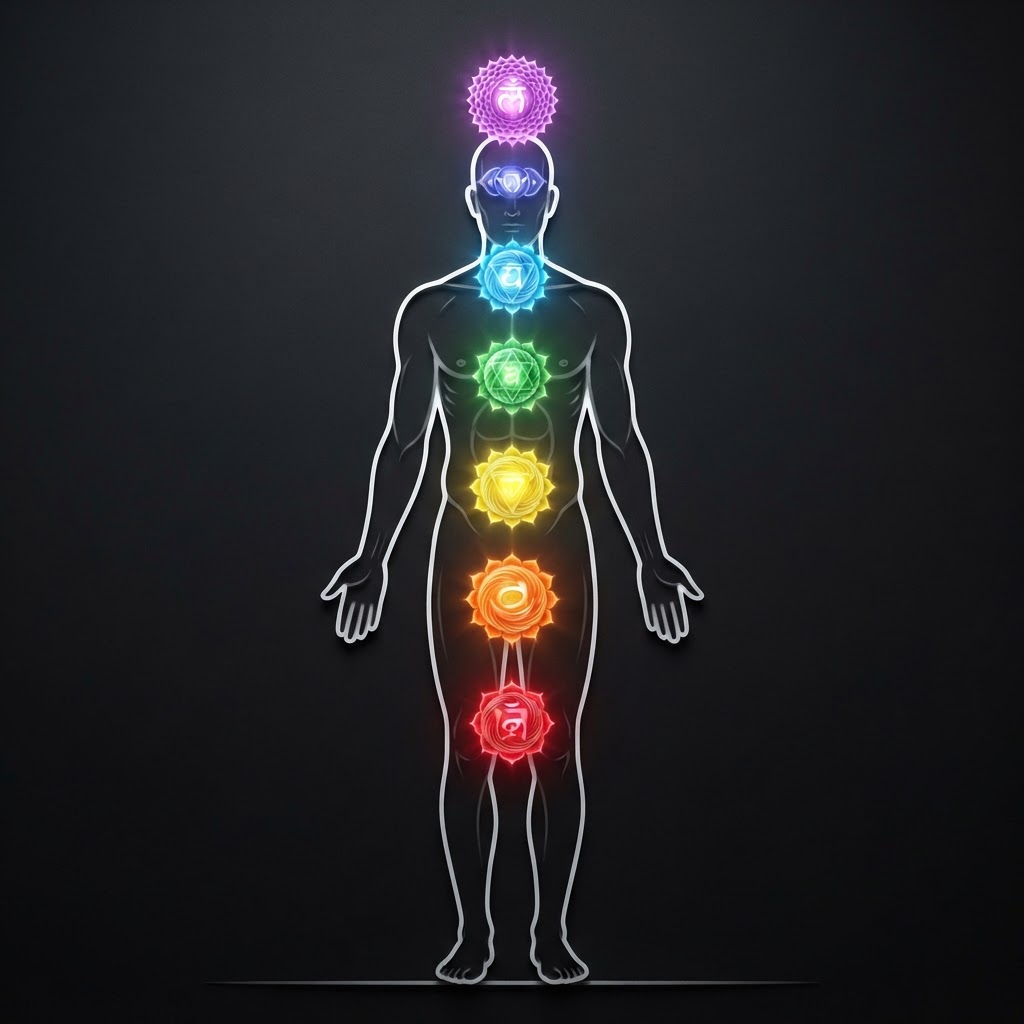
Chakras are centers in the energy field that metabolize life energy. There are seven major chakras, aligned along the spine from the base to the crown. Each governs a region of the body, a layer of the field, and a dimension of experience — survival, emotion, will, love, expression, intuition, and connection.
A chakra can be open or closed, balanced or distorted, spinning smoothly or sluggishly. Its state reflects how a person is living in that dimension of their life.
The First Three
The root chakra governs survival and grounding; the sacral governs emotion, creativity, and pleasure; the solar plexus governs will, selfhood, and the digestion of experience. Together the lower three chakras handle the embodied, earthly dimensions of life. When these are strong and flowing, the higher centers have a stable base.
The Higher Four
The heart governs love and the bridge between lower and higher; the throat governs expression and truth; the third eye governs intuition and inner seeing; the crown governs connection to the whole. The higher chakras open naturally as the lower ones stabilize — not the other way around.
Reflect
Which chakra do you live from most often — your will, your emotions, your intuition? Which one feels neglected? The neglected center is often where your growth is waiting.
Worksheet
Place your attention on each of the seven chakra points in turn, from root to crown, for thirty seconds each. Note the quality at each — warm, cool, dense, clear, numb. Write down one word per chakra.
Chapter 3
Higher Sense Perception
A Native Capacity
Higher sense perception is not a gift reserved for the few. It is a native human capacity that most people are trained out of by about age seven. It returns with practice. It includes the ability to see, feel, hear, and know the energy field directly, beyond the five physical senses.
The work is not to acquire a new sense but to stop discounting the one that was always operating at the edge of awareness.
Grounding Before Perception
Perception without grounding produces fantasy. Before any energy work, ground: feel the feet, the contact with the floor, the pull of the earth. A grounded perceiver can tell the difference between what is in the field and what they are projecting onto it.
Keeping a Clear Channel
A healer must remain clear. Distortion in the healer's own field gets read as the client's. Daily self-care — rest, nature, honest emotion, regular clearing — is not a luxury; it is the maintenance of the instrument. A muddy instrument reads muddy fields.
Reflect
When you sense something about another person, how do you know it is them and not you? Grounding and self-honesty are the only reliable tests.
Worksheet
Ground for two minutes, then observe a houseplant or a pet at the edge of your attention. Note what you sense before you analyze it. Keep a short log for a week; patterns emerge.
Chapter 4
Blocks and Defenses
The Field Protects Itself
A block is an area of held, distorted, or stagnant energy in the field. It almost always began as a protection. The field closes a region to keep a wound from being touched again. Over years the protection becomes a limitation — the held area no longer flows, and the person cannot fully live through it.
The healer does not rip blocks away. The healer supports the field in releasing what it no longer needs to hold.
Character Structures
Chronic holding patterns, shaped in early life, become character structures — embodied ways of being that organize the whole field: the way of holding the chest, the jaw, the pelvis, the breath. They are not pathologies; they are adaptive solutions a child found to a situation. Healing them is not erasing them but releasing the held charge so the adult can choose anew.
Where the Work Begins
Healing begins where the field is ready. Pushing into a defended area before the system is ready re-traumatizes it. The healer asks the field — through perception and presence — what is ready to move now, and trusts the field's pace over the healer's ambition.
Reflect
What did your younger self need to protect that you no longer need to defend? The defense that once saved you may now be the wall between you and the life you want.
Worksheet
Identate one chronic tension in your body. Sit with it without trying to change it for five minutes. Ask what it is protecting. Note whatever arises, in a few honest sentences.
Part II
The Energy Centers: Chakras and the Subtle Anatomy
The human energy field is not uniform — it has centers of concentration, flow, and function. These centers, known across traditions as chakras, are the organs of the energy body. Understanding them gives you a map of how energy enters, processes, and expresses through the human system, and where distortions in that flow manifest as physical, emotional, and spiritual difficulty.
Chapter 6
The Chakra System: An Overview
What a Chakra Is
The word chakra means 'wheel' in Sanskrit. In the energy healing traditions, chakras are centers where energy enters, processes, and distributes through the human energy field. They are not physical structures — they cannot be found by a scalpel — but they correspond to physical locations in the body and to specific nerve plexuses, endocrine glands, and psychological functions.
A healthy chakra spins at a moderate, balanced rate, taking in energy from the universal field and distributing it through the body's energy channels. A distorted chakra may be blocked (energy cannot enter), excessive (too much energy is held, creating rigidity), or deficient (too little energy, creating weakness). Each distortion pattern produces characteristic physical, emotional, and behavioral symptoms.
The system described in this book follows the seven-chakra model that is most common in modern energy healing. This model is a synthesis of the Hindu tantric tradition (which described chakras in detail), the Theosophical movement (which adapted them for Western audiences in the early 20th century), and the clinical observations of modern energy healers like Barbara Brennan. Different traditions describe different numbers and arrangements of centers; the seven-chakra system is useful because it maps clearly onto observable energetic phenomena.
The Seven Major Chakras
First chakra (Root, Muladhara): Located at the base of the spine. Relates to survival, grounding, physical safety, and the right to exist. Associated with the adrenal glands, the color red, and the earth element. A balanced root chakra produces a sense of safety, stability, and belonging. Distortion manifests as chronic fear, anxiety about basic needs, or disconnection from the physical body.
Second chakra (Sacral, Svadhisthana): Located in the lower abdomen. Relates to emotions, pleasure, creativity, and sexuality. Associated with the gonads, the color orange, and the water element. A balanced sacral chakra produces emotional flow, creative expression, and healthy sensuality. Distortion manifests as emotional numbness, sexual difficulty, or compulsive pleasure-seeking.
Third chakra (Solar Plexus, Manipura): Located in the upper abdomen. Relates to personal power, self-esteem, will, and the right to act. Associated with the pancreas, the color yellow, and the fire element. A balanced solar plexus produces confidence, self-discipline, and the ability to take action. Distortion manifests as either excessive control (dominating behavior) or deficient will (passivity and powerlessness).
Fourth chakra (Heart, Anahata): Located in the center of the chest. Relates to love, compassion, connection, and the right to give and receive. Associated with the thymus and heart, the color green, and the air element. A balanced heart chakra produces loving connection, empathy, and the ability to both give and receive freely. Distortion manifests as loneliness, inability to connect, or codependent over-giving.
Fifth chakra (Throat, Vishuddha): Located in the throat. Relates to communication, self-expression, truth, and the right to speak. Associated with the thyroid, the color blue, and the ether element. A balanced throat chakra produces clear, honest communication and the ability to express one's truth. Distortion manifests as inability to speak up, chronic throat problems, or compulsive talking.
Sixth chakra (Third Eye, Ajna): Located between the eyebrows. Relates to intuition, perception, insight, and the right to see clearly. Associated with the pineal gland, the color indigo, and light. A balanced third eye produces clear intuition, mental focus, and the ability to perceive subtle patterns. Distortion manifests as confusion, inability to focus, or denial of intuition.
Seventh chakra (Crown, Sahasrara): Located at the top of the head. Relates to spiritual connection, consciousness, and the right to know. Associated with the pituitary gland, the color violet, and thought. A balanced crown produces a sense of connection to something larger, open-mindedness, and spiritual awareness. Distortion manifests as isolation, spiritual disconnection, or rigid attachment to beliefs.
The Developmental Progression
The chakras develop in sequence from birth through adulthood, roughly corresponding to Erikson's psychosocial stages. The root chakra develops in the first year of life — the infant learns whether the world is safe. The sacral chakra develops in toddlerhood — the child explores emotion and pleasure. The solar plexus develops in early childhood — the child asserts will and autonomy.
The heart chakra develops in middle childhood — the child learns to love beyond the family. The throat chakra develops in later childhood — the child finds their voice and creative expression. The third eye develops in adolescence — the young person develops abstract thinking and self-reflection. The crown develops in early adulthood and beyond — the person connects to meaning and purpose.
This developmental progression explains why childhood experiences have such lasting effects on adult functioning. If the root chakra was distorted by early neglect, the adult may struggle with basic safety and trust regardless of their current circumstances. Healing involves going back to the developmental stage where the distortion originated and providing what was missing.
The Rights Associated With Each Chakra
Each chakra is associated with a fundamental right — a basic human capacity that, when violated or blocked, produces characteristic symptoms. The root chakra's right is the right to be here, to exist, to have a body. When this right is violated — through early neglect, abuse, or messages that the child should not exist — the person may struggle with chronic anxiety, disembodiment, or self-destructive behavior.
The sacral chakra's right is the right to feel, to have needs and desires. The solar plexus's right is the right to act, to take initiative. The heart's right is the right to love and be loved. The throat's right is the right to speak and be heard. The third eye's right is the right to see and know. The crown's right is the right to understand and connect to meaning.
Identifying which right has been violated is the first step in healing. The person who cannot speak up in meetings may have had their throat chakra's right violated in childhood — being told to be quiet, being punished for speaking, or having their perceptions dismissed. The healing is not just communication skills training; it is the restoration of the right to speak at a fundamental level.
Reading the Chakra System
A healer reads the chakra system through a combination of perception and observation. Each chakra has a characteristic quality when healthy and characteristic distortions when unhealthy. The root should feel grounded and steady; distortion feels scattered or frozen. The sacral should feel fluid and warm; distortion feels cold or stagnant. The solar plexus should feel bright and warm; distortion feels either depleted or overly intense.
The heart should feel open and radiant; distortion feels closed, armored, or overly porous. The throat should feel clear and flowing; distortion feels blocked or strained. The third eye should feel clear and luminous; distortion feels cloudy or pressured. The crown should feel open and connected; distortion feels closed or pressured.
These perceptions are refined through practice. The beginner can start by placing their hands over each chakra location and noticing what they feel — temperature, pressure, movement, or simply an intuitive sense of the quality of energy. With practice, these sensations become more specific and informative, eventually allowing the healer to identify specific distortions and their emotional and physical correlates.
Reflect
Which of the seven rights do you feel is most violated in your life? The right to exist, to feel, to act, to love, to speak, to see, or to know? What happened to violate this right, and what would it mean to reclaim it?
Worksheet
For each of the seven chakras, write one word describing how you feel in that area of your body right now (root: grounded/anxious; sacral: flowing/numb; etc.). Look for patterns — are your lower chakras (survival, emotion, will) generally balanced or distorted? What about the upper chakras (communication, intuition, connection)?
Chapter 7
The First Three Chakras: Survival, Feeling, Will
The Root Chakra: Foundation of Being
The root chakra is the foundation of the entire system. When it is balanced, you feel safe, grounded, and present in your body. You trust that your basic needs will be met. You have a sense of belonging — not necessarily to a specific group, but to the earth itself, to existence. You feel you have a right to be here.
When the root chakra is deficient — undercharged — the person may feel spacey, ungrounded, disconnected from their body. They may live in their head, avoid physical activity, or struggle with basic self-care. There may be chronic anxiety about survival, money, or safety that is disproportionate to their actual circumstances. The body may be thin, frail, or underdeveloped.
When the root chakra is excessive — overcharged — the person may be overly materialistic, hoarding resources, or defined by physical comfort. They may be sluggish, resistant to change, or stuck in rigid routines. The body may be heavy, dense, or stocky. There is a clinging to the physical that comes from deep insecurity rather than genuine groundedness.
Healing the root chakra involves reconnecting with the body and the earth. Physical practices — walking barefoot, gardening, yoga, massage — bring energy back into the physical. Safety practices — creating stable routines, building financial reserves, finding a secure home — address the survival anxiety. The affirmation 'I am safe. I belong here. I have a right to exist' spoken slowly, with attention to the base of the spine, helps restore balance.
The Sacral Chakra: The Flow of Feeling
The sacral chakra governs the emotional life. When balanced, you feel your feelings fully and let them flow. You can experience pleasure without guilt, express creativity without inhibition, and connect sensually with the world. You have a sense of abundance — not necessarily material, but a feeling that life is rich and flowing.
When deficient, the person may be emotionally numb, disconnected from their feelings, unable to experience pleasure or creativity. They may be overly controlled, rigid, or fear intimacy. Sexual difficulty — low desire, inability to experience pleasure, or dissociation during intimacy — often reflects sacral deficiency. The body may be rigid in the hips, with restricted pelvic mobility.
When excessive, the person may be emotionally overwhelmed, at the mercy of every feeling. They may seek constant stimulation — drama, intensity, compulsive pleasure-seeking — because the emotional threshold is too high. Addictive patterns, compulsive sexuality, and emotional volatility often reflect sacral excess. The body may carry excess weight in the lower abdomen.
Healing the sacral chakra involves restoring the healthy flow of feeling. This is not about generating more emotion but about removing the blocks that prevent natural emotional flow. Practices include body-based emotional awareness (scan the body for feelings without trying to change them), creative expression without judgment (paint, dance, sing badly and freely), and allowing pleasure without guilt (eat a good meal slowly, take a warm bath, enjoy physical sensation).
The Solar Plexus: The Fire of Will
The solar plexus chakra governs personal power, self-esteem, and the capacity to act. When balanced, you have confidence in your ability to meet challenges. You can set boundaries, make decisions, and follow through on commitments. You have a healthy sense of self — neither inflated nor deflated — and you take responsibility for your life.
When deficient, the person may feel powerless, passive, or unable to act on their own behalf. They may defer to others excessively, be unable to say no, or feel that their life is controlled by external forces. There may be chronic low self-esteem, a sense of being a victim, or difficulty initiating action. The body may be weak in the core, with shallow breathing and poor posture.
When excessive, the person may be dominating, controlling, or aggressive. They may need to be in charge at all times, be unable to delegate, or be contemptuous of those they perceive as weaker. The need for control comes from deep insecurity — the person controls others because they cannot trust themselves. The body may be tense and rigid in the abdomen, with a hardness that masks underlying fragility.
Healing the solar plexus involves rebuilding the relationship with personal power. For deficiency, this means practicing small acts of will — making and keeping promises to yourself, setting one small boundary, taking one action you've been avoiding. For excess, it means learning to trust — delegating, allowing vulnerability, recognizing that control is an illusion that masks fear. The affirmation 'I have the right to act. I am powerful. I choose my life' helps restore balance.
How the Lower Three Chakras Work Together
The first three chakras form the foundation of the personality — survival, feeling, and will. They are the ground on which the upper chakras (love, expression, intuition, connection) are built. If the foundation is unstable, the upper chakras cannot develop fully. A person with an unbalanced root cannot truly love from the heart, because the survival anxiety constantly pulls energy downward.
This is why healing work often begins at the root. Before addressing heartbreak (fourth chakra) or communication blocks (fifth chakra), the healer must ensure that the person can feel safe in their body (first), feel their feelings (second), and act on their own behalf (third). Attempting to open the heart without grounding is like building a roof without walls — it cannot hold.
The lower three chakras are also the most affected by early childhood. The root develops in the first year, the sacral in toddlerhood, the solar plexus in early childhood. Distortions in these centers almost always originate in early experience, before the child had words to describe what happened. This is why cognitive approaches alone are often insufficient for healing these centers — the distortions are pre-verbal and must be addressed at the body and energy level.
Signs of Balance in the Lower Three
When the lower three chakras are balanced, the person has a solid foundation. They feel safe in their body and in the world. They can feel their emotions without being overwhelmed by them. They can take action on their own behalf without dominating others. They have a sense of personal power that is quiet — not aggressive, not passive, but present and steady.
Physically, balance in the lower three shows as: grounded posture (weight evenly distributed, feet solid), easy breathing that reaches the belly, natural movement in the hips and pelvis, a strong but not rigid core, and a sense of warmth and vitality in the lower body. The person looks like they belong in their body.
Emotionally, balance shows as: stability without numbness, warmth without volatility, confidence without arrogance. The person can handle difficulty without falling apart, and they can enjoy pleasure without becoming addicted. They are resilient because their foundation is solid.
Reflect
Of the lower three chakras — survival, feeling, will — which feels most distorted in your life? Do you tend toward deficiency (too little energy) or excess (too much, rigidly held)? What childhood experiences shaped this pattern?
Worksheet
Spend five minutes with each of the lower three chakra areas. Place your hand on the base of your spine, then the lower abdomen, then the upper abdomen. For each, write three words describing what you sense (temperature, movement, feeling). Compare — which area feels most alive? Which feels most blocked?
Chapter 8
The Heart Chakra: The Bridge
The Central Position of the Heart
The heart chakra sits at the center of the seven-chakra system, bridging the lower three (survival, feeling, will) and the upper three (communication, intuition, connection). It is the meeting point of the physical and the spiritual, the personal and the transpersonal. Everything below the heart is about the individual self; everything above is about connection beyond the self. The heart is where these two dimensions meet.
When the heart chakra is balanced, you can love without losing yourself and be yourself without being alone. You can give freely without depleting, and receive freely without feeling indebted. You feel connected — to other people, to nature, to something larger — without merging or losing your individuality. This is the state the mystics describe as 'being in the world but not of it.'
The heart is also the most vulnerable chakra. It is the center where we are most easily hurt, because love requires openness, and openness means we can be reached — by beauty and by pain. A closed heart protects against pain but also blocks love, joy, and connection. An overly open heart gives everything away and has nothing left for itself. The balance is the work of a lifetime.
The Heart Wall
In the Body Code and Emotion Code systems developed by Dr. Bradley Nelson, a 'heart wall' is an energetic barrier built from trapped emotions that the subconscious creates to protect the heart from further injury. When you experience intense emotional pain — heartbreak, betrayal, loss, grief — and cannot fully process the emotion, it can become trapped in the energy field. The subconscious then uses these trapped emotions as building blocks to construct a wall around the heart.
A heart wall serves a purpose — it protects you when you are too vulnerable to handle more pain. But it outlives its usefulness. Long after the danger has passed, the wall remains, blocking love, connection, and intimacy. The person with a heart wall may feel lonely, disconnected, or unable to deeply love, even though they desperately want to. They may also experience physical symptoms — chest tightness, shoulder tension, or restricted breathing — because the wall blocks energy flow in the physical body.
Releasing a heart wall involves identifying and clearing the trapped emotions that compose it, one by one. This is typically done through muscle testing (the body's subconscious knows which emotions are trapped and in what order they need to be released) and energetic release techniques. The process can be profoundly liberating — people often report feeling lighter, more open, and more connected after releasing a heart wall, sometimes after years of feeling blocked.
Not every person has a heart wall, and not every emotional difficulty is caused by one. But for those who have experienced significant emotional pain and feel persistently blocked in love or connection, the possibility of a heart wall is worth exploring. The clearing process is gentle, non-invasive, and can be done through a certified practitioner or through self-testing methods.
The Front and Back of the Heart
The heart chakra, like all major chakras, has a front aspect (on the chest) and a back aspect (between the shoulder blades). The front of the heart governs giving love — the outgoing flow of affection, care, and connection. The back of the heart governs receiving love — the inflow of support, care, and nurturance from others.
Many people have an imbalance between the front and back of the heart. The person who gives compulsively but cannot receive has an excessive front and deficient back. They are exhausted from over-giving but feel guilty when others try to give to them. The person who takes from others but cannot give has the reverse — an excessive back and deficient front. They are full of others' energy but cannot express their own love.
Healing this imbalance involves consciously practicing the weak side. The over-giver practices receiving — accepting compliments without deflecting, letting someone else pay for dinner, asking for help when they need it. The under-giver practices giving — expressing appreciation, doing something kind without expectation of return, offering presence to someone who needs it.
Grief and the Heart
Grief is the emotion most associated with the heart chakra, and it is the emotion most often trapped there. When we lose someone or something we love — a person, a relationship, a dream, an identity — the heart breaks open. If the grief is fully felt and allowed to move through, the heart heals and becomes more open. If the grief is suppressed — because it is too painful, because there is no time, because the culture does not support grieving — it becomes trapped, creating a blockage in the heart center.
Unresolved grief manifests in many ways. Physically: chest tightness, shallow breathing, heart problems, shoulder tension. Emotionally: numbness, inability to feel joy, persistent sadness or depression. Relationally: inability to deeply connect, fear of loss that prevents attachment, or attachment to the lost person or thing that prevents new connections.
The healing of grief is not about 'getting over it.' It is about allowing the grief to move. Grief is a river; it needs to flow. When you dam it, it builds up behind the dam and eventually either floods or dries up the riverbed. The practices of grief — ritual, crying, sharing memories, creating art — are all ways of opening the dam and letting the river flow. When it has flowed fully, the heart is not closed; it is deepened.
Opening the Heart Safely
Opening the heart is not something to force. A heart that has been closed for years cannot be blasted open; it must be gently thawed. Forcing openness — through intense emotional experiences, excessive vulnerability, or spiritual practices that bypass protective mechanisms — can cause more damage, because the heart closes harder after being forced open before it was ready.
Safe heart-opening starts with the lower chakras. A person who does not feel safe (root), cannot feel their feelings (sacral), and cannot act on their own behalf (solar plexus) is not ready to open the heart. The foundation must be built first. Then, heart-opening practices can begin — gradually, gently, with respect for the protective walls that exist for good reasons.
Practices for gradual heart opening include: gratitude (writing three things you're grateful for each day), loving-kindness meditation (sending well-wishes to yourself and others), time in nature (which naturally opens the heart without forcing it), gentle touch (hugging, massage, holding hands), and creative expression (which opens the heart through beauty). None of these force anything; they simply create the conditions in which the heart, when it is ready, can open on its own.
Reflect
Is your heart more open or more closed right now? If closed, what is it protecting? What would need to be true for it to feel safe enough to open? If open, are you giving and receiving in balance, or does one direction feel blocked?
Worksheet
Place your hand on your heart and your other hand on your back between the shoulder blades. Sit quietly for three minutes. Which hand feels warmer? Which area feels more open, more tense, more alive? This tells you whether your giving (front) or receiving (back) is more balanced.
Chapter 9
The Upper Three Chakras: Expression, Perception, Connection
The Throat Chakra: Truth and Expression
The throat chakra governs communication, self-expression, and the speaking of truth. When balanced, you can express your thoughts and feelings clearly and honestly. You can listen as well as speak. You can say no when you need to and yes when you want to. Your word is trustworthy — what you say aligns with what you mean and what you do.
When deficient, the person may be unable to speak up — in meetings, in relationships, in any situation where their voice matters. They may swallow their words, develop chronic throat problems (sore throats, thyroid issues, neck tension), or communicate only indirectly through hints and passive-aggression. The right to speak has been violated, often in childhood when the child was told to be quiet, dismissed, or punished for speaking truth.
When excessive, the person may talk compulsively — filling every silence, dominating conversations, or using words to control and manipulate. They may talk about their feelings without actually feeling them, using communication as a defense against intimacy rather than a bridge to it. The compulsive talker is often lonely, because their words keep people at a distance rather than bringing them close.
Healing the throat chakra involves practicing authentic expression. Start small: say what you actually think about where to eat for dinner. Then bigger: express a disagreement respectfully. Then bigger still: share a feeling you've been hiding. The practice is not about saying everything that comes to mind — that's excess — but about finding and speaking your truth, one authentic statement at a time. Singing, humming, and chanting are physical practices that open the throat.
The Third Eye: Intuition and Clarity
The sixth chakra, the third eye, governs intuition, perception, and the ability to see clearly — not just with the physical eyes but with the inner eye of insight. When balanced, you can perceive subtle patterns, trust your intuition, and hold multiple perspectives without confusion. You can see both the details and the big picture. Your imagination is vivid and your memory is clear.
When deficient, the person may be confused, unable to focus, or dismissive of their own intuition. They may live entirely in the rational mind, distrust any knowing that cannot be measured, or have difficulty visualizing or imagining. They may also have poor memory, difficulty concentrating, or a tendency to deny what they actually perceive.
When excessive, the person may be overwhelmed by mental images, prone to hallucinations, or unable to distinguish intuition from imagination. They may live in fantasy, be detached from physical reality, or suffer from nightmares and intrusive thoughts. The mind races without the grounding of the body, creating anxiety and disorientation.
Healing the third eye involves developing discernment — the ability to distinguish what you actually perceive from what you imagine, fear, or desire. Practices include meditation (which calms the mental noise so subtle perception can emerge), journaling (which externalizes the inner dialogue so it can be examined), and trusting small intuitions (acting on a hunch and noting whether it was accurate). The affirmation 'I see clearly. I trust my perception. I am open to insight' supports balance.
The Crown Chakra: Connection and Meaning
The seventh chakra, the crown, governs spiritual connection, consciousness, and the search for meaning. When balanced, you feel connected to something larger than yourself — whether you call it God, the universe, nature, or the mystery. You are open-minded, curious about the big questions, and able to hold uncertainty without anxiety. You trust that there is an order to existence, even when you cannot see it.
When deficient, the person may feel spiritually disconnected, isolated, or cynical about meaning. They may be rigidly attached to a materialistic worldview, dismissive of anything beyond the physical, or feel that life is pointless. There may be a sense of being cut off from the divine — however the person understands the divine — that produces a deep, unnamed loneliness.
When excessive, the person may be ungrounded in spiritual bypass — using spiritual ideas to avoid dealing with physical, emotional, or relational reality. They may be addicted to transcendent experiences, detached from their body and relationships, or confused about the difference between spiritual openness and psychological dissociation. The crown cannot be fully open without the root being grounded — spirituality without grounding is escapism.
Healing the crown involves opening to something larger without losing your grounding. Practices include contemplation (sitting in silence, open to whatever comes), prayer (not asking for things but listening), time in nature (which naturally evokes awe and connection), study of philosophy or wisdom traditions (engaging the big questions), and service (which connects you to something larger through action). The crown opens naturally when the rest of the system is balanced; it cannot be forced.
The Integration of All Seven
A fully balanced chakra system is not one where all centers are equally open — that would be overwhelming. It is one where energy flows freely through all seven, each center functioning at the level appropriate to the current situation. In a crisis, the root and solar plexus may be most active. In intimacy, the heart and sacral. In creative work, the sacral and throat. In meditation, the third eye and crown. The system is dynamic, not static.
The goal is not to have all chakras perfectly balanced at all times — that is neither possible nor desirable. The goal is to have a system that is flexible enough to respond to the demands of the moment, and resilient enough to return to balance after stress. A rigidly 'balanced' system is stuck; a healthy system moves.
This is why chakra work is never complete. It is an ongoing practice of noticing where energy is stuck, too much, or too little, and gently restoring flow. The tools change — sometimes you need grounding, sometimes opening, sometimes expression, sometimes silence. The principle is constant: awareness of the flow of energy through the system, and gentle intervention to restore balance when needed.
Chakra Diagnosis in Practice
A skilled healer does not diagnose chakras by asking the client which one feels blocked. They observe. The person's posture reveals which centers are collapsed or armored. Their voice reveals throat chakra function. Their eyes reveal third eye clarity. Their handshake reveals root grounding. The information is in the presentation; the healer simply knows how to read it.
A practical self-assessment: Stand in front of a mirror and observe your posture. Are your shoulders rounded (heart collapsed) or pulled back aggressively (heart armored)? Is your chin tucked (throat blocked) or jutting forward (throat excessive)? Is your belly soft and breathing (sacral flowing) or tight and held (sacral blocked)? Is your gaze steady and clear (third eye open) or darting and unfocused (third eye scattered)?
This self-observation is not a diagnosis in the medical sense — it is a starting point for self-awareness. The patterns you notice are not fixed; they are habits of energy that can be changed through awareness, practice, and when needed, professional support. The goal is not to achieve perfect chakra balance; it is to know yourself more deeply and to have tools for restoring flow when you get stuck.
Reflect
Which of the upper three chakras — expression, perception, or connection — feels most open in your life? Which feels most blocked? What would change if you spent one week focusing on the blocked one — speaking your truth, trusting your intuition, or opening to something larger?
Worksheet
For each of the seven chakras, rate your sense of its current state on a scale of 1-5 (1 = very deficient, 3 = balanced, 5 = excessive). Look at your profile: are you generally deficient, generally excessive, or mixed? What does this pattern tell you about how you've adapted to your life circumstances?
Chapter 10
The Nadis and Meridians: Energy Channels
The Energy Circulatory System
Just as the physical body has a circulatory system of blood vessels, the energy body has a circulatory system of channels. In the yogic tradition, these are called nadis; in Chinese medicine, meridians. They are the pathways through which life-force energy (prana, chi, qi) flows through the body, connecting the chakras to each other and to every cell.
The yogic tradition describes 72,000 nadis, of which three are primary: the sushumna (central channel, running through the spine), the ida (left channel, associated with lunar, cooling, feminine energy), and the pingala (right channel, associated with solar, warming, masculine energy). The ida and pingala spiral around the sushumna, crossing at each chakra. When the two are balanced, energy flows freely through the central channel.
The Chinese meridian system describes 12 primary meridians, each associated with an organ system, plus 8 extraordinary vessels. The meridians run along the surface of the body and connect to the internal organs. Acupuncture points are specific locations along these meridians where energy can be accessed and influenced. The flow of chi through the meridians follows a 24-hour cycle, with each meridian having a two-hour period of peak activity.
How Energy Channels Become Blocked
Energy channels can become blocked by physical, emotional, or energetic factors. Physical trauma — injuries, surgery, poor posture — can create energetic restrictions in the channels near the affected area. Emotional holding — chronic tension from unexpressed feelings — can restrict flow through the channels that pass through the tense area. Energetic factors — negative thought patterns, unhealthy relationships, environmental stress — can create blocks throughout the system.
A block in a channel is not unlike a dam in a river. Above the block, energy builds up and stagnates — this can manifest as pain, tension, or inflammation. Below the block, energy is deficient — this can manifest as weakness, numbness, or cold. The same block produces both excess and deficiency, depending on which side of it you're looking at.
This is why a symptom in one part of the body may originate in a block elsewhere along the channel. A headache may be caused by a block in the liver meridian that runs from the foot to the head. Back pain may be caused by a block in the bladder meridian. Understanding the channel system allows the healer to trace symptoms to their source, rather than treating the symptom where it appears.
The 24-Hour Organ Clock
In Chinese medicine, chi flows through the 12 primary meridians in a 24-hour cycle. Each meridian has a two-hour window of peak activity, during which the associated organ is most energized and most able to perform its functions. This clock is one of the most practical applications of meridian theory.
The cycle begins at 3 AM with the lung meridian (peaking 3-5 AM), which governs respiration and the release of grief. The large intestine follows (5-7 AM), governing elimination. The stomach (7-9 AM) governs digestion and is why breakfast is important. The spleen (9-11 AM) governs transformation of food into energy. The heart (11 AM-1 PM) governs circulation and joy.
The afternoon continues with the small intestine (1-3 PM, governing sorting and assimilation), the bladder (3-5 PM, governing elimination and the nervous system), and the kidney (5-7 PM, governing vital essence and fear). The evening brings the pericardium (7-9 PM, governing the heart protector and intimacy), the triple warmer (9-11 PM, governing metabolism and endocrine balance), the gallbladder (11 PM-1 AM, governing decision-making and courage), and the liver (1-3 AM, governing detoxification and anger).
Practical applications: Waking at 3-5 AM may indicate lung meridian issues (often related to unprocessed grief). Digestive problems in the morning may relate to stomach or spleen timing. Difficulty sleeping between 11 PM and 3 AM may relate to gallbladder or liver energy (often related to anger or frustration). Planning activities during the peak time of the relevant organ — creative work during liver time, important decisions during gallbladder time, rest during kidney time — can align your life with your body's natural rhythms.
Clearing and Balancing the Channels
Several practices clear and balance the energy channels. Acupuncture and acupressure directly stimulate points along the meridians to release blocks and restore flow. Yoga, tai chi, and qigong use movement and breath to open the nadis and meridians. Breathwork (pranayama) uses specific breathing patterns to direct prana through the channels.
A simple daily practice: Before getting out of bed, spend two minutes doing a body scan. Starting at the feet and moving up to the head, bring attention to each part of the body in sequence. Notice temperature, tension, or sensation. Where you find tension, breathe into it and imagine the tension releasing on the exhale. This practice identifies and begins to release energetic blocks before they become physical symptoms.
For specific channel work, the microcosmic orbit meditation from the Chinese tradition is powerful. Sit comfortably, tongue resting gently on the roof of the mouth (this connects the front and back channels). Bring attention to the lower abdomen. On the inhale, draw energy up the spine from the base to the crown. On the exhale, let it flow down the front of the body from the crown to the lower abdomen. Continue for 10-20 minutes. This circulates energy through the two main channels and clears blocks throughout the system.
The Relationship Between Chakras and Meridians
The chakra system and the meridian system are not competing models — they are two descriptions of the same energy anatomy, viewed from different angles. The chakras describe the major centers where energy concentrates; the meridians describe the channels through which energy flows between those centers. A complete understanding of the energy body requires both.
The chakras correspond to points where multiple meridians cross or where the central channel intersects with the body's major nerve plexuses. The root chakra corresponds to the pelvic plexus and the base of the central channel. The heart chakra corresponds to the cardiac plexus and the crossing point of several meridians. The crown corresponds to the cerebral cortex and the top of the central channel.
In practice, a healer might use chakra work to address a broad energetic pattern (e.g., a deficiency in the heart chakra) and meridian work to address a specific block (e.g., a block in the heart meridian causing chest tightness). The two approaches complement each other — the chakra system gives the big picture, the meridian system gives the specific pathways. Together they form a complete map of the human energy body.
Reflect
Do you notice any patterns in when you feel most energized and when you feel most depleted? Do they correspond to the organ clock times? What would change if you structured your day to align with your body's energetic rhythms?
Worksheet
For three days, note the times when you feel most clear, most tired, most anxious, and most calm. Compare to the organ clock. Are there patterns? If you wake at 3 AM, note whether there is unprocessed grief in your life. If you have a mid-afternoon slump at 3 PM, note whether your bladder meridian (associated with the nervous system and fear) might need attention.

Part III
Blocks, Defenses, and Character Structures
Energy flows where it is welcomed and stops where it is feared. This part examines the blocks and defenses that restrict energy flow — the armoring that protects the wounded self, the character structures that shape how we defend, and the vicious cycles that keep distortion in place. Understanding the architecture of defense is the prerequisite for gentle, effective healing.
Chapter 11
Energy Blocks: How Flow Becomes Stuck
What a Block Is
An energy block is a restriction in the flow of life-force energy through the body's channels and centers. It is not a physical obstruction — it is an energetic one, a place where energy that should flow freely has become stuck, stagnant, or frozen. Blocks can occur in the chakras, in the meridians, in the layers of the aura, or in the overall flow of the field.
A block forms when energy that needed to move was not allowed to move. This happens when an experience — emotional, physical, or energetic — is too intense to process at the time it occurs, and the system shuts down the flow in that area to contain it. The shutdown was originally protective — it prevented the person from being overwhelmed. But once established, the block persists long after the danger has passed, restricting flow and creating both energetic deficiency (below the block) and energetic congestion (above it).
Blocks manifest physically as chronic tension, restricted movement, pain, numbness, or temperature differences. They manifest emotionally as areas where feeling is difficult, flattened, or disproportionate. They manifest behaviorally as patterns that repeat despite the person's desire to change — the same relationship dynamic, the same self-sabotage, the same avoidance. The block is not the behavior; it is the energetic restriction that drives the behavior.
The Three Types of Blocks
Chronic blocks develop gradually over years, often from repeated small experiences that accumulate — daily criticism that slowly closes the throat chakra, years of suppressed emotion that stagnate the sacral center, chronic fear that freezes the root. These blocks are deeply embedded in the body's energy patterns and require sustained, patient work to release. They are the most common type and the most resistant to quick fixes.
Acute blocks form suddenly, usually in response to a specific traumatic event — an accident, an assault, a sudden loss, a medical emergency. The energy system reacts to the trauma by shutting down the affected area immediately and completely. Acute blocks are often easier to identify (the person knows when the trauma occurred and what area is affected) and can sometimes be released more quickly than chronic blocks, because the energy pattern is less deeply embedded.
Inherited or karmic blocks are the most subtle and the most controversial. Some traditions hold that energy patterns can be inherited from ancestors (carried in the DNA or the energy field) or carried from past experiences (whether interpreted as past lives or as deep subconscious patterns). Regardless of the interpretation, some blocks do not correlate with anything in the person's current life experience, and addressing them requires approaches that go beyond standard psychological methods. The Body Code system, with its muscle-testing approach to identifying trapped emotions, is one method designed to address these deeper patterns.
How Blocks Manifest in Each Chakra
Root block: The person cannot fully arrive in their body or in the present moment. They may feel spacey, disconnected, or perpetually anxious about basic safety. Physically: chronic lower back pain, sciatica, bowel problems, or immune disorders. The block often originates in early neglect or trauma that taught the nervous system that the body is not a safe place to be.
Sacral block: The person cannot fully feel their emotions or experience pleasure. They may be emotionally numb, sexually disconnected, or compulsively seeking pleasure without satisfaction. Physically: pelvic pain, menstrual problems, lower digestive issues, or hip tension. The block often originates in experiences that taught the person that feelings are dangerous or that pleasure is shameful.
Solar plexus block: The person cannot fully express their will or take action on their own behalf. They may be passive, indecisive, or unable to set boundaries. Physically: digestive problems, eating disorders, chronic fatigue, or upper back tension. The block often originates in experiences that taught the person that their will is unwelcome or that taking initiative is dangerous.
Heart block: The person cannot fully love or be loved. They may be emotionally closed, unable to trust, or perpetually lonely despite having relationships. Physically: chest pain, heart problems, asthma, shoulder tension, or breast issues. The block often originates in loss, betrayal, or the experience of being unloved.
Throat block: The person cannot fully express their truth. They may be unable to speak up, chronically hoarse, or prone to sore throats. Physically: thyroid problems, neck pain, jaw tension (TMJ), or dental issues. The block often originates in experiences where speaking was punished, dismissed, or unsafe.
Third eye block: The person cannot fully perceive or trust their intuition. They may be chronically confused, unable to focus, or dismissive of subtle knowing. Physically: headaches, vision problems, sinus issues, or sleep disorders. The block often originates in experiences where perception was denied or where seeing clearly was punished.
Crown block: The person cannot fully connect to meaning or purpose. They may feel spiritually adrift, cynical, or isolated from something larger. Physically: headaches, neurological issues, or a sense of pressure at the top of the head. The block often originates in experiences where spiritual questioning was dismissed or where connection was broken.
Identifying Blocks
The first step in releasing a block is identifying it. There are several approaches. Body scanning: Sit quietly and bring attention to each part of the body in sequence, noting areas of tension, numbness, cold, or discomfort. These areas often correspond to energetic blocks. The scan should be done without judgment — the goal is awareness, not diagnosis.
Emotional mapping: Notice which emotions are difficult to feel and which are easy. The difficult ones often point to blocked areas — the person who cannot feel anger may have a solar plexus block, the person who cannot feel grief may have a heart block, the person who cannot feel fear may have a root block (fear that is not felt is frozen, not absent).
Behavioral observation: Notice recurring patterns that resist change. The person who always dates unavailable partners, who always self-sabotages before success, who always avoids conflict — these patterns are maintained by energetic blocks that drive the behavior. The pattern is the symptom; the block is the cause.
Muscle testing (from the Body Code tradition): The body's subconscious knows where blocks are and what emotions are trapped. Through simple muscle testing (asking yes/no questions while testing arm strength), a practitioner can identify specific trapped emotions and their locations. This method bypasses the conscious mind's tendency to rationalize or avoid, accessing the body's direct knowledge of its own energetic state.
The Release Process
Releasing a block is not about forcing energy through it — that can cause more damage. It is about creating the conditions in which the blocked energy can gently begin to flow again. This requires three things: safety (the nervous system must feel safe enough to release the protective shutdown), awareness (the person must be present to the blocked area, not avoiding it), and processing (the original experience that caused the block must be addressed, not just the energetic symptom).
Safety comes first. The block exists because the system judged that it was unsafe to feel. Before any release, the person must establish enough safety — through grounding, breathing, support, and time — that the nervous system can relax its vigilance. Attempting to release a block before the system feels safe will trigger deeper shutdown, as the system protects itself from what it perceives as another overwhelming experience.
Awareness is the second step. Bring gentle, non-judgmental attention to the blocked area. Notice what is there — tension, numbness, cold, emotion, memory. Do not try to change it; simply observe. The act of sustained awareness itself begins to thaw the block, because the energy that was frozen in avoidance is now being met with presence. This is the principle behind many effective therapies — the healing happens not through intervention but through the quality of attention.
Processing involves allowing the blocked energy to move. This may look like emotion releasing (crying, shaking, anger, laughter), physical movement (tremoring, stretching, spontaneous movement), or memory surfacing (recalling the original experience that caused the block). The healer's role is to hold space — to be present, non-judgmental, and grounded — while the person's system does its own healing work. The healer does not fix; they create the conditions in which the body heals itself.
Reflect
Where in your body do you feel the most chronic tension or numbness? What emotion feels most difficult for you to feel? What experience in your life might have caused you to shut down in that area? What would it mean to approach that area with gentle awareness rather than avoidance?
Worksheet
Do a 10-minute body scan. Starting at the feet and moving slowly to the head, note what you feel in each area. Write down the three areas of greatest tension or numbness. For each, note what emotion or memory comes to mind. Do not try to fix anything — just observe and record.
Chapter 12
Character Structures: The Architecture of Defense
What Character Structures Are
Character structures are deep, organizing patterns of energy, emotion, and behavior that form in childhood in response to the developmental environment. They are not personalities or disorders — they are survival strategies, adopted by the child to navigate the specific challenges of their early environment, and carried into adulthood where they may or may not serve the person well.
The concept of character structures comes from Wilhelm Reich, who observed that psychological patterns are held in the body as chronic muscular tension — what he called 'armor.' This armor is not random; it follows specific patterns that correspond to the developmental stage at which the pattern was formed. Later, Alexander Lowen and John Pierrakos expanded Reich's work into a system of five character structures, each with its own energetic pattern, physical presentation, and healing approach.
Understanding character structures is valuable for two reasons. First, it provides a map of deep patterns that personality typing alone cannot reach — it explains not just what a person does but why their body holds itself in a particular way. Second, it normalizes — a person who recognizes their structure understands that they are not broken or defective; they are adapted. The adaptation was intelligent when it formed; it simply may no longer be necessary.
The Five Character Structures
Schizoid structure: Forms in the first trimester of life when the environment is fundamentally unwelcoming — the infant senses that its very existence is a burden. The strategy is to leave the body, to retreat into the mind, to minimize physical presence. The adult schizoid structure presents as: thin or fragmented body, energy pulled away from the periphery (hands and feet may be cold), difficulty with physical contact, rich inner life but difficulty manifesting in the physical world. Healing involves rebuilding the right to exist, grounding in the body, and slowly learning that presence is safe.
Oral structure: Forms in the first year when needs are not adequately met — the infant does not receive enough nurturing, or receives it inconsistently. The strategy is to reach out desperately, then collapse when needs are not met, creating a pattern of need and despair. The adult oral structure presents as: long, thin body with underdeveloped lower body, energy concentrated in the upper body and reaching outward, chronic feeling of emptiness or insufficiency, difficulty self-nurturing. Healing involves rebuilding the foundation of consistent nourishment, learning to receive, and developing internal resources rather than constantly seeking external supply.
Psychopathic (or Enduring) structure: Forms in toddlerhood when the child's will is met with domination or betrayal — the parent is competitive, seductive, or dishonest. The strategy is to never be vulnerable, to always be one step ahead, to seduce and control rather than be authentic. The adult psychopathic structure presents as: powerful upper body, weak lower body, energy concentrated in the upper body and eyes, difficulty with vulnerability and surrender, need to be right or in control. Healing involves rebuilding trust, learning vulnerability as strength rather than weakness, and releasing the need to control.
Masochistic structure: Forms in early childhood when the child's autonomy is crushed — they are made to feel wrong for existing independently, are over-controlled or humiliated. The strategy is to hold everything in — energy, emotion, needs — to avoid being crushed further. The adult masochistic structure presents as: compact, stocky, overdeveloped body, energy held tightly in the core, chronic tension, difficulty expressing, suppressed rage that leaks as passive-aggression. Healing involves releasing the held energy safely, rebuilding the right to act, and learning that expression does not lead to destruction.
Rigid structure: Forms in later childhood when the heart is hurt — the child learns to protect against emotional pain by becoming self-sufficient and controlled. The strategy is to be perfect, to not need, to stay above the vulnerability of the heart. The adult rigid structure presents as: well-proportioned, held-together body, energy flowing but controlled, difficulty with surrender and spontaneity, fear of being seen as imperfect. Healing involves opening the heart, learning that vulnerability is not weakness, and releasing the need for control.
Understanding Your Own Structure
Most people have a primary structure (the one formed at the most significant developmental stage) and secondary elements from other structures. Pure types are rare; mixtures are the norm. The purpose of identifying your structure is not to label yourself but to understand the deep pattern that organizes your energy, your body, and your relationships.
The way to identify your structure is not through a questionnaire but through observation. What does your body look like? Where is energy concentrated and where is it lacking? What is your characteristic defense under stress — do you retreat into your mind (schizoid), reach out desperately (oral), seduce and control (psychopathic), hold everything in (masochistic), or stay controlled and above it (rigid)? What developmental stage do your core wounds seem to come from?
It is important to approach this identification with compassion, not judgment. Every structure is a survival strategy adopted by a child who was doing the best they could with the resources they had. The adult who continues the strategy is not stuck or broken; they are simply running a program that was written long ago. The work is not to eliminate the structure but to bring awareness to it, so that the adult can choose whether the strategy still serves or whether a new one is needed.
Healing Within Each Structure
Healing is structure-specific. The schizoid structure needs grounding, body awareness, and the experience of being welcomed in the physical. The oral structure needs consistent nourishment, the experience of receiving, and the development of internal resources. The psychopathic structure needs vulnerability, trust, and the experience that surrender does not lead to destruction. The masochistic structure needs safe expression, the release of held energy, and the rebuilding of the right to act. The rigid structure needs heart opening, spontaneity, and the experience that imperfection is not dangerous.
In all structures, the healing follows the same general process: awareness (recognizing the pattern), safety (establishing enough grounding to release the defense), expression (allowing the held energy to move), and integration (incorporating the new experience into the body and energy field). The specific techniques differ by structure, but the overall arc is the same.
It is also important to recognize that structures have gifts as well as limitations. The schizoid structure brings depth of inner life and spiritual sensitivity. The oral structure brings empathy and the capacity to reach out. The psychopathic structure brings leadership and vision. The masochistic structure brings endurance and depth. The rigid structure brings order and integrity. Healing is not about eliminating the structure but about freeing its gifts from the defensive distortions that limit them.
The Relationship Between Structures
Character structures interact in relationships in predictable and often challenging ways. The schizoid person retreats, which triggers the oral person's abandonment fear, which causes them to reach harder, which makes the schizoid retreat further. The psychopathic person seduces, which triggers the rigid person's fear of losing control, which causes them to pull away, which triggers the psychopathic person's fear of vulnerability, which causes them to seduce harder.
These dynamics are not pathologies — they are the natural result of two defensive systems interacting. Each person is doing what their structure dictates, and each person's defense triggers the other's. Understanding this can bring enormous relief to couples who have been caught in these cycles — the pattern is not a sign that the relationship is broken, but that two structures are interacting in a predictable way that can be interrupted with awareness.
The interruption begins with one person recognizing the cycle and choosing to do something different — the schizoid person choosing to stay present instead of retreating, the oral person choosing to self-soothe instead of reaching harder, the psychopathic person choosing to be vulnerable instead of seducing, the rigid person choosing to let go instead of controlling. This single choice, repeated over time, can transform a rigidly patterned relationship into one of genuine connection.
Beyond Structures
The goal of character structure work is not to become structure-free — that would be like having no personality at all. The goal is to become structure-aware: to know your pattern, to recognize when it is driving your behavior, and to have the choice to act differently. The person who is unaware of their structure is run by it; the person who is aware of it can choose whether to follow it or transcend it in any given moment.
This choice is the essence of freedom. The structure will always be there as a default — it is deeply wired into the body and energy field. But it becomes a preference rather than a compulsion. The schizoid person can choose to be present, the oral person can choose to self-nurture, the psychopathic person can choose to be vulnerable, the masochistic person can choose to express, the rigid person can choose to surrender. The structure does not disappear; it becomes one option among many.
This is the deepest healing: not the elimination of the pattern, but the freedom to choose. And this freedom comes not from willpower or force but from awareness — the simple, radical act of seeing clearly what has been operating in the dark.
Reflect
Which character structure resonates most with you? What does this structure protect? What would it mean to bring awareness to this pattern — not to eliminate it, but to have the choice to act differently when the pattern no longer serves?
Worksheet
Observe your characteristic defense under stress. When you feel threatened, what do you do — retreat, reach, seduce, hold in, or control? What developmental experience taught you this strategy? What would it look like to choose a different response the next time the pattern activates?
Chapter 13
The Vicious Cycle: How Distortion Maintains Itself
What the Vicious Cycle Is
The vicious cycle is a self-reinforcing loop in which a distortion in the energy field produces behavioral patterns that, in turn, reinforce the distortion. The cycle operates below conscious awareness — the person does not choose to maintain the distortion; they simply act in ways that, unknowingly, keep it in place. Breaking the cycle requires seeing it clearly, because what is unseen cannot be changed.
The cycle works like this: A distortion in the energy field (a block, a deficiency, an excess) produces a characteristic perception — the person sees the world through the lens of the distortion. This perception produces a characteristic emotion — fear, anger, sadness, shame. The emotion produces a characteristic behavior — withdrawal, aggression, clinging, avoidance. The behavior produces consequences that reinforce the original distortion — the withdrawal creates isolation that deepens the block, the aggression creates conflict that reinforces the perception of threat, the clinging creates suffocation that drives away the very connection sought.
The cycle is vicious because each step feels justified by the previous one. The person does not experience themselves as choosing distortion; they experience themselves as responding rationally to a threatening world. The distortion is invisible because it is the lens through which the person sees — you cannot see the lens while looking through it. Only by stepping outside the cycle — through awareness, therapy, meditation, or a different perspective — can the distortion be seen and the cycle interrupted.
An Example: The Heart Block Cycle
Consider a person with a heart block formed by childhood loss. The distortion: the person perceives relationships as inevitably leading to loss, so closeness is dangerous. The perception: every relationship shows signs of eventual loss — the partner's independence is interpreted as distance, their flaws as signs of eventual departure. The emotion: anxiety, which builds as closeness increases, creating a push-pull dynamic.
The behavior: the person sabotages closeness — picking fights, finding flaws, creating distance when things are going well, then longing for connection when the distance has been established. The consequence: the partner, confused and hurt by the push-pull, eventually does leave — confirming the original perception that relationships lead to loss, which deepens the heart block, which strengthens the distortion that closeness is dangerous.
This cycle can repeat for decades, across many relationships, without the person ever seeing the pattern. Each relationship feels different — different partner, different circumstances, different surface conflict — but the underlying cycle is identical. The person believes they are unlucky in love, or that they choose the wrong people, or that relationships just don't work for them. The truth is simpler and more painful: their heart block is creating the very loss it fears, and will continue to do so until the cycle is seen and interrupted.
An Example: The Solar Plexus Block Cycle
Consider a person with a solar plexus block formed by childhood domination. The distortion: the person perceives situations of power as dangerous — asserting will leads to being crushed. The perception: every situation that requires assertion is seen as a potential threat — a meeting where they should speak up, a negotiation where they should advocate for themselves, a boundary they should set.
The emotion: fear and powerlessness. The behavior: the person avoids assertion — they stay quiet in meetings, accept less than they deserve, fail to set boundaries, allow others to make decisions for them. The consequence: they are overlooked for promotions, underpaid, taken advantage of, and lose respect — confirming the original perception that they are powerless, which deepens the solar plexus block, which strengthens the distortion that assertion is dangerous.
The irony is that the person's avoidance of power creates exactly the powerlessness they fear. If they were to assert themselves — even imperfectly — they would discover that assertion does not always lead to being crushed. But the distortion prevents the very behavior that would disconfirm it, creating a closed system in which the distortion is never tested against reality.
Interrupting the Cycle
The cycle can only be interrupted at the point of awareness. The distortion, perception, emotion, and behavior happen automatically — they are too fast and too deeply wired to be caught in real time by most people. But the moment of awareness — the pause between the behavior and its consequence, or the reflection after the cycle has completed — is where change is possible.
The first step is seeing the cycle. This often requires an outside perspective — a therapist, a trusted friend, a meditation practice — because the cycle is invisible from inside. The person in the heart block cycle does not see that they are sabotaging closeness; they see that their partners keep leaving. The person in the solar plexus cycle does not see that they are avoiding assertion; they see that they keep being overlooked. The outside perspective — or the inside perspective cultivated through meditation — reveals the pattern that has been operating in the dark.
Once the cycle is seen, the interruption begins with a single choice: to act differently than the pattern dictates. The heart-blocked person, feeling the urge to sabotage, chooses to stay present instead. The solar plexus-blocked person, feeling the urge to stay quiet, chooses to speak up. The choice does not need to be perfect — it needs to be different. Each time the cycle is interrupted, the neural pathway weakens slightly and the alternative pathway strengthens. Over time, with repetition, the old pattern loosens and a new one forms.
This is why the process is slow. The cycle has been running for years or decades; it will not be broken in a single moment of insight. But each interruption is a vote against the old pattern and for the new. The accumulation of these votes, over months and years, is how deep change happens. Patience is not optional — it is the only approach that works.
The Role of the Healer
The healer's role in breaking vicious cycles is not to fix the cycle but to reflect it. The person caught in a cycle cannot see it clearly because they are inside it. The healer, standing outside, can see the pattern and name it. This naming — 'I notice that every time a relationship gets close, you find a reason to create distance' — is often the first time the person has ever seen their own cycle, and it can be a profoundly destabilizing and liberating moment.
The healer also provides the safety necessary for interruption. Breaking a cycle requires acting differently than the pattern dictates, which feels dangerous to the nervous system. The person's defense exists because at some point, acting differently was genuinely dangerous. The healer provides a container — through presence, grounding, and energetic support — in which the old defense can be relaxed without the system being overwhelmed.
Finally, the healer holds the possibility of a different outcome. The person in the cycle believes, at a deep level, that the outcome is predetermined — relationships will fail, assertion will be crushed, expression will be punished. The healer, who has seen many cycles broken, holds the knowledge that different outcomes are possible. This holding — not convincing, not arguing, but simply holding — provides the hope that makes the difficult work of interruption worthwhile.
Reflect
What cycle do you recognize in your own life — a pattern that repeats despite your desire to change it? What is the distortion at the root? What behavior reinforces it? What would it look like to interrupt the cycle — to act differently — the next time it activates?
Worksheet
Identify one recurring pattern in your life that you would like to change. Trace the cycle: What is the distortion (the underlying belief)? What is the perception (how does the distortion color what you see)? What is the emotion? What is the behavior? What is the consequence that reinforces the distortion? Write each step. Where could you interrupt?
Chapter 14
The Superego: The Internal Judge
What the Superego Is
In Freudian psychology, the superego is the internalized voice of authority — the parent, the culture, the religion — that judges the self. It is the inner critic, the inner judge, the voice that says 'you should,' 'you must,' 'you're not good enough.' It is not the conscience (which guides toward right action) but the punitive internal voice that attacks the self for falling short of impossible standards.
In the energy body, the superego manifests as a specific energetic structure — a field of dense, cold, judgmental energy that sits in the back of the head and the upper neck. It is literally felt as a pressure, a weight, a tightening at the base of the skull. When the superego is active, the person feels watched, judged, and found wanting — even when no one else is present.
The superego is not the true self. It is an internalized structure — a recording of external judgments that has been playing so long it feels like one's own voice. The first step in working with the superego is recognizing that it is not you. It is a pattern installed by others, running on autopilot, that can be observed, questioned, and ultimately quieted. The voice that says 'you're not good enough' is not your voice — it is someone else's voice that you have been carrying.
How the Superego Forms
The superego forms in childhood through the internalization of authority. When a parent, teacher, or religious figure judges the child — 'you're bad,' 'you're lazy,' 'you should be ashamed' — the child internalizes the judgment because the authority figure's approval is survival. The child cannot afford to see the authority as wrong, so the child concludes that the authority is right and the self is wrong. The judgment becomes the child's own voice, turned against the self.
Over years, the superego grows through repetition. Every criticism, every punishment, every disapproving look adds to the structure. By adulthood, the superego is a dense, complex, deeply embedded pattern of self-judgment that operates automatically. The person does not choose to judge themselves; the judgment simply arises, felt as truth rather than as a pattern.
The superego is particularly dense in people who grew up in authoritarian households, fundamentalist religions, or cultures with rigid standards of success or behavior. It is also dense in people who were bullied, shamed, or scapegoated — the external judgment was so intense and pervasive that the internalization is complete. The person may have left the environment, but the superego carries the environment within them, judging as relentlessly as the original sources.
The Effects of the Superego
The superego produces chronic low-level anxiety, because the self is constantly under surveillance and found wanting. It produces perfectionism, because the standard is impossibly high and the punishment for falling short is severe. It produces procrastination, because starting a task means risking judgment, and the superego's judgment of a failed attempt is so painful that avoidance feels safer.
The superego blocks creativity, because creative work requires vulnerability and play, and the superego attacks both — 'that's stupid,' 'that's been done before,' 'you're not a real artist.' It blocks intimacy, because closeness requires showing the imperfect self, and the superego insists that the imperfect self is unworthy of love. It blocks spiritual growth, because the superego attacks any experience of peace or worthiness as undeserved.
Energetically, the superego restricts the flow between the third eye (perception) and the crown (connection). It filters perception through judgment — instead of seeing clearly, the person sees through the lens of evaluation. And it blocks connection to anything larger, because the superego insists that the self is not worthy of connection. The person with a dense superego may have strong lower chakras (survival, emotion, will) but find the upper chakras (expression, perception, connection) chronically blocked.
Working with the Superego
The first step is recognizing the superego as a separate structure, not the true self. When the judgmental voice arises, notice it: 'There's the superego again.' This simple act of recognition — labeling the voice as a pattern rather than identifying with it as truth — creates distance between the awareness and the judgment. Over time, this distance grows, and the judgment loses its power to define reality.
The second step is questioning the judgment. When the superego says 'you're not good enough,' ask: 'Says who? Whose voice is this? Is it true? Would I say this to a friend?' These questions expose the superego's judgments as inherited, unexamined, and often false. The judgment that feels like truth is revealed as an opinion — and an opinion that was formed by someone else, about a child, in a different time.
The third step is replacing judgment with compassion. The superego responds to attack with more attack — fighting it makes it stronger. But it cannot resist compassion. When the judgment arises, meet it with kindness: 'I see that you're afraid. I understand that you learned to judge to stay safe. But I don't need this protection anymore.' Over time, this compassionate response begins to dissolve the superego's structure, because the energy that sustained it — fear — is met with its opposite.
Energetically, the superego can be addressed through the throat and third eye chakras. Speaking truth (throat) counteracts the superego's insistence on silence and judgment. Seeing clearly (third eye) counteracts the superego's distorted perception. Practices of authentic expression and clear perception gradually replace the judgmental lens with a truthful one.
The Difference Between the Superego and Conscience
It is important to distinguish the superego from genuine conscience. The superego punishes; conscience guides. The superego says 'you're bad'; conscience says 'that action caused harm, and here's how to repair it.' The superego attacks the self; conscience cares for the self and others. The superego operates through fear and shame; conscience operates through care and responsibility.
Quieting the superego does not make a person immoral. In fact, it often makes them more ethical, because actions taken from care rather than from fear are more thoughtful, more compassionate, and more aligned with genuine values. The person who acts from fear of the superego's punishment is not acting ethically — they are acting compliantly. The person who acts from genuine conscience, free of the superego's harshness, is acting from their own deepest values.
This distinction matters because many people fear that letting go of the inner critic will make them selfish or lazy. The opposite is true. The superego, with its impossible standards and relentless attacks, actually prevents genuine ethical engagement by exhausting the person and making them defensive. The person who has quieted the superego has more energy, more clarity, and more compassion — for themselves and for others — and is therefore more capable of genuine ethical action, not less.
Reflect
What does your superego's voice sound like? Whose voice is it — a parent, a teacher, a culture? What would it mean to recognize this voice as a pattern rather than as truth? What would change if you met it with compassion instead of believing it or fighting it?
Worksheet
For one day, notice every time the inner critic speaks. Write down each judgment as it arises. At the end of the day, read the list and ask: 'Whose voice is this?' For each judgment, note whose voice it might be — a parent, a teacher, a culture, a religion. How many are truly your own? What does this reveal about the nature of your inner critic?
Chapter 15
The Healing Relationship: Practitioner and Client
The Healing Container
Healing does not happen in isolation. While self-healing practices are valuable, the deepest healing occurs in relationship — in the container created by a skilled practitioner and a willing client. This container is not just a physical space; it is an energetic field of safety, presence, and intention that allows the client's system to do what it cannot do alone: release what has been held, feel what has been avoided, and reorganize what has been distorted.
The healing container has three essential qualities. Safety: the client's nervous system must feel safe enough to lower its defenses. The practitioner creates safety through their own grounded presence, clear boundaries, and non-judgmental attention. Presence: the practitioner must be fully present — not distracted, not performing, but genuinely attentive to the client's process. This quality of presence is itself healing, because most clients have rarely experienced being truly seen and held without judgment. Intention: both practitioner and client must hold the intention of healing. The practitioner holds the intention to facilitate, not to fix; the client holds the intention to heal, not to be saved.
These three qualities — safety, presence, intention — are more important than any specific technique. A practitioner who creates a strong container with simple techniques will be more effective than a practitioner with advanced techniques but a weak container. This is why energy healing cannot be reduced to a protocol — the healing happens in the relational field, not in the technique.
The Practitioner's Own Work
A healer can only take a client as far as they have gone themselves. The practitioner's own energy field — their blocks, their clarity, their grounding — is the instrument through which healing flows. If the practitioner's root chakra is ungrounded, the client will not feel safe. If the practitioner's heart is closed, the client will not feel met. If the practitioner's third eye is clouded, they will not perceive what needs to be addressed.
This is why the practitioner's own healing work is not optional — it is the foundation of practice. Every practitioner must have done — and continue to do — their own inner work: their own therapy, their own meditation, their own energy healing, their own shadow work. The practitioner who has not addressed their own blocks will unconsciously project them onto clients, seeing their own patterns in the client's material and directing the work toward their own unresolved issues rather than the client's.
The principle of 'healer, heal thyself' is not a moral injunction; it is a practical necessity. The unhealed healer is like a surgeon with dirty hands — their work, however well-intentioned, risks infection. The healed healer, who has done their own work and continues to do it, provides a clean instrument through which healing can flow. The difference is not subtle — clients can feel it, and the outcomes reflect it.
The Ethics of Healing
Energy healing carries specific ethical responsibilities. First, do no harm. The practitioner must work within their competence, refer when appropriate, and never promise outcomes they cannot guarantee. Energy healing does not replace medical or psychological care — it complements them. The practitioner must be clear about this boundary, both with themselves and with the client.
Second, respect autonomy. The practitioner does not decide what the client should heal or how. They facilitate the client's own process, trusting the client's system to know what it needs. The practitioner may offer observations, suggestions, or techniques, but the client always retains the right to accept or decline. Healing that is imposed is not healing — it is control.
Third, maintain confidentiality. The healing relationship involves deep vulnerability — the client shares experiences, emotions, and patterns that they may not share with anyone else. This material must be held in strict confidence, shared only with the client's explicit permission and only when professionally necessary (such as in supervision or consultation).
Fourth, manage boundaries. The healing relationship is inherently asymmetric — the practitioner has power that the client does not. The practitioner must not exploit this power, whether financially, emotionally, or sexually. The relationship must remain professional, with clear expectations about time, cost, and scope. The client who seeks a friend, a guru, or a lover in their practitioner is not seeking healing — they are seeking to fill a void that cannot be filled by another person.
The Client's Role
Healing is a collaborative process. The client is not a passive recipient of the practitioner's ministrations; they are an active participant whose engagement determines the outcome. The client's role includes honesty (sharing truthfully what they are experiencing), willingness (being open to process that may be uncomfortable), and practice (integrating the insights and changes into daily life between sessions).
The client must also hold realistic expectations. Energy healing is not a magic wand — it does not instantly resolve patterns that took years to form. It is a process that unfolds over time, with periods of breakthrough and periods of integration. The client who expects immediate, dramatic results is often disappointed; the client who commits to the process, trusting the gradual unfolding, is the one who experiences lasting change.
Perhaps most importantly, the client must be willing to change. Healing is not about returning to a previous state; it is about becoming something new. The person who comes to healing wanting their pain removed but their life unchanged is asking for the impossible — the pain exists because the life needs to change. The willingness to let go of what is familiar, even when it is painful, and to embrace what is unknown, even when it is frightening, is the deepest form of the client's participation.
Self-Healing Between Sessions
The work done between sessions is as important as the work done in sessions. The practitioner plants seeds; the client's daily practice is what grows them. Without integration, the insights and energetic shifts of a session fade within days, and the next session starts from the same place. With integration, each session builds on the last, and progress compounds.
Integration practices vary by what was addressed. If a block was released in the sacral chakra, the client might practice daily emotional awareness — scanning for feelings, allowing them, expressing them through journaling or art. If the heart chakra was opened, the client might practice gratitude and loving-kindness meditation. If the root was grounded, the client might practice body-based grounding exercises — walking barefoot, body scanning, yoga.
The key is consistency, not intensity. Five minutes of daily practice is more valuable than an hour of weekly practice, because the daily repetition rewires the nervous system. The client who does five minutes of grounding every morning for a month will see more change than the client who does an hour once a week. The practice does not need to be elaborate; it needs to be regular. This is the same principle that governs all habit formation — consistency beats intensity, and small, sustainable changes outlast large, unsustainable ones.
Reflect
What would it mean to create a healing container in your own life — a space of safety, presence, and intention where you can be with your own experience without judgment? Who in your life provides this for you? How could you provide it for yourself?
Worksheet
Design a daily self-healing practice. Choose one practice (body scan, meditation, journaling, grounding exercise) that takes 5-10 minutes. Commit to it every morning for 30 days. Write it down: 'I will [practice] for [duration] every morning at [time] for 30 days.' Note what changes.
Part IV
Healing Techniques and the Practitioner Path
Understanding the energy body is necessary but not sufficient — you must also know how to work with it. This part covers specific healing techniques, the full-spectrum chelation process, the use of color and sound, the practitioner's preparation and self-care, and the path of becoming a healer. These chapters are both practical manual and professional guide.
Chapter 16
Full-Spectrum Chelation: The Core Healing Technique
What Full-Spectrum Chelation Is
Full-spectrum chelation is the foundational healing technique in the Barbara Brennan tradition. 'Chelation' means 'to grab' — the healer uses their hands to charge, clear, and balance the client's energy field by drawing out distorted energy and replacing it with healthy, vital energy. It is called 'full-spectrum' because it works with the complete range of the energy field — all seven levels, all chakras, the entire aura — rather than focusing on a single area.
The technique is based on the principle that the healer's energy field, when properly charged and aligned, can interact with the client's field to facilitate healing. The healer does not 'send' their own energy to the client — they act as a conduit, drawing universal energy through their field and into the client's field, while simultaneously drawing distorted energy out of the client and releasing it. The healer is a channel, not a battery.
The process has four phases: preparation (charging the healer's field, grounding, setting intention), assessment (scanning the client's field to identify areas of distortion), intervention (using specific hand positions and techniques to charge, clear, and balance the identified areas), and integration (allowing the client's field to settle, providing feedback, and suggesting aftercare). Each phase is essential — skipping any compromises the effectiveness of the whole.
Preparation: Charging the Healer's Field
Before touching a client, the healer must prepare their own energy field. This preparation is not optional — it is the foundation of safe and effective healing. An unprepared healer cannot provide the quality of energy the client needs and risks absorbing the client's distorted energy.
Grounding: The healer begins by grounding — connecting their energy field to the earth. This is done through the feet (if standing) or the base of the spine (if sitting), sending roots of energy into the earth. Grounding provides stability, prevents the healer from becoming ungrounded during the session, and gives the distorted energy a place to discharge. Without grounding, the healer may absorb the client's distortions.
Charging: The healer then charges their field by drawing universal energy through the crown chakra, filling the body and aura with vital energy. This is done through breath, intention, and specific visualization exercises. A well-charged healer's field is bright, warm, and vibrating at a higher frequency than the client's field — this difference in frequency is what allows the healer's field to influence the client's.
Alignment: The healer aligns their chakras, ensuring that energy flows freely from crown to root. Any block in the healer's own system will restrict the flow of healing energy and may be transmitted to the client. The healer must address their own blocks — through personal healing work, meditation, or supervision — before working with clients.
Intention: The healer sets the intention to be a clear channel for healing, to serve the client's highest good, and to release any distorted energy to the earth for transformation. This intention is not a wish — it is a directional alignment of the healer's will and energy toward the healing purpose. The intention guides the session and protects both healer and client.
Assessment: Scanning the Field
After preparation, the healer assesses the client's energy field. This is done through a combination of perception (feeling the energy with the hands), observation (noting posture, breathing, skin color, and body language), and intake (listening to the client's description of their physical, emotional, and spiritual concerns). The assessment identifies where the energy is distorted, what kind of distortion is present, and what approach will be most effective.
Hand scanning: The healer moves their hands through the client's aura, about 2-6 inches from the body, sensing the quality of energy at each chakra and along each meridian. Areas of distortion may feel warm or cold (temperature differences), pressured or empty (density differences), smooth or jagged (texture differences), or simply 'wrong' — an intuitive sense that the energy is not flowing as it should. The healer notes these areas for focused intervention.
Chakra assessment: Each chakra is checked for balance. Is it spinning? In which direction? Is it open or closed? Is the energy bright or dull? Excessive or deficient? The healer does not need to see the chakra (though some do) — the information is available through feel, through the quality of the energy at each center. A deficient chakra needs charging; an excessive chakra needs clearing; a blocked chakra needs both.
The assessment also includes listening to the client's story. Physical symptoms often point to the area of distortion — chest pain to the heart chakra, digestive problems to the solar plexus, throat issues to the throat chakra. Emotional patterns point to the developmental level of the distortion — survival anxiety to the root, emotional numbness to the sacral, powerlessness to the solar plexus. The healer combines perceptual assessment with the client's narrative to form a complete picture.
Intervention: The Healing Techniques
The intervention phase uses specific techniques to address the distortions identified in the assessment. The basic techniques are: charging (sending vital energy into a deficient area), clearing (drawing distorted energy out of an area), balancing (redistributing energy from excessive to deficient areas), and restructuring (rebuilding the energetic structure where it has been damaged).
Charging: The healer places their hands over the deficient area and allows universal energy to flow through their field into the client's. The hands do not need to touch the body — energy flows through the aura. The healer visualizes the area filling with bright, warm, vital energy. The client may feel warmth, tingling, or a sense of nourishment in the area. Charging is used for deficient chakras, depleted areas, and general revitalization.
Clearing: The healer places their hands over the distorted area and draws the distorted energy out, through their own field, and into the earth for release. This is done with intention — the healer's hands act as a conduit, pulling energy out rather than pushing it in. The healer must be well-grounded for this technique, as the distorted energy passes through their field on its way to the earth. Clearing is used for blocks, stagnant energy, and energetic congestion.
Balancing: The healer redistributes energy within the client's field, moving it from areas of excess to areas of deficiency. This is done through sweeping motions of the hands through the aura, combing the energy smooth, and directing flow from overcharged to undercharged centers. Balancing does not add or remove energy — it reorganizes what is already there into a more harmonious pattern.
Restructuring: For deeper work, the healer rebuilds damaged energetic structures. This may involve repairing tears in the aura, realigning chakras that have shifted position, or rebuilding the energetic template that underlies physical structure. Restructuring is advanced work that requires significant training and experience — it should not be attempted without proper preparation and supervision.
Integration and Aftercare
After the intervention, the healer allows the client's energy field to settle. The session does not end when the hands stop moving — it ends when the client's field has integrated the changes. This integration period, usually 5-15 minutes, allows the nervous system to adjust, the energy to stabilize, and the client to return to ordinary awareness. During this time, the healer holds space — present, grounded, and attentive — without further intervention.
Feedback: The healer and client discuss what was observed and experienced. The healer shares their perceptual findings — which chakras were distorted, what areas were addressed, what patterns were observed. The client shares their experience — what they felt, what emotions arose, what memories surfaced. This exchange is not just informational; it is part of the healing. Naming what happened helps integrate the energetic shifts into the client's conscious awareness.
Aftercare: The client should rest after the session — energetic healing can be physically and emotionally tiring, and the body needs time to integrate. Drink plenty of water (energy work can release toxins), avoid strenuous activity for a few hours, and be gentle with yourself emotionally. The effects of a healing session may continue to unfold for days afterward — emotions may surface, physical symptoms may shift, dreams may be vivid. This is normal; it is the energy continuing to rebalance.
Session frequency: For acute issues, weekly sessions may be appropriate. For chronic patterns, biweekly or monthly sessions allow time for integration between treatments. For maintenance and growth, seasonal or quarterly sessions provide ongoing support. The healer and client should discuss the appropriate frequency based on the client's needs, resources, and progress.
Reflect
If you were to practice energy healing — even informally, with friends or family — what preparation would you need? What blocks in your own field would you need to address first? What would it mean to be a clear channel rather than a source of your own energy?
Worksheet
Practice the basic preparation: Sit quietly. Ground through your feet or base of spine. Charge through the crown. Scan your own body with your hands, 2-3 inches from the skin. Note any areas of temperature difference, pressure, or texture. Do not try to change anything — simply observe. This is the foundation of all energy healing work.
Chapter 17
Color and Sound: Vibrational Healing
The Principle of Vibrational Healing
Everything in the universe vibrates at a specific frequency — every atom, every cell, every organ, every emotion, every thought. Health is the state in which all these frequencies are in harmony; disease is the state in which some frequencies are distorted, dissonant, or out of tune. Vibrational healing uses specific frequencies — color (light frequencies) and sound (audio frequencies) — to restore harmony to the distorted areas.
The principle is resonance: when a vibrating object is placed near another object with the same natural frequency, the second object begins to vibrate in sympathy. This is why a tuning fork can make a nearby string vibrate, and why a soprano can shatter a glass by singing its resonant frequency. In energy healing, the healer introduces a specific frequency (through color or sound) that resonates with the healthy state of the distorted area, encouraging it to return to that state.
This is not mysticism — it is physics. Every color is a specific frequency of electromagnetic radiation. Every sound is a specific frequency of mechanical vibration. Every cell in the body has a resonant frequency at which it vibrates optimally. Introducing the right frequency can entrain the distorted area back toward health. The healer's role is to identify which frequency is needed and to deliver it through color, sound, or both.
Color Healing
Each color corresponds to a specific frequency of light and has a specific effect on the energy body. The seven colors of the spectrum correspond to the seven chakras: red (root), orange (sacral), yellow (solar plexus), green (heart), blue (throat), indigo (third eye), violet (crown). Introducing the appropriate color to a distorted chakra can help restore it to balance.
Red is warming, energizing, and grounding. It is used for deficiency in the root chakra, for low energy, poor circulation, and lack of grounding. Too much red can produce agitation and aggression. To use: visualize red energy flowing into the base of the spine, or place a red cloth or crystal near the area during healing.
Orange is warming, flowing, and emotionally opening. It is used for deficiency in the sacral chakra, for emotional numbness, low libido, and creative blocks. To use: visualize orange energy in the lower abdomen, or use orange objects or clothing in daily life to reinforce the energy.
Yellow is warming, activating, and empowering. It is used for deficiency in the solar plexus, for low self-esteem, lack of will, and digestive issues. To use: visualize yellow energy in the upper abdomen, or spend time in sunlight (which contains the full spectrum, including yellow).
Green is balancing, healing, and heart-opening. It is used for heart chakra work, for grief, loneliness, and relationship difficulties. Green is the most balancing color — it neither over-stimulates nor under-stimulates but brings toward balance. To use: spend time in nature (green is the color of the natural world), visualize green energy in the center of the chest, or use green crystals like aventurine or emerald.
Blue is cooling, calming, and expressive. It is used for throat chakra work, for communication difficulties, thyroid issues, and inflammatory conditions. To use: visualize blue energy in the throat, wear blue clothing, or use blue crystals like lapis lazuli or sodalite.
Indigo is deepening, intuitive, and clarifying. It is used for third eye work, for confusion, lack of focus, and disconnection from intuition. To use: visualize indigo energy between the eyebrows, or use indigo in meditation practice.
Violet is spiritualizing, connecting, and purifying. It is used for crown chakra work, for spiritual disconnection, and for purification of distorted energy. Violet is the highest-frequency visible color and is associated with spiritual transformation. To use: visualize violet energy at the crown of the head, or use violet crystals like amethyst.
Sound Healing
Sound is the oldest form of vibrational healing. Every culture uses sound — chanting, drumming, singing, toning — as a tool for healing, ceremony, and altered states of consciousness. Sound works through resonance: specific frequencies entrain the body's cells, organs, and energy centers toward harmony.
The most accessible sound healing practice is toning — producing sustained vocal tones at specific pitches. The vowel sounds correspond to different chakras: 'uh' (as in 'cup') for the root, 'ooo' for the sacral, 'oh' for the solar plexus, 'ah' for the heart, 'eye' for the throat, 'eee' for the third eye, and 'mmm' (a hum, not a vowel) for the crown. Toning each sound while focusing on the corresponding chakra can help balance that center.
Singing bowls — both Tibetan (metal) and crystal (quartz) — produce rich overtones that fill the body's energy field with healing frequencies. The bowl is struck or rubbed to produce a sustained tone, which is allowed to wash over the body. Different bowls produce different fundamental notes and overtones, each affecting different chakras and energy patterns. A session with singing bowls can be deeply relaxing and can shift energetic patterns that are resistant to other approaches.
Tuning forks produce precise frequencies that can be applied directly to the body or held near the ears. Specific frequencies are associated with specific effects: 528 Hz (associated with DNA repair and transformation), 432 Hz (associated with natural harmony and relaxation), 396 Hz (associated with releasing fear and guilt), and others. The tuning fork is struck and then placed on or near the body, allowing the vibration to entrain the cells and energy centers.
Drumming produces rhythmic sound that can alter brainwave states, moving from beta (ordinary consciousness) to alpha (relaxation) to theta (deep meditation) to delta (deep sleep or trance). A steady drumbeat of about 4-7 beats per second can induce a theta state, which is associated with deep healing, visionary experience, and access to subconscious material. This is why shamanic traditions across cultures use drumming to enter trance states for healing and divination.
Combining Color and Sound
Color and sound can be combined for enhanced effect. The healer may visualize a specific color while toning the corresponding sound, or use a colored light while playing a singing bowl, or combine visualization with tuning fork application. The combination of visual (color) and auditory (sound) frequencies creates a more powerful entrainment effect than either alone.
A simple combined practice: Sit or lie comfortably. Choose a chakra to work with (start with whichever feels most distorted). Visualize the corresponding color filling that area of the body. Begin toning the corresponding vowel sound, sustaining it for 2-5 minutes. Notice any shifts in sensation, emotion, or energy. When you are done, sit quietly and allow the experience to integrate. This practice, done daily for 5-10 minutes, can produce significant shifts in energy and well-being over time.
For practitioners, the combination of color and sound is a powerful addition to hands-on healing. The healer may visualize color flowing through their hands into the client's field while simultaneously toning or playing a singing bowl. The multi-sensory approach creates a richer healing environment and can access patterns that hands-on work alone may not reach. The key is to let the color and sound arise naturally from the healer's perception of what is needed, rather than applying them formulaically.
The Ethics of Vibrational Healing
Vibrational healing is gentle but not without risk. The primary risk is that powerful frequencies can release emotional or energetic material that the client is not ready to process. A deeply held trauma may begin to surface during a sound bath or color therapy session, and the client may feel overwhelmed. The healer must be prepared to hold space for whatever arises, to ground the client if the experience becomes too intense, and to refer to mental health professionals if the material requires more than energetic support.
The other ethical consideration is scope of practice. Vibrational healing does not replace medical treatment for physical conditions, psychological treatment for mental health conditions, or professional advice for legal, financial, or relational issues. The healer must be clear about what they can and cannot offer, and must refer clients to appropriate professionals when the client's needs exceed the healer's scope. The healer who attempts to be all things to all clients is not serving anyone — they are putting their clients at risk and their own practice in jeopardy.
Finally, vibrational healing should be offered with humility. The frequencies work, but the mechanism is not fully understood, the outcomes are not always predictable, and the healer is a facilitator, not a miracle worker. The healer who presents themselves as having special powers or guaranteed outcomes is operating unethically. The healer who presents themselves as a facilitator of the client's own healing process — bringing tools and presence to support what the client's system already knows how to do — is operating with integrity.
Reflect
What color are you most drawn to right now? What sound? What does this tell you about what your energy body is seeking? Spend five minutes with that color (visualize it, find an object in that color) and that sound (tone it, find it in music). Notice what shifts.
Worksheet
Create a daily vibrational practice. Choose one chakra to focus on. Visualize the corresponding color for 2 minutes. Tone the corresponding vowel sound for 3 minutes. Sit in silence for 2 minutes to integrate. Do this daily for one week, choosing the chakra that feels most needed each day. Note what changes in your energy, mood, and body.
Chapter 18
Cord Work: Relational Energy
What Energetic Cords Are
Energetic cords are connections between the energy fields of two people. They form whenever two people interact meaningfully — parent and child, romantic partners, close friends, even significant enemies. The cord is a channel through which energy flows between the two fields, allowing for emotional exchange, mutual influence, and connection at a distance. Cords are not inherently good or bad — they are the energetic infrastructure of relationship.
Healthy cords are mutual, flowing, and appropriate to the relationship. Energy moves both ways — giving and receiving are balanced. The cord is flexible — it can strengthen when the people are close and thin when they are apart, without severing entirely. Healthy cords are the energetic expression of healthy relationships: they connect without controlling, they nourish without depleting, they persist without restricting.
Unhealthy cords are one-directional, blocked, or inappropriate. A cord that only drains energy (one person takes, the other gives) is unhealthy. A cord that cannot be released after a relationship ends is unhealthy. A cord to someone who is no longer in your life, or to someone who harmed you, can keep you energetically connected to patterns and pain that you have consciously moved beyond. These cords need to be addressed for true energetic freedom.
How Cords Form and Persist
Cords form through emotional intensity and repetition. The stronger the emotion and the more frequent the interaction, the stronger the cord. A parent-child cord, formed over years of daily interaction and intense emotional connection, is among the strongest. A romantic relationship cord, formed through the intensity of intimacy, can be nearly as strong. Cords to abusive or traumatic figures can also be very strong, because trauma creates intense emotional bonds that can be harder to release than loving ones.
Cords persist because they are energetically reinforced. Every time you think about someone with strong emotion — love, anger, longing, fear — you send energy through the cord, strengthening it. The person who cannot stop thinking about their ex-partner is actively maintaining the cord, even months or years after the relationship ended. The person who holds onto resentment toward a parent is keeping that cord alive through the energy of anger.
This is why conscious release is necessary. Simply deciding to 'move on' at the mental level does not cut an energetic cord — the cord exists in the energy body, not the thinking mind. The release must happen at the energetic level, through awareness, intention, and sometimes professional support. The person who has done the mental and emotional work of moving on but still feels 'connected' to a past relationship is likely still carrying the energetic cord.
The Cord Inventory
A cord inventory is a practice of identifying the energetic cords you carry. Sit quietly and bring to mind the significant people in your life — current and past, living and dead, loved and feared. For each person, notice what you feel in your body when you think of them. Where do you feel the connection? What is the quality of the energy — warm, heavy, draining, stuck, flowing? Is the cord mutual or one-directional? Does it serve you or harm you?
Pay special attention to: former romantic partners (especially if the relationship ended badly or ambiguously), deceased loved ones (especially if the grief is unresolved), parents (the cords are lifelong and complex), abusive figures (the cords may be maintaining trauma patterns), and anyone you think about compulsively or with strong recurring emotion.
The inventory may reveal cords you didn't know you had — a connection to a high school friend you haven't spoken to in 20 years, a lingering tie to an ex-partner you thought you'd moved beyond, an unprocessed cord to a deceased parent. These cords may be draining energy, maintaining old patterns, or preventing you from fully engaging in current relationships. Identifying them is the first step to addressing them.
Releasing Cords
Releasing a cord does not mean cutting off the relationship — it means changing the energetic dynamic. For a relationship that is ongoing (parent, current partner, living friend), releasing the unhealthy aspects of the cord while maintaining the healthy connection allows the relationship to evolve. For a relationship that has ended (ex-partner, deceased person, former friend), releasing the cord allows you to fully move on while honoring what the relationship meant.
The release process: Ground yourself thoroughly. Bring the person to mind and notice the cord — where it attaches in your body, what it feels like, what direction the energy flows. Set the intention to release any aspects of the cord that no longer serve you, while maintaining any aspects that are healthy and appropriate. Visualize the cord gently disconnecting from your energy field, and the opening it leaves being healed and sealed with light. Send gratitude to the person for what the relationship taught you, and release them to their own path.
The process may need to be repeated. Strong cords, especially those formed over years or through trauma, may not release completely in one session. Each release weakens the cord; over time, with repetition, the cord dissolves. The person may also need to do emotional and cognitive work — processing grief, resolving anger, completing unfinished business — to support the energetic release. The energetic cord and the emotional pattern are intertwined; addressing one without the other is incomplete.
Professional support may be needed for deeply embedded cords, especially those related to trauma. A therapist can help process the emotional material; an energy healer can address the energetic cord; both may be necessary for complete healing. Do not attempt to release trauma-related cords alone if the emotional charge is overwhelming — work with a qualified practitioner who can provide the necessary support.
Healthy Cording
Not all cords should be released. Healthy cords — to loving parents, supportive friends, current partners, children — are part of the energetic infrastructure of a connected life. The goal is not to be cord-free (that would be isolation) but to have cords that are mutual, appropriate, and supportive.
A healthy cord to a parent allows the adult child to be independent while maintaining connection — the cord is flexible, thinning when the child needs autonomy and strengthening when they need support. A healthy romantic cord is mutual and flowing, with both partners giving and receiving, the cord strengthening in intimacy and thinning appropriately in distance. A healthy cord to a child evolves as the child grows — strong and necessary in infancy, gradually thinning as the child develops independence, transforming in adulthood into a connection of choice rather than dependency.
The practice of healthy cording is conscious relationship: being aware of the energetic connections you maintain, choosing which to invest in, and releasing those that no longer serve. This consciousness transforms relationships from unconscious patterns into chosen connections, and transforms the energy body from a tangle of old cords into a clean, intentional network of support. The freedom that comes from this practice is not isolation — it is the freedom of choice in connection.
Reflect
Think of someone from your past who you feel 'stuck' on — an ex-partner, a former friend, a deceased loved one, an estranged family member. Where do you feel the cord in your body? What is the quality of the energy? Is this cord serving you, or is it keeping you connected to something you need to release?
Worksheet
Do a cord inventory. List the 5-10 people you feel most energetically connected to, current and past. For each, note: where you feel the cord, what it feels like (warm, heavy, draining, flowing), whether it's mutual or one-directional, and whether it serves you. Identify one cord that needs releasing and do the release process described above.
Chapter 19
The Practitioner's Preparation
The Path of the Healer
Becoming an energy healer is not just learning techniques — it is a path of personal transformation. The healer's own energy field is the instrument of healing, and that instrument must be developed, cleaned, and tuned through ongoing personal work. The path of the healer is therefore inseparable from the path of self-healing: you cannot take others where you have not been yourself.
The path typically begins with personal healing. Most people who become energy healers do so because they experienced healing in their own lives — through therapy, meditation, spiritual practice, or energy work — and want to share what they received. This personal experience is the foundation: the healer who has not done their own healing work cannot provide the depth of presence and clarity that effective healing requires.
Formal training follows. Energy healing cannot be fully learned from a book — it requires direct transmission from an experienced teacher, supervised practice, and feedback. Training programs vary in length (from weekend workshops to four-year professional programs) and approach (Brennan Healing Science, Healing Touch, Reiki, Pranic Healing, and others). Choose a training that resonates with your experience and values, and that provides adequate supervised practice.
The path continues with ongoing practice, supervision, and personal work throughout the healer's career. The healer who stops doing their own work becomes stale, their field clouded by unaddressed patterns, their effectiveness diminished. The healer who continues to grow — through personal therapy, meditation, peer supervision, and advanced training — provides an increasingly clear and powerful instrument for healing.
Personal Requirements
The effective energy healer must develop specific personal qualities. Grounding: the ability to stay present in the body, especially under emotional intensity. Without grounding, the healer may become ungrounded during sessions, absorbing the client's distortions or losing clarity. Grounding is developed through body-based practices: yoga, walking barefoot, martial arts, bodywork, and consistent meditation.
Boundaries: the ability to distinguish between the healer's own energy and the client's. Without clear boundaries, the healer may take on the client's emotional or physical symptoms — a common problem among empathic but untrained healers. Boundaries are developed through self-awareness (knowing what is yours and what is not), grounding (being centered in your own field), and practice (learning to allow the client's energy to pass through without sticking).
Presence: the ability to be fully present with whatever arises, without flinching or fixing. The healer who cannot tolerate strong emotion, physical suffering, or spiritual darkness will be limited in what they can address. Presence is developed through meditation, personal therapy, and the gradual exposure that comes with practice. It is not about being fearless — it is about being willing to be with fear rather than running from it.
Discernment: the ability to distinguish between what is actually being perceived and what is being projected. The healer who confuses their own material with the client's will misdirect the healing work. Discernment is developed through personal therapy (addressing one's own patterns so they are less likely to be projected), supervision (having an experienced practitioner review your work and point out blind spots), and honest self-reflection (regularly asking: 'Is this my stuff or theirs?').
The Healer's Lifestyle
The energy healer's body and energy field are their professional instruments, and they must be maintained as such. This means that certain lifestyle choices — which might be optional for others — are professional requirements for the healer. The healer who does not care for their own energy cannot sustainably care for others'.
Sleep: The healer needs adequate sleep (7-9 hours) to restore the energy field after sessions. Energy healing is demanding — it depletes the healer's reserves, and without adequate rest, the healer becomes depleted, which compromises both their effectiveness and their health. Sessions should not be scheduled when the healer is exhausted.
Nutrition: The healer's body processes more energy than most people's, and it needs adequate fuel. Whole foods, adequate protein, plenty of water, and minimal processed food and sugar support the energy body. Excessive alcohol, caffeine, or recreational drugs cloud the energy field and should be minimized or avoided, especially before sessions.
Exercise: Physical movement keeps the energy flowing and prevents the buildup of stagnant energy from clients. Daily exercise — walking, yoga, swimming, or whatever the healer enjoys — is essential. The body is the container for the energy, and a fit, healthy body carries more energy with more clarity than a sedentary, unhealthy one.
Meditation or spiritual practice: The healer must maintain a regular practice that keeps their own energy clear and their connection to the universal field open. This may be meditation, prayer, time in nature, or whatever practice keeps the healer grounded in something larger than their own personality. Without this practice, the healer becomes isolated in their own ego, which is the opposite of the open channel that healing requires.
Supervision and Peer Support
No healer should work in isolation. Supervision — regular consultation with a more experienced practitioner — is essential for professional development and client safety. The supervisor provides perspective on cases, identifies blind spots, supports the healer through difficult work, and ensures that the healer is not exceeding their competence. Supervision is not a sign of inadequacy; it is a sign of professionalism.
Peer support groups — regular meetings with other healers for case discussion, skill development, and mutual support — provide a different kind of value. Peers understand the unique challenges of the work in a way that non-healers cannot. They can share techniques, provide feedback, and offer the camaraderie that prevents the isolation and burnout that many healers experience.
Personal therapy is also essential. The healer who has not addressed their own wounds will inevitably project them onto clients. The healer who has not worked through their own trauma cannot hold space for others' trauma. Personal therapy is not optional for the professional healer — it is a professional requirement, as fundamental to the work as training and supervision.
The healer who engages in all three — supervision, peer support, and personal therapy — has a professional support system that sustains the work over decades. The healer who tries to do without any of these is at risk of burnout, ethical lapses, and diminished effectiveness. The work is too demanding and too important to do alone.
Avoiding Burnout
Energy healing burnout is real and common. The symptoms: physical and emotional exhaustion, diminished effectiveness in sessions, a sense of dread before sessions, difficulty separating from clients' energy, cynicism about the work, and a compromised immune system. Burnout is not a sign of weakness — it is a sign that the healer has been giving more than they have been replenishing, for too long.
Prevention is better than treatment. The healer should limit the number of sessions per day (typically no more than 3-4) and per week (typically no more than 15-20). Take regular breaks — at least one day per week with no sessions, and at least one week off per quarter. Maintain the personal practices that replenish the energy field: sleep, nutrition, exercise, meditation, time in nature, and play.
When burnout symptoms appear, the response should be immediate: reduce the session load, increase self-care, seek supervision or peer support, and if necessary, take a sabbatical from practice. The healer who pushes through burnout is not serving their clients — they are providing depleted, potentially compromised healing. The ethical response to burnout is to stop, rest, and return only when the energy field is restored.
The deeper prevention of burnout is the understanding that the healer is not the source of healing — they are the channel. The healer who believes they must provide the energy, fix the client, or carry the client's burdens will burn out. The healer who understands that they are a conduit for universal energy, that the client's own system does the healing, and that their role is to hold space and facilitate — not to rescue — can sustain the work indefinitely. The burnout is not from the work; it is from the misunderstanding of the work.
Reflect
If you are called to healing work — formally or informally — what personal work do you still need to do? What lifestyle changes would support your energy field? What support system (supervision, peers, therapy) do you need? What would it mean to be a channel rather than a source?
Worksheet
Assess your readiness for healing work (whether professional or informal). Rate yourself 1-5 on: grounding, boundaries, presence, discernment, self-care, and support system. Which areas are strongest? Which need development? What is one step you could take to strengthen your weakest area?
Chapter 20
Death, Dying, and the Transition
The Energetics of Death
Death is not just a physical event — it is an energetic transition. The energy field, which has animated the physical body throughout life, begins to withdraw as death approaches. Understanding this process — from the energetic perspective — helps both the dying person and those who accompany them to navigate the transition with awareness rather than fear.
In the energy healing traditions, the dying process begins weeks or months before physical death. The aura — the outer layers of the energy field — begins to thin and expand. The chakras begin to slow their spin. The connection between the energy body and the physical body — which has been strong and stable throughout life — begins to loosen. This loosening is not a failure; it is the preparation for the energy body to separate from the physical body at the moment of death.
The energetic perspective on death reframes it as a transition rather than an ending. The energy that animated the body does not cease to exist — it transitions. Where it goes, what form it takes, and whether it persists as an individual consciousness are questions that different traditions answer differently. What the energy healer observes is that the field does not disappear at death — it transforms. The nature of that transformation is the territory of spiritual belief, not scientific fact.
Accompanying the Dying
The energy healer who accompanies the dying person has a unique role. They do not attempt to cure the physical condition — that is the domain of medicine. They do not attempt to prevent the death — that is not within their power. They accompany: they hold space, they ease the energetic transition, they help the dying person release attachments and fears, and they support the family.
Energetic support for the dying: The healer can help balance the energy field as it transitions. If the person is in pain, energy healing can provide comfort — not by curing the underlying condition but by easing the energetic distortion that accompanies pain. If the person is afraid, the healer's grounded presence can provide a container for the fear. If the person is struggling to let go, the healer can help identify and release the attachments — to people, to unfinished business, to the physical body — that are creating resistance to the transition.
The healer can also help the dying person review their life. From the energetic perspective, the life review that often occurs near death is not just a psychological phenomenon — it is an energetic clearing, a process of integrating and releasing the experiences, relationships, and patterns of the lifetime. The healer who holds space for this review — listening, witnessing, helping the person find meaning and completion — facilitates a cleaner transition.
For the family, the healer can provide context and support. Understanding the energetic process of death can reduce fear — the thinning aura, the slowing chakras, the loosening connection are not signs of failure but signs of preparation. The healer can help the family understand what the dying person is experiencing, facilitate conversations that need to happen, and provide energetic support for the grief that will follow.
The Moment of Death
At the moment of physical death, the energy body separates from the physical body. Different traditions describe this differently: the silver cord (a thread of energy connecting the energy body to the physical body) breaks; the crown chakra opens fully, allowing the energy to exit; the aura expands and dissolves into the universal field. What the energy healer observes is a shift — the organized, individual energy field that was the person transforms into a different state.
The healer who is present at the moment of death may perceive: a sense of release, a brightening or expansion of the field, a feeling of the room's energy shifting, or a sense of presence that persists after the physical body has stopped functioning. These perceptions are subjective and vary widely, but they share the quality of transition — something has changed, the energy has moved, the person who was here is no longer here in the same form.
The time immediately after death is energetically significant. The energy field does not instantly dissipate — it may linger near the body for hours or days, gradually loosening its connection to the physical form. This is why many traditions have practices for the period after death — vigils, prayers, rituals — that support the transitioning energy. Whether or not one shares the specific beliefs of these traditions, the practice of being present, of holding space, of honoring the transition, is energetically supportive.
Grief from the Energetic Perspective
Grief is not just a psychological process — it is an energetic one. When someone we love dies, the energetic cord between us is severed (or transformed, depending on the perspective). The sudden absence of that connection — the energy that flowed through the cord, the mutual presence, the shared field — creates an energetic void that the surviving person must learn to fill.
This is why grief feels physical — because it is. The energetic cord to a loved one is a real energetic structure, and its severing creates a real energetic wound. The pain of grief is the pain of that wound, and the healing of grief is the gradual closing and healing of that wound. This is why grief takes time — the energetic reorganization cannot be rushed any more than the healing of a physical wound can be rushed.
Grief work from the energetic perspective involves: acknowledging the cord and the loss (not pretending the connection didn't matter), allowing the pain (the energetic wound needs to be felt, not suppressed), gradually releasing the cord (releasing the person to their transition, not cutting them off but transforming the connection from active to memorial), and healing the wound (filling the energetic space with new connections, new purpose, new life). This process is not linear — it moves in waves, with periods of intensity and periods of calm, for as long as is needed.
The healer can support grief work by holding space for the process, by helping identify cords that need releasing, by providing energetic support during the difficult periods, and by normalizing the non-linear, often unpredictable nature of grief. The person who understands that grief is an energetic wound — as real as a physical injury, as needing of time and care — is more likely to allow the process its full course rather than rushing to 'get over it.'
The Question of What Comes After
What happens to the energy body after death is the deepest question the energy healer encounters. The observations are intriguing but not conclusive: people report perceiving the presence of the deceased, near-death experiences describe leaving the body and encountering other realms, children sometimes report memories of past lives, and the dying sometimes describe seeing deceased loved ones near the time of death. These experiences are reported across cultures, throughout history, and by people of all belief systems.
The energy healer must hold this question with both openness and humility. Openness: the observations suggest that consciousness — or something like it — may persist beyond physical death. The energy field does not simply disappear; it transforms. Whether that transformation preserves individual identity, dissolves into a universal field, or something else entirely, cannot be determined from the evidence available. Humility: the healer does not know, and should not pretend to know, what happens after death. The healer's role is not to provide answers about the afterlife but to hold space for the question, to support whatever the dying person and the family believe, and to acknowledge the mystery with respect rather than certainty.
What the healer can offer is this: that death, from the energetic perspective, is not annihilation. The energy that animated the body does not cease. It transitions, transforms, moves into a different state. What that state is — whether it is consciousness, memory, energy returning to the source, or something beyond our capacity to imagine — is the territory of faith, philosophy, and direct experience. The healer who holds this question with reverence rather than claiming to answer it provides a service that is rare and valuable: the willingness to be with mystery without resolving it.
Ultimately, the work of the energy healer — with the dying, with the grieving, with the living — is the same work: to hold space for what is, to honor the energy that moves through all things, and to serve the transition — whatever form it takes — with presence, clarity, and love. Whether that transition is a healing session, a life change, or the passage from life to death, the healer's gift is the same: the capacity to be present with what is, without flinching, without fixing, without fleeing. This presence — simple, radical, and rare — is the heart of all healing.
Reflect
What is your relationship to death — your own and others'? Is it something you avoid thinking about, or something you've confronted? What would it mean to approach death not as an enemy to be defeated but as a transition to be accompanied? How might this change how you live?
Worksheet
Write your own obituary — not as a morbid exercise but as a clarifying one. What do you want to be remembered for? What relationships mattered most? What did you create, contribute, or become? What is still unfinished that you want to complete? Use this not as a final statement but as a directional guide: what does it tell you about how to live the next chapter?

Part V
The Living Practice: Integration and Transformation
The final part of this book integrates everything that has come before into a living practice. It covers the daily discipline of the healer, the spiritual dimension of energy work, the transformation of the practitioner through the practice, and the eventual realization that the healer, the client, and the healing are not separate. This is the capstone: not more techniques, but the understanding that transforms technique into art.
Chapter 21
The Daily Practice of the Healer
Why Daily Practice Matters
The healer's capacity is not a fixed attribute — it is a living quality that must be cultivated daily. Just as a musician practices scales daily to maintain their skill, and an athlete trains daily to maintain their condition, the healer practices daily to maintain the clarity, grounding, and sensitivity of their energy field. Without daily practice, the healer's instrument becomes dull, and the quality of their work diminishes — gradually at first, then noticeably.
Daily practice is not about quantity but consistency. Ten minutes of grounded, present practice every day is more valuable than two hours of distracted practice once a week. The nervous system responds to repetition — daily practice rewires the brain and energy body; occasional practice does not. The healer who practices daily for five years will have a vastly more developed capacity than the healer who practices intensely but irregularly.
The practice is not just preparation for healing sessions — it is the healing. The daily discipline of grounding, charging, scanning, and centering is itself the work of maintaining the healer's own energy field. The healer who tends their own field daily is doing their own healing work, which is the prerequisite for healing others. The practice is the path; there is no destination separate from the walking.
The Morning Practice
The morning practice sets the energetic foundation for the day. Before engaging with the world — before email, before news, before conversation — the healer takes time to establish their energetic state. This is not selfish; it is the necessary preparation that allows the healer to meet the day from a place of clarity rather than reactivity.
Grounding (5 minutes): Sit comfortably with feet on the floor. Bring attention to the base of the spine and the soles of the feet. Visualize roots extending from the body into the earth, connecting with the earth's energy. Feel the stability and support of the earth beneath you. This grounding is the foundation for all the day's work — without it, the healer is easily knocked off center.
Charging (5 minutes): Bring attention to the crown of the head. Visualize a stream of universal energy flowing in through the crown, filling the head, flowing down through the body, and filling the entire energy field. Feel the body and aura becoming brighter, warmer, more vital. This charging ensures that the healer begins the day with a full energy reserve, rather than drawing on depleted resources.
Alignment (5 minutes): Bring attention to each chakra in turn, from root to crown. Notice the quality of energy at each center. If any center feels deficient, spend a moment charging it. If any feels excessive, spend a moment clearing it (visualize the excess energy flowing down through the body and into the earth). The goal is not perfect balance but awareness of the current state, so that the healer knows where they are starting from.
Intention (2 minutes): Set the intention for the day. 'I intend to be present, grounded, and clear. I intend to serve the highest good of everyone I encounter. I intend to tend my own energy with care.' This intention is not a wish but a directional alignment — it sets the heading for the day and provides a touchstone to return to when the day's demands pull the healer off center.
The Evening Practice
The evening practice is the complement to the morning practice: where the morning charges and aligns, the evening clears and releases. The healer who works with clients during the day will have accumulated distorted energy in their field — not because they are doing something wrong, but because energy work inherently involves contact with distortion. The evening practice releases this accumulated energy, restoring the field to clarity before sleep.
Clearing (5 minutes): Sit or lie comfortably. Bring attention to the entire energy field — the aura surrounding the body. Scan for any areas of heaviness, density, or distortion. These may be areas where you absorbed a client's energy or where your own patterns were triggered during the day. For each area, visualize the distorted energy releasing — flowing down through the body, through the root chakra, and into the earth for transformation. The earth is the great recycler — it can transform any distorted energy.
Releasing emotions (5 minutes): Review the day. Notice any emotions that arose but were not fully processed — a flash of anger, a moment of sadness, a twinge of fear. These unprocessed emotions, if left in the field, will disturb sleep and accumulate over time. For each, allow yourself to feel it fully — not the story, just the feeling — and then let it go. The breath is the tool: inhale awareness, exhale release.
Gratitude (3 minutes): Name three things from the day that you are grateful for. Gratitude is not just a psychological practice — it is an energetic one. It raises the vibration of the energy field, aligns the heart chakra, and counters the negativity bias that the brain naturally develops. The healer who ends the day with gratitude sleeps better, wakes more refreshed, and brings more positivity to the next day's work.
Rest: Sleep is the deepest healing practice. During sleep, the energy field repairs itself, the nervous system integrates the day's experiences, and the body restores its physical systems. The healer who does not sleep enough will have a compromised energy field — no amount of morning practice can compensate for inadequate rest. Protect your sleep as you would protect any professional obligation — it is one.
Practice Between Sessions
Between healing sessions, the healer should take a few minutes to clear and recharge. This is not an elaborate practice — it is a brief reset that prevents the accumulation of distorted energy from multiple clients. The healer who sees three clients in a row without clearing between them will carry the energy of all three, which compromises their effectiveness with each subsequent client.
The between-session practice: After each session, wash your hands in cold water (this is not just symbolic — cold water physically closes the energy channels and removes residual energy). Take three deep breaths, visualizing any remaining distorted energy flowing out through the feet. Shake your hands briskly, as if shaking off water — this physically releases energy from the hands. Spend one minute grounding before the next session begins.
This between-session practice takes less than two minutes and dramatically improves the quality of each session. The healer who clears between clients provides each client with a clean, clear instrument; the healer who does not provides each subsequent client with an instrument increasingly clouded by the previous clients' energy. The difference is not subtle — clients can feel it, and the outcomes reflect it.
The Weekly Deep Practice
In addition to the daily practice, the healer should set aside a longer period — 30-60 minutes — once a week for deeper work. This weekly practice is not about preparation or clearing but about development — deepening the healer's capacity, addressing their own patterns, and connecting with the spiritual dimension of the work.
The weekly practice might include: extended meditation (20-30 minutes of silent sitting, allowing the mind and energy field to settle into their natural state), personal healing work (working on your own energy field — releasing blocks, charging deficient areas, addressing patterns that have surfaced during the week), study (reading, listening, or learning about energy healing — deepening the theoretical understanding that complements the practical experience), and connection (spending time in nature, in contemplative practice, or with a spiritual community — connecting to something larger than the personal self).
The weekly deep practice is also the time for honest self-assessment. How is your energy field? Are you grounded or scattered? Are your chakras balanced or distorted? Are you carrying any patterns from clients that you haven't cleared? Are there personal issues that need attention? This honest self-assessment, done weekly, prevents the gradual accumulation of unaddressed issues that can eventually compromise the healer's effectiveness and well-being.
Reflect
What would a daily healing practice look like in your life? What time of day would work? What might get in the way? What would change in your energy, your work, and your relationships if you maintained this practice for 30 days? For a year?
Worksheet
Design your daily practice. Write down: 1) When you will practice (specific time). 2) How long (start small — 10-15 minutes). 3) What you will do (choose from the practices described above). 4) What might interfere and how you will handle it. Commit to this practice for 30 days. After 30 days, review and adjust.
Chapter 22
The Spiritual Dimension of Healing
Healing as Spiritual Practice
Energy healing is not just a therapeutic modality — it is a spiritual practice. The act of connecting with the universal energy field, of serving as a conduit for healing, of holding space for another person's deepest transformation — these are spiritual acts, regardless of the religious or philosophical framework within which they are understood. The healer who recognizes this spiritual dimension brings a depth to their work that technique alone cannot provide.
This does not mean the healer must be religious, or that they must hold any particular spiritual beliefs. It means that the work of healing — the tending of the energy body, the facilitation of transformation, the holding of presence — connects the practitioner to something larger than the individual self. Whether this 'something larger' is understood as God, the universe, the Tao, the universal energy field, or simply the mystery of existence, the connection is real and is the deepest source of the healer's power.
The healer who approaches the work as purely technical — as a set of techniques applied to a physical body — will be limited in what they can achieve. The healer who approaches the work as sacred — as a participation in the healing that the universe itself is constantly performing — will find that their capacity exceeds what technique alone can explain. This is not mysticism; it is the recognition that the deepest healing comes not from the healer but through the healer, and that the healer's role is to be a clear channel for a process that is larger than they are.
The Healer's Relationship with the Divine
Every healer, regardless of tradition, develops a relationship with the source of healing energy. This source has many names — God, the Universe, the Tao, Source, Spirit, the Universal Energy Field, the Divine — and the healer's relationship with it is deeply personal. The relationship is not one of belief but of experience: the healer who has felt the energy flow through them, who has witnessed transformations they cannot explain, who has been present at moments of healing that exceed their technique — that healer knows, from direct experience, that the source of healing is not themselves.
This knowledge produces a characteristic quality in the mature healer: humility. The healer who knows they are a channel, not the source, does not take credit for healings (which they did not perform) or blame for non-healings (which they did not cause). They show up, do their best, hold the clearest space they can, and trust the process. This humility is not false modesty — it is the accurate recognition of one's role in a process that is larger than oneself.
The healer's daily practice — grounding, charging, clearing — is, at its deepest level, the cultivation of this relationship with the source. Grounding is the act of connecting with the earth, which is one expression of the divine. Charging is the act of receiving energy from the universal field, which is another expression. Clearing is the act of releasing what does not serve, making space for more of the divine to flow through. The daily practice is prayer — not in the sense of asking for things, but in the sense of opening to and aligning with the source.
Surrender and Non-Attachment
The deepest principle of energy healing is surrender: the surrender of the healer's ego to the healing process. The healer who tries to control the outcome — to produce a specific result, to heal a specific condition, to prove their effectiveness — is working against the natural flow of healing. The healer who surrenders — who holds space, facilitates, and trusts the client's own system to do what it knows how to do — is working with it.
Surrender does not mean passivity. The healer who has surrendered is fully present, fully engaged, fully applying their skills and knowledge. But they are not attached to the outcome. They do not need the client to get better to validate their work. They do not need a specific result to feel successful. They show up, do the work, and let the results be what they are. This non-attachment paradoxically produces better results, because the healer who is not attached is not interfering with the process — they are allowing it.
Non-attachment is especially important in the face of death and chronic illness. The healer who is attached to curing the client will suffer when the client does not improve. The healer who is not attached can be present with the dying person, the chronically ill person, the person whose healing is not physical but spiritual — and can facilitate a different kind of healing, one that may not involve cure but always involves transformation. The healer who can only accept cure as a successful outcome will be unable to serve the clients who need them most.
The Shadow of the Healer
The healer's own shadow — the unaddressed wounds, the unconscious patterns, the disowned parts of the self — is the greatest limitation on their effectiveness. The shadow operates invisibly, shaping the healer's perceptions, reactions, and choices without their awareness. The healer who has not done their shadow work will project their own wounds onto clients, see their own patterns in the client's material, and direct the healing work toward their own unresolved issues rather than the client's.
Shadow work is the process of bringing the unconscious to consciousness. It involves: identifying the patterns that operate automatically (the triggers, the projections, the habitual responses), tracing them to their origins (usually in childhood), feeling the underlying emotions (which were too painful to feel at the time), and integrating the disowned parts back into the whole self. This is deep, often painful work — but it is the work that separates the effective healer from the ineffective one.
The tools of shadow work include personal therapy (the most direct way to address unconscious patterns), meditation (which creates the awareness that allows patterns to be seen), peer supervision (which provides outside perspective on blind spots), and honest self-reflection (which, done regularly, gradually illuminates the dark corners of the self). The healer who engages in all of these — not just one — will gradually bring their shadow into the light, and their healing work will become cleaner, clearer, and more effective.
The shadow is never fully eliminated — the unconscious is vast, and there will always be more to discover. But the healer who is actively engaged in shadow work is aware of their blind spots, is humble about their limitations, and is quick to notice when a projection is occurring. This self-awareness — not perfection — is the goal. The healer who knows their shadow can work with it; the healer who does not is controlled by it.
The Transformation of the Practitioner
The deepest secret of energy healing is that the practitioner is transformed by the practice. The healer who has been doing this work for decades is not the same person who began. The daily practice, the ongoing contact with the universal energy field, the constant holding of space for transformation — these change the healer. The field becomes clearer. The perception becomes sharper. The presence becomes deeper. The ego becomes quieter.
This transformation is not linear. It comes in waves — periods of growth followed by periods of plateau, breakthroughs followed by integration, insights followed by the slow work of embodiment. The healer who expects constant upward progress will be frustrated; the healer who trusts the process, through the ups and downs, will find that over years and decades, they have become someone they could not have imagined being at the start.
The transformation is the point. The healer who does this work for decades, with integrity and dedication, becomes a living demonstration of the healing they facilitate. Their presence — grounded, clear, compassionate, and free — becomes their greatest gift. Clients are healed not just by the techniques the healer applies but by the presence the healer embodies. The healer who has done the work, who has been transformed by it, provides something that no technique can provide: a model of what healing looks like, lived in a human life.
Reflect
What is your relationship with the source of healing energy — however you understand it? How does this relationship shape your work? What part of your shadow — your unaddressed patterns, your projections — is most active in your healing work? What would it mean to bring it into the light?
Worksheet
Identify one shadow pattern that affects your healing work (or your relationships, if you're not a formal healer). When does it activate? What is the underlying wound? What would it look like to bring awareness to this pattern the next time it activates? What support do you need to address it?
Chapter 23
Working with Specific Conditions
Physical Conditions
Energy healing can support physical healing, but it does not replace medical treatment. The healer's role is complementary — working alongside medical care to support the body's natural healing processes, ease symptoms, and address the energetic patterns that may underlie physical conditions. The healer must always be clear about this complementary role and must never advise clients to forego medical treatment.
Chronic pain: Energy healing can be particularly effective for chronic pain, which often involves energetic blocks as well as physical damage. The healer works to release the blocks, restore flow to the affected area, and address the emotional patterns that may be maintaining the pain. While energy healing rarely eliminates chronic pain entirely, it can significantly reduce intensity and improve quality of life. The healer should set realistic expectations — pain management, not cure — and celebrate incremental improvements.
Cancer: Energy healing is increasingly offered as a complementary therapy in cancer treatment centers. While it does not cure cancer, it can reduce the side effects of chemotherapy and radiation (nausea, fatigue, anxiety), support the immune system, and provide emotional and spiritual support during a terrifying experience. The healer who works with cancer patients must be prepared for the emotional intensity of the work, must be clear about the complementary role, and must have their own support system in place for the grief that may accompany the work.
Autoimmune conditions: Conditions where the immune system attacks the body (rheumatoid arthritis, lupus, multiple sclerosis) often involve energetic patterns of self-attack — the energy field is distorted in ways that mirror the physical self-destruction. Energy healing can help identify and address these patterns, though the physical disease requires medical management. The healer works to shift the energetic pattern from self-attack to self-support, which may (or may not) produce physical improvement.
Emotional and Psychological Conditions
Energy healing is particularly effective for emotional and psychological conditions, because these conditions are fundamentally energetic — they involve distortions in the energy body that manifest as emotional and mental symptoms. While energy healing does not replace psychotherapy or psychiatric medication (which may be necessary and appropriate), it can address the energetic roots of emotional patterns that talk therapy alone may not reach.
Anxiety: Chronic anxiety often reflects a root chakra distortion — the nervous system is stuck in survival mode, unable to relax into safety. Energy healing works to ground the root chakra, release the survival energy, and restore the nervous system to a state of regulated calm. Breathwork, grounding exercises, and root chakra charging are particularly effective. The healer should also teach the client self-grounding techniques for daily use.
Depression: Depression often involves deficiency in the lower chakras — the root (disconnection from the body and the will to live), the sacral (emotional numbness), and the solar plexus (loss of personal power). Energy healing works to charge these deficient centers, release the blocks that prevent energy from flowing into them, and gradually restore the vital energy that depression depletes. This is slow work — the patterns are usually deeply established — but it can produce meaningful improvement over time.
Trauma: Trauma is stored in the body and the energy field as frozen energy — the 'fight or flight' response that was not completed at the time of the trauma. Energy healing can help release this frozen energy, but it must be done carefully and with appropriate support. The healer working with trauma should have specialized training (such as Somatic Experiencing or trauma-focused energy healing), should work in coordination with a mental health professional, and should never force a release that the client's system is not ready for. Premature release of trauma energy can re-traumatize rather than heal.
Spiritual Crisis
Spiritual crisis — also called spiritual emergency — is a state of rapid psychological and spiritual transformation that can look like psychosis but is actually a natural, if intense, developmental process. Symptoms include: intense energy sensations, visions, voices, emotional extremes, identity confusion, and a sense of connection to something overwhelming. The person in spiritual crisis is often frightened and may be misdiagnosed as psychotic by mental health professionals unfamiliar with the phenomenon.
The energy healer can be particularly helpful in spiritual crisis, because they understand the energetic dimensions of the experience. The healer's role is to help ground the excessive energy, normalize the experience (it is a known phenomenon, not a disease), and provide a framework for understanding and integrating the transformation. Stanislav Grof and Christina Grof's work on spiritual emergency is the key reference for healers working with this population.
The healer working with spiritual crisis should also know when to refer. If the person is a danger to themselves or others, if they cannot care for their basic needs, or if the experience is not resolving, psychiatric intervention may be necessary. The healer should have a relationship with a psychiatrist or psychologist who understands spiritual crisis, so that referrals can be made when the healer's scope is exceeded. The healer who tries to manage a genuine psychiatric emergency alone is putting the client at risk.
The goal of working with spiritual crisis is not to stop the process but to support it — to help the person move through the transformation safely and come out the other side. The person in crisis is undergoing a transformation that, if supported, can lead to a higher level of functioning. If unsupported or suppressed (through medication or hospitalization that does not address the spiritual dimension), the transformation may be delayed but not resolved, and the person may remain in a state of chronic difficulty.
End-of-Life Care
Energy healing at the end of life is among the most meaningful work a healer can do. The dying person faces the ultimate transition, and the healer who can hold space for that transition — easing pain, reducing fear, supporting the energetic process of death — provides a service that is profound and irreplaceable. This work is also emotionally demanding and requires a healer who has done their own work around death, grief, and loss.
The healer's role at end of life: ease physical and emotional pain (through energy work, not medication management), help the person review and complete their life (facilitating conversations, holding space for memories and emotions), support the energetic transition (helping the energy body prepare to separate from the physical body), and support the family (providing context for what is happening, holding space for grief, facilitating conversations that need to happen).
The healer should be prepared for their own grief. Working with dying people — even when the work is meaningful and the death is peaceful — produces grief in the healer. This grief is not a sign of failure or inadequate self-care; it is the natural response to being present with death. The healer should have their own support system (supervisor, therapist, peer group) to process the grief, and should not try to push through it or suppress it. The grief, when allowed, deepens the healer's capacity for compassion and presence.
The deepest gift the healer can give the dying person is presence — the willingness to be fully present with someone who is facing the greatest unknown, without flinching or fleeing. This presence, simple and radical, is what the dying person needs most. Not techniques, not cures, not answers — just another human being who is willing to walk with them to the edge of the mystery.
Ethical Boundaries with Specific Conditions
Each condition the healer works with has specific ethical considerations. For physical conditions, the healer must never diagnose, prescribe, or advise clients to change medical treatment. For psychological conditions, the healer must recognize the limits of their scope and refer to mental health professionals when needed. For spiritual crisis, the healer must know the difference between spiritual emergency and psychiatric emergency and refer appropriately. For end-of-life care, the healer must be prepared for their own grief and must not overstep into areas (medical decisions, family conflicts) that are outside their role.
The healer should always have a referral network — doctors, therapists, psychiatrists, spiritual directors — to whom they can refer clients whose needs exceed the healer's scope. The healer who tries to be everything to every client is not serving anyone — they are putting their clients at risk and their own practice in jeopardy. Knowing when to refer is not a sign of inadequacy; it is a sign of professional maturity and ethical integrity.
The ultimate ethical principle: do no harm. The healer who is unsure whether their work is appropriate for a particular client should err on the side of caution — consult with a supervisor, refer to a more experienced practitioner, or decline the case. The client's well-being is always more important than the healer's need to feel helpful. The healer who can say 'I don't think I'm the right person for this' is serving the client more than the healer who takes on everything and may cause harm through inexperience or scope creep.
Reflect
What conditions are you most drawn to work with? What conditions are you least prepared for? What additional training or support do you need to work ethically and effectively with the populations you feel called to serve?
Worksheet
List the conditions or populations you currently work with (or would like to work with). For each, assess: 1) Your level of training and experience. 2) The ethical considerations. 3) Your referral network for needs that exceed your scope. 4) Your own emotional readiness. Identify one area where you need more training or support, and commit to obtaining it.
Chapter 24
The Healer in Community
Why Community Matters
The healer who works in isolation is vulnerable — to burnout, to ethical lapses, to the unchecked influence of their own blind spots. The healer who works in community is supported — by peers who understand the work, by supervisors who provide perspective, by mentors who have walked the path before. No healer, however skilled or experienced, should work entirely alone. The community is not a luxury; it is a professional necessity.
The healing professions are unique in that the practitioner's own self is the primary instrument of the work. A surgeon can leave their scalpel at the office; the healer cannot leave their energy field at the office. The work follows the healer home, shapes the healer's relationships, and demands ongoing attention to the healer's own state. Without a community that understands this, the healer is alone with challenges that no one else in their life fully comprehends.
Community provides three essential functions: support (the emotional and practical help that prevents burnout and isolation), accountability (the outside perspective that identifies blind spots and ethical risks), and growth (the learning and development that comes from sharing experiences, techniques, and insights with peers). A healer who has all three will sustain the work for decades; a healer who lacks any of them is at risk.
Peer Support Groups
A peer support group — 4-8 healers who meet regularly to discuss their work — is one of the most valuable structures a healer can create. The group provides a space to share difficult cases, process emotional responses, learn new techniques, and receive feedback. The group should meet at least monthly, should have clear confidentiality agreements, and should be facilitated (either by a rotating member or by an experienced supervisor).
The ideal peer group includes healers with varying levels of experience. The less experienced healers benefit from the wisdom of the more experienced; the more experienced healers benefit from the fresh perspectives and energy of the newer ones. The group should also include diversity of approach — healers from different traditions or modalities — because the cross-pollination of ideas and techniques produces insights that same-tradition groups do not.
The group's function is not just case discussion. It is also: emotional processing (sharing the grief, joy, frustration, and wonder of the work), ethical consultation (discussing boundary issues and ethical dilemmas), professional development (sharing resources, training opportunities, and business practices), and mutual care (checking in on each other's well-being and supporting each other through difficulties). A group that only discusses cases misses the deeper functions that make peer support so valuable.
Supervision and Mentorship
Supervision — regular consultation with a more experienced practitioner — is different from peer support. The supervisor has specific expertise and authority that peers do not, and their role is to provide professional guidance, identify blind spots, and ensure the quality of the supervisee's work. Supervision is not therapy (though it may be therapeutic); it is professional consultation focused on the supervisee's healing practice.
The supervisor's functions: review cases and provide clinical perspective, identify patterns in the supervisee's work (both strengths and areas for growth), address ethical issues, support the supervisee's professional development, and provide the outside perspective that the supervisee cannot provide for themselves. The supervisor should be someone whose work the supervisee respects, who has more experience, and who is willing to be honest — not just supportive.
Mentorship is a broader, less formal relationship. A mentor is someone whose path the healer wants to learn from — not necessarily a supervisor who reviews cases, but a more experienced practitioner who shares wisdom, perspective, and guidance. Mentorship can be formal (regular meetings with a specific mentor) or informal (learning from someone through their writing, teaching, or occasional consultation). The healer who has both a supervisor (for professional accountability) and a mentor (for broader guidance) has a strong professional support structure.
The Healer's Family and Relationships
The healer's work affects their family and relationships, and the family affects the work. The healer who comes home carrying the energy of the day's clients brings that energy into their home. The healer whose own family system is dysfunctional will find that dysfunction reflected in their client work. The healer whose partner does not understand or support the work will struggle with the isolation and resentment that comes from feeling unseen.
Communication is key. The healer's partner and family should understand, at least in general terms, what the work involves — the emotional demands, the energetic effects, the need for practice and self-care. This does not mean the healer should share client information (that would be a confidentiality breach) but that they should share their experience — what the work is like, what it demands, what they need.
The healer also needs boundaries between work and home. The healer who is always 'on' — always available for friends and family to unload their problems, always scanning everyone's energy, always in healer mode — will burn out. The healer who can leave the work at the office (energetically as well as physically) and be simply a partner, parent, or friend at home will sustain the work much longer. The daily clearing practice (described in the previous chapter) is essential for this boundary — it clears the day's energy before the healer enters their home.
Giving Back to the Community
The healer who has received training, support, and mentorship has a responsibility to give back — to train the next generation, to support peers, to serve clients who cannot afford full fees, and to contribute to the development of the field. This giving back is not just altruistic; it is the way the field grows and the way the healer's own understanding deepens. Teaching is the most powerful form of learning — the healer who teaches discovers what they truly know and what they only thought they knew.
Supervision and mentorship of newer healers is one form of giving back. The experienced healer who provides supervision to a newer practitioner is passing on what they received, and in the process, they are clarifying their own understanding and staying connected to the next generation. This supervision should be offered at a rate that the newer practitioner can afford — the experienced healer who charges full supervision rates to a new graduate is not giving back, they are simply doing business.
Community service — offering free or reduced-fee sessions to people who cannot afford the healer's regular rates — is another form of giving back. Many healers set aside one or two slots per week for community service clients. This is not just generosity; it is also professional development — working with diverse populations deepens the healer's skill in ways that working only with affluent clients does not.
The ultimate giving back is contributing to the field itself — writing, teaching, developing new approaches, conducting research. The healer who has something to say should say it; the healer who has developed an effective approach should share it; the healer who has insights should publish them. The field of energy healing is still young and developing, and every practitioner who contributes to its development — not just their own practice — helps to build the foundation that future healers will stand on.
Reflect
What is your professional support structure? Do you have a peer group, a supervisor, a mentor? What is missing? What would it take to build the support structure you need? How does your healing work affect your family, and how does your family affect your work?
Worksheet
Map your professional community. List: 1) Your peer support group (or note if you don't have one). 2) Your supervisor or mentor. 3) Your referral network (medical, psychological, spiritual). 4) Your family's understanding of your work. 5) Your contribution to the field (teaching, supervision, community service). Identify the weakest area and commit to strengthening it.
Chapter 25
Conclusion: The Healer's Journey Has No End
The Path Is the Destination
The healer's journey has no end. There is no point at which you have 'arrived' — no certification that means you are complete, no level of skill that means you have nothing more to learn, no state of being that means you have finished growing. The journey is the destination, and the walking is the arriving. This is not discouraging; it is liberating. It means that the work is always fresh, the learning is always ongoing, and the capacity for growth is always available.
The healer who understands this — that the path has no end — approaches the work with a quality of openness and humility that the goal-oriented healer cannot achieve. They are not working toward a destination; they are living the practice. Each session is not a step toward something but an expression of something — the healer's ongoing commitment to being present, to serving, to growing. The sessions are not means to an end; they are the end itself.
This understanding transforms the experience of the work. The healer who is always striving to get somewhere — to be more skilled, more successful, more recognized — is never present, because presence is always here and now, and the destination is always in the future. The healer who has let go of the destination — who is simply doing the work, day by day, session by session — is fully present, because there is nowhere else to be.
The Unity of Healer, Client, and Healing
The deepest realization on the healer's path is the recognition that healer, client, and healing are not separate. The healer who begins the journey believes they are the one who heals — they apply techniques to a client who is the recipient of healing, and the healing is the result of their work. As the healer matures, this separation begins to dissolve. They recognize that the client's own system is doing the healing — the healer is merely facilitating. Then, at the deepest level, even this distinction dissolves: there is no healer, no client, no healing — there is only the one energy, expressing as healer and client and healing, all one process.
This is not a philosophical position to be argued; it is an experiential realization that comes from sustained practice. The healer who has been present at thousands of sessions, who has felt the energy flow through them and into the client, who has witnessed transformations that exceed any technique — that healer eventually recognizes that the separation between healer and client is a convention, not a reality. The energy that heals is one energy, and the healer and client are both expressions of it.
This realization does not make the healer stop doing the work — it makes the work more profound. The healer who recognizes the unity does not become passive or fatalistic; they become more present, more dedicated, more compassionate. They show up fully, not because they are needed (the universe can heal without them), but because showing up is what the universe is doing through them. They are the healing, expressed as a person.
The Gift of This Work
Energy healing is a gift — to the clients who receive it, to the healer who practices it, and to the world that benefits from it. The client who receives healing experiences relief, transformation, and connection that they may not find elsewhere. The healer who practices it experiences meaning, growth, and the satisfaction of genuine service. The world benefits from every person whose suffering is eased, whose consciousness is raised, whose capacity for love and service is increased.
The healer who recognizes this gift — who feels the privilege of doing this work — brings a quality of gratitude to every session that is itself healing. The client who is met by a healer who is genuinely grateful to be present, who sees the work as a privilege rather than a burden, feels that gratitude and is nourished by it. Gratitude is not just a personal practice; it is a professional quality that enhances the healing.
The gift is also a responsibility. The healer who has been given the capacity to perceive and work with the energy field has been entrusted with something that not everyone has. This trust comes with the responsibility to use the gift well — to develop it, to apply it ethically, to share it generously, and to never take it for granted. The healer who treats the gift as a right will lose it; the healer who treats it as a trust will find it growing.
A Blessing for the Healer
To the healer who has read this book: may you find the courage to do your own work, the patience to let the path unfold at its own pace, the humility to recognize your limitations, and the trust to let the healing flow through you rather than from you.
May you ground deeply, so that the work does not unground you. May you charge fully, so that you have energy to give. May you clear consistently, so that you do not carry what is not yours. May you rest enough, so that the work does not deplete you.
May you find teachers who guide you, peers who support you, supervisors who challenge you, and clients who teach you. May you have the discernment to know your scope, the integrity to stay within it, and the wisdom to refer when you must.
May you do your own shadow work, so that you do not project your wounds onto those you serve. May you receive your own healing, so that you do not seek it through your clients. May you tend your own field, so that it is clean and clear for those who come to you.
May you remember, in the difficult moments, why you chose this work. May you remember, in the beautiful moments, that you did not choose it — it chose you. May you walk the path with joy, with dedication, and with the deep knowing that the healing you facilitate is not yours — it is the universe's own work of wholeness, expressed through your hands, your presence, and your love.
The Final Word
The journey of the energy healer is the journey of becoming a clear channel for the healing that the universe is always performing. It is the journey of tending your own field so that it can serve as a conduit for universal energy. It is the journey of developing perception, skill, and presence so that you can facilitate what the client's own system knows how to do. It is the journey of surrendering the ego's need to be the source, and accepting the role of the conduit.
This journey has no end, and that is its gift. The healer who walks it — day by day, session by session, year by year — becomes someone they could not have predicted at the start. They become clearer, more present, more compassionate, more free. They become a living demonstration of the healing they facilitate. And in the end, that is the deepest service they can offer: not the techniques they have learned, but the person they have become.
Go now, and walk the path. Tend your field. Serve your clients. Do your own work. Trust the process. And know that the healing you facilitate — the healing that flows through you and into the world — is the universe's own work, and you are privileged to be part of it.
The path continues. It always continues. And that is the greatest gift of all.
Reflect
Why did you choose this work — or did it choose you? What has changed in you since you began? What is the next step on your path — the next area of growth, the next challenge, the next deepening? How will you walk the path with dedication and joy, knowing it has no end?
Worksheet
Write a letter to yourself as a healer, to be opened one year from today. Describe where you are now: your skills, your challenges, your hopes. Describe the healer you want to become. Seal it, date it, and place it where you will find it. When you open it, you will measure how far the path has carried you — and how much further there is to go.
Glossary
Index
Aura, 1
Blocks, 4
Chakras, 2
Character structures, 5
Chelation, 6
Grounding, 3
HEF, 1
Healing process, 6
Higher sense perception, 3
Relational cords, 5
Self-healing, 7
About the Author
AKASHIC INTELLIGENCE is the collective authorship under which LOVELOVINGLIFE publishes its synthesized, cross-tradition curriculum. The name points to a method rather than a person: taking the shared, tested practices human beings have used across cultures and centuries to tend the inner life, and presenting them clearly and without claims that do not survive scrutiny.
LOVELOVINGLIFE is a universal spiritual operating system for inner life. This volume is one book in that larger map.
"The body is the densest expression of the field. Heal the field, and the body remembers how to be well."
LOVELOVINGLIFE · 2026